Cigarette tar yields in relation to mortality from lung cancer in the cancer prevention study II prospective cohort, 1982-8
- PMID: 14715602
- PMCID: PMC314045
- DOI: 10.1136/bmj.37936.585382.44
Cigarette tar yields in relation to mortality from lung cancer in the cancer prevention study II prospective cohort, 1982-8
Abstract
Objective: To assess the risk of lung cancer in smokers of medium tar filter cigarettes compared with smokers of low tar and very low tar filter cigarettes.
Design: Analysis of the association between the tar rating of the brand of cigarette smoked in 1982 and mortality from lung cancer over the next six years. Multivariate proportional hazards analyses used to assess hazard ratios, with adjustment for age at enrollment, race, educational level, marital status, blue collar employment, occupational exposure to asbestos, intake of vegetables, citrus fruits, and vitamins, and, in analyses of current and former smokers, for age when they started to smoke and number of cigarettes smoked per day.
Setting: Cancer prevention study II (CPS-II).
Participants: 364 239 men and 576 535 women, aged > or = 30 years, who had either never smoked, were former smokers, or were currently smoking a specific brand of cigarette when they were enrolled in the cancer prevention study.
Main outcome measure: Death from primary cancer of the lung among participants who had never smoked, former smokers, smokers of very low tar (< or = 7 mg tar/cigarette) filter, low tar (8-14 mg) filter, high tar (> or = 22 mg) non-filter brands and medium tar conventional filter brands (15-21 mg).
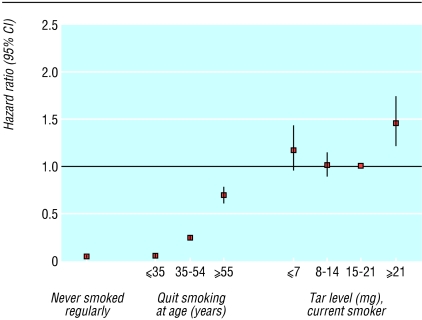
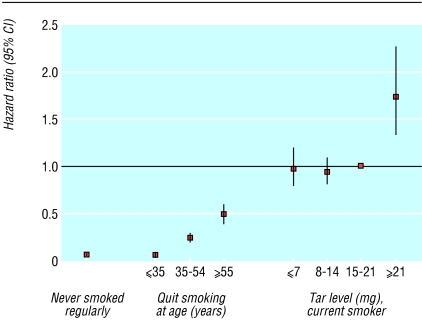
Results: Irrespective of the tar level of their current brand, all current smokers had a far greater risk of lung cancer than people who had stopped smoking or had never smoked. Compared with smokers of medium tar (15-21 mg) filter cigarettes, risk was higher among men and women who smoked high tar (> or = 22 mg) non-filter brands (hazard ratio 1.44, 95% confidence interval 1.20 to 1.73, and 1.64, 1.26 to 2.15, respectively). There was no difference in risk among men who smoked brands rated as very low tar (1.17, 0.95 to 1.45) or low tar (1.02, 0.90 to 1.16) compared with those who smoked medium tar brands. The same was seen for women (0.98, 0.80 to 1.21, and 0.95, 0.82 to 1.11, respectively).
Conclusion: The increase in lung cancer risk is similar in people who smoke medium tar cigarettes (15-21 mg), low tar cigarettes (8-14 mg), or very low tar cigarettes (< or = 7 mg). Men and women who smoke non-filtered cigarettes with tar ratings > or = 22 mg have an even higher risk of lung cancer.
Figures
References
-
- Hoffmann D, Djordjevic M, Brunnemann K. Changes in cigarette design and composition over time and how they influence the yields of smoke constituents. In: Shopland D, ed. The FTC cigarette test method for determining tar, nicotine, and carbon monoxide yields of US cigarettes: report of the NCI expert committee. NCI smoking and tobacco control monograph No 7. Bethesda MD: US National Institutes of Health, National Cancer Institute, 1996: 15-37. (NIH Publication No 96-4028.)
-
- Kozlowski LT, O'Connor RJ, Sweeney CT. Cigarette design. Risks associated with smoking cigarettes with low machine-measured yields of tar and nicotine. Bethesda, MD: US National Institutes of Health, National Cancer Institute, NCI Smoking and Tobacco Control, 2001: 13-37. (Monograph No 13.)
-
- Kiryluk S, Wald N. Trends in cigarette smoking habits in the United Kingdom, 1905-1985. In: Wald N, Froggatt P, eds. Nicotine, smoking and the low tar programme. Oxford: Oxford University Press, 1989.
-
- Thun MJ, Lally CA, Flannery JT, Calle EE, Flanders WD, Heath CW Jr. Cigarette smoking and changes in the histopathology of lung cancer. J Natl Cancer Inst 1997;89: 1580-6. - PubMed
MeSH terms
Substances
LinkOut - more resources
Full Text Sources
Medical