


Incidence and mortality of Alzheimer's disease or dementia using an illness-death model
- PMID: 14716722
- PMCID: PMC5352829
- DOI: 10.1002/sim.1709
Incidence and mortality of Alzheimer's disease or dementia using an illness-death model
Abstract
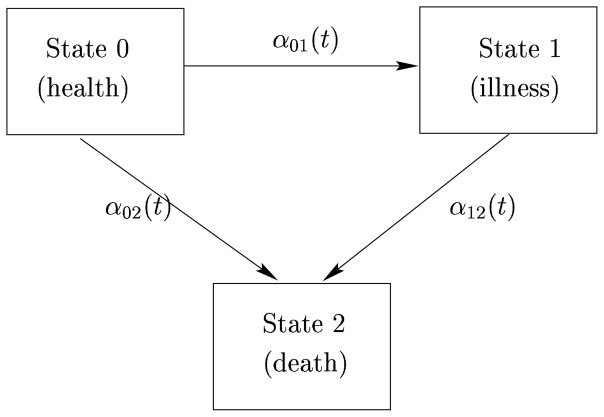
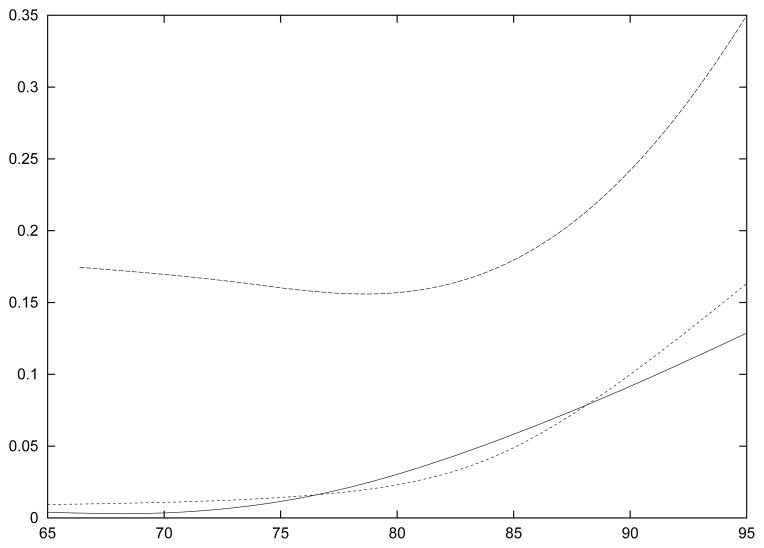
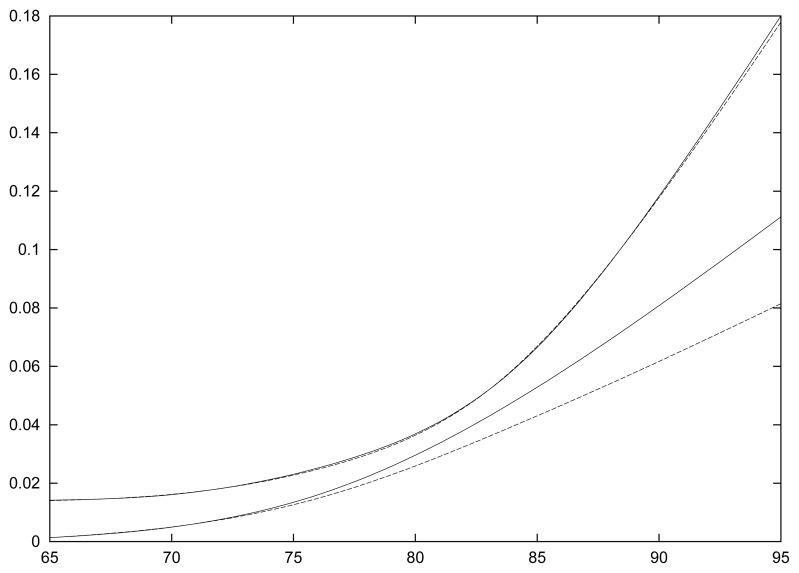
We present an illness-death model for studying the incidence and the prevalence of Alzheimer's disease or dementia. We argue that the illness-death model is better than a survival model for this purpose. In this model the best choice for the basic time-scale is age. Then we present extensions of this model for incorporating covariates and taking account of a possible effect of calendar time. Calendar time is introduced via a proportional intensity model. We give the likelihood for a mixed discrete-continuous observation pattern from this model: clinical status is observed at discrete visit-times while the date of death is observed exactly or right-censored. The penalized likelihood approach allows to non-parametrically estimate the transition intensities. Application on the data of the Paquid study allows to produce estimates of the age-specific incidence of dementia together with mortality rates of both demented and non-demented subjects. Then the effect of calendar time and educational level are studied. Low educational level increases the risk of dementia. The risk of dementia increases with calendar time while the mortality of demented subjects decreases. The most likely explanation of this result seems to be in a shift in the diagnosis of dementia towards earlier stages of the disease prompted by a change in the perception of dementia and the arrival of new drugs.
Copyright 2004 John Wiley & Sons, Ltd.
Figures

References
-
- Peto R. Experimental survival curves for interval-censored data. Applied Statistics. 1973;22:86–91.
-
- Turnbull BW. The empirical distribution function with arbitrarily grouped, censored and truncated data. Journal of the Royal Statistical Society, Series B. 1976;38:290–5.
-
- Finkelstein D. A proportional hazards model for interval-censored failure time data. Biometrics. 1986;42:845–854. - PubMed
-
- Alioum A, Commenges D. A proportional hazards model for arbitrarily censored and truncated data. Biometrics. 1996;52:95–107. - PubMed
-
- Joly P, Commenges D, Letenneur L. A penalized likelihood approach for arbitrarily censored and truncated data: application to age-specific incidence of dementia. Biometrics. 1998;54:203–212. - PubMed
MeSH terms
LinkOut - more resources
Full Text Sources
Other Literature Sources
Medical