. 2004 Feb;78(3):1219-29.
doi: 10.1128/jvi.78.3.1219-1229.2004.

Transduction of bone-marrow-derived mesenchymal stem cells by using lentivirus vectors pseudotyped with modified RD114 envelope glycoproteins

Affiliations

Transduction of bone-marrow-derived mesenchymal stem cells by using lentivirus vectors pseudotyped with modified RD114 envelope glycoproteins

Xian-Yang Zhang et al. J Virol. 2004 Feb.

Abstract

Bone-marrow-derived mesenchymal stem cells (MSCs) have attracted considerable attention as tools for the systemic delivery of therapeutic proteins in vivo, and the ability to efficiently transfer genes of interest into such cells would create a number of therapeutic opportunities. We have designed and tested a series of human immunodeficiency virus type 1 (HIV-1)-based vectors and vectors based on the oncogenic murine stem cell virus to deliver and express transgenes in human MSCs. These vectors were pseudotyped with either the vesicular stomatitis virus G (VSV-G) glycoprotein (GP) or the feline endogenous virus RD114 envelope GP. Transduction efficiencies and transgene expression levels in MSCs were analyzed by quantitative flow cytometry and quantitative real-time PCR. While transduction efficiencies with virus particles pseudotyped with the VSV-G GP were found to be high, RD114 pseudotypes revealed transduction efficiencies that were 1 to 2 orders of magnitude below those observed with VSV-G pseudotypes. However, chimeric RD114 GPs, with the transmembrane and extracellular domains fused to the cytoplasmic domain derived from the amphotropic Moloney murine leukemia virus 4070A GP, revealed about 15-fold higher titers relative to the unmodified RD114 GP. The transduction efficiencies in human MSCs of HIV-1-based vectors pseudotyped with the chimeric RD114 GP were similar to those obtained with HIV-1 vectors pseudotyped with the VSV-G GP. Our results also indicate that RD114 pseudotypes were less toxic than VSV-G pseudotypes in human MSC progenitor assays. Taken together, these results suggest that lentivirus pseudotypes bearing alternative Env GPs provide efficient tools for ex vivo modification of human MSCs.


Figures

FIG. 1.
FIG. 1.
Representation of HIV-1-based lentivirus vectors. (A) Vector constructs. pNL-EGFP/CMV, pNL-EGFP/CEF, and pNL-EGFP/CAG harbor CMV-IE, CEF, and CAG promoters, respectively (61). pNL-EGFP(MSCV), lentivirus vector lacking an internal promoter but harboring a hybrid LTR in which the U3 region of the HIV-1 LTR was replaced by the MSCV U3 region; pMG, vector derived from the MSCV oncoretrovirus vector (11); PCMV, human CMV-IE promoter; PCEF, Hybrid promoter consisting of the enhancer region of the CMV-IE promoter fused to EF-1α promoter elements; PCAG, hybrid promoter consisting of the enhancer region of the CMV-IE promoter fused to the chicken β-actin promoter; PPT, central polypurine tract. (B) Helper (packaging) constructs. pCD/NL-BH* (73) and pCD/NL-BH*ΔΔΔ, lentiviral helper constructs. pCD/NL-BH*ΔΔΔ carries deletions of all accessory protein-encoding regions. Plasmids pHIT60 (66) and pTAT-REV (67) were used to package MG vector genomes. (C) Envelope constructs. The pLTR-G plasmid (60) encodes the VSV-G GP, and pLTR-RD114 encodes the RD114 GP. Plasmids pLTR-RD114A and pLTR-RD114Am encode hybrid RD114 Env GPs. pLTR-RD114Am carries a point mutation in the ectodomain. ACT, cytoplasmic tail domain derived from the MLV 4070A Env.
FIG. 2.
FIG. 2.
Influence of promoters and vector copy numbers on EGFP transgene expression in HOS cells. Cells were transduced with NL-EGFP/CMV, NL-EGFP/CEF, and NL-EGFP/CAG vector stocks at various MOIs in DMEM-10% FBS containing 8 μg of Polybrene/ml at 37°C for 20 h. (A) Percentages of EGFP-positive cells as a function of the amount (nanograms) of p24 added. (B) Percentages of EGFP-positive cells as a function of the number of EGFP transgene copies. (C) MFI values of the EGFP-positive cell populations as a function of the number of EGFP transgene copies. The cells were analyzed by FACS 3 days after transduction. Aliquots were processed for quantitative real-time PCR with EGFP-specific primers. The MFI values and the numbers of EGFP copies per genome are displayed. The data shown were obtained from two independent experiments. Virus titers were 3.6 × 10⁴ infectious units (IU)/ng of p24 for NL-EGFP/CMV, 1.42 × 10⁴ IU/ng of p24 for NL-EGFP/CEF, and 7.6 × 10³ IU/ng of p24 for NL-EGFP/CAG.
FIG. 3.
FIG. 3.
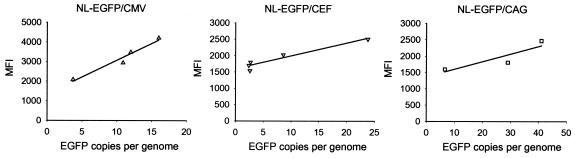
Influence of promoters and vector copy numbers on EGFP transgene expression in MSCs. Cells were transduced with NL-EGFP/CMV, NL-EGFP/CEF, and NL-EGFP/CAG vector stocks at various MOIs in LTCM containing 8 μg of Polybrene/ml at 37°C for 20 h. The cells were analyzed by FACS 3 days after transduction. Aliquots were processed for quantitative real-time PCR with EGFP-specific primers. The MFI values and the numbers of EGFP copies per genome are displayed. The data shown were obtained from two independent experiments.
FIG. 4.
FIG. 4.
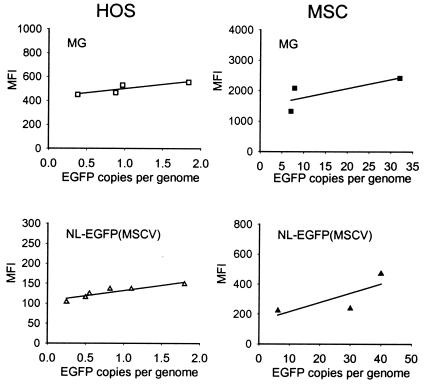
Transgene expression in HOS cells and MSCs from oncoretrovirus and lentivirus vectors bearing MSCV promoter sequences. Cells were transduced with oncogenic MG vector stocks and NL-EGFP(MSCV) lentivirus vector stocks at various MOIs. The cells were analyzed by FACS 3 days after transduction. Aliquots were processed for quantitative real-time PCR with EGFP-specific primers. The MFI values and the numbers of EGFP copies per genome are displayed. The data shown were obtained from two independent experiments.
FIG. 5.
FIG. 5.
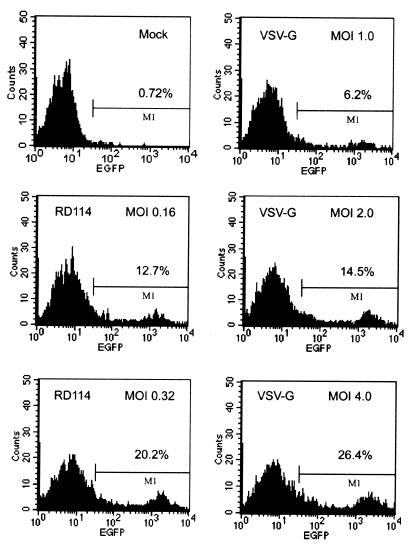
Transduction of MSCs with lentivirus vectors pseudotyped with the RD114 Env GP. MSCs were transduced with NL-EGFP/CEF/RD114 vector stocks at MOIs of 0.16 and 0.32. NL-EGFP/CEF/VSV-G vector stocks were tested in parallel at the MOIs indicated. The cells were analyzed by FACS 3 days after transduction. MOIs were adjusted based on titers determined on HOS cells. Panels: top left, mock (control); middle and bottom left, RD114 pseudotypes; right, VSV-G pseudotypes.
FIG. 6.
FIG. 6.
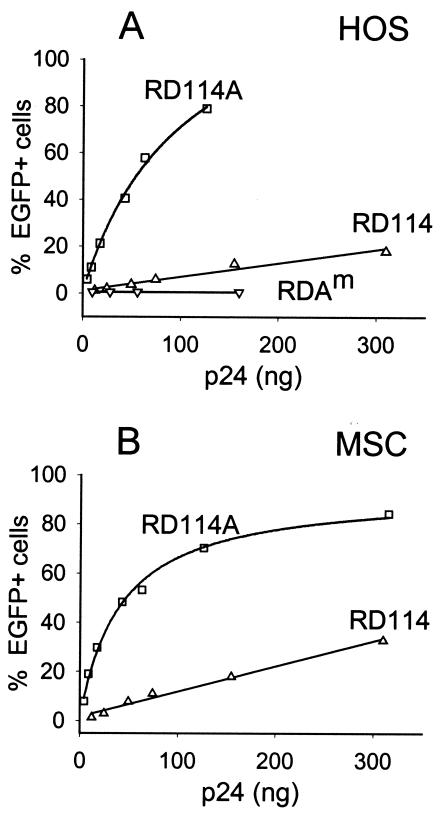
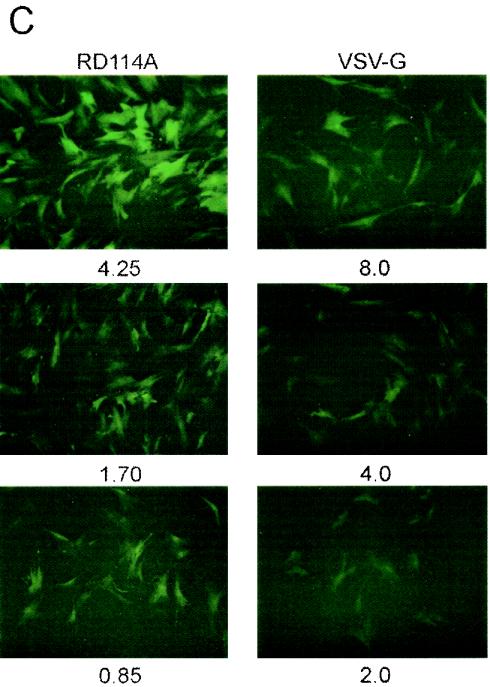
Transduction of MSCs with lentivirus vectors bearing chimeric RD114 Env GPs. (A and B) HOS cells and MSCs were trans-duced with NL-EGFP/CMV vector stocks bearing RD114 or chimeric RD114A GP. Both vector stocks had been prepared side-by-side to minimize differences in titers due to variations in vector production. The amount of virus added is indicated (expressed as nanograms of p24). The cells were analyzed by FACS 3 days after transduction. (C) Fluorescence microscopy of MSCs transduced with RD114A (left panels) and VSV-G (right panels) pseudotypes 3 days after transduction. The MOIs used (HOS units) are indicated.
FIG. 6.
FIG. 6.
Transduction of MSCs with lentivirus vectors bearing chimeric RD114 Env GPs. (A and B) HOS cells and MSCs were trans-duced with NL-EGFP/CMV vector stocks bearing RD114 or chimeric RD114A GP. Both vector stocks had been prepared side-by-side to minimize differences in titers due to variations in vector production. The amount of virus added is indicated (expressed as nanograms of p24). The cells were analyzed by FACS 3 days after transduction. (C) Fluorescence microscopy of MSCs transduced with RD114A (left panels) and VSV-G (right panels) pseudotypes 3 days after transduction. The MOIs used (HOS units) are indicated.

References

    1. Adachi, A., H. E. Gendelman, S. Koenig, T. Folks, R. Willey, A. Rabson, and M. A. Martin. 1986. Production of acquired immunodeficiency syndrome-associated retrovirus in human and nonhuman cells transfected with an infectious molecular clone. J. Virol. 59:284-291. - PMC - PubMed
    1. Allay, J. A., J. E. Dennis, S. E. Haynesworth, M. K. Majumdar, D. W. Clapp, L. D. Shultz, A. I. Caplan, and S. L. Gerson. 1997. LacZ and interleukin-3 expression in vivo after retroviral transduction of marrow-derived human osteogenic mesenchymal progenitors. Hum. Gene Ther. 8:1417-1427. - PubMed
    1. Bartholomew, A., S. Patil, A. Mackay, M. Nelson, D. Buyaner, W. Hardy, J. Mosca, C. Sturgeon, M. Siatskas, N. Mahmud, K. Ferrer, R. Deans, A. Moseley, R. Hoffman, and S. M. Devine. 2001. Baboon mesenchymal stem cells can be genetically modified to secrete human erythropoietin in vivo. Hum. Gene Ther. 12:1527-1541. - PubMed
    1. Baxter, M. A., R. F. Wynn, J. A. Deakin, I. Bellantuono, K. G. Edington, A. Cooper, G. T. Besley, H. J. Church, J. E. Wraith, T. F. Carr, and L. J. Fairbairn. 2002. Retrovirally mediated correction of bone marrow-derived mesenchymal stem cells from patients with mucopolysaccharidosis type I. Blood 99:1857-1859. - PubMed
    1. Beyer, W. R., M. Westphal, W. Ostertag, and D. von Laer. 2002. Oncoretrovirus and lentivirus vectors pseudotyped with lymphocytic choriomeningitis virus glycoprotein: generation, concentration, and broad host range. J. Virol. 76:1488-1495. - PMC - PubMed

Publication types

MeSH terms

Substances

LinkOut - more resources