Review
. 2004 Jan;17(1):136-73.
doi: 10.1128/CMR.17.1.136-173.2004.

Global change and human vulnerability to vector-borne diseases

Affiliations
Review

Global change and human vulnerability to vector-borne diseases

Robert W Sutherst. Clin Microbiol Rev. 2004 Jan.

Abstract

Global change includes climate change and climate variability, land use, water storage and irrigation, human population growth and urbanization, trade and travel, and chemical pollution. Impacts on vector-borne diseases, including malaria, dengue fever, infections by other arboviruses, schistosomiasis, trypanosomiasis, onchocerciasis, and leishmaniasis are reviewed. While climate change is global in nature and poses unknown future risks to humans and natural ecosystems, other local changes are occurring more rapidly on a global scale and are having significant effects on vector-borne diseases. History is invaluable as a pointer to future risks, but direct extrapolation is no longer possible because the climate is changing. Researchers are therefore embracing computer simulation models and global change scenarios to explore the risks. Credible ranking of the extent to which different vector-borne diseases will be affected awaits a rigorous analysis. Adaptation to the changes is threatened by the ongoing loss of drugs and pesticides due to the selection of resistant strains of pathogens and vectors. The vulnerability of communities to the changes in impacts depends on their adaptive capacity, which requires both appropriate technology and responsive public health systems. The availability of resources in turn depends on social stability, economic wealth, and priority allocation of resources to public health.


Figures
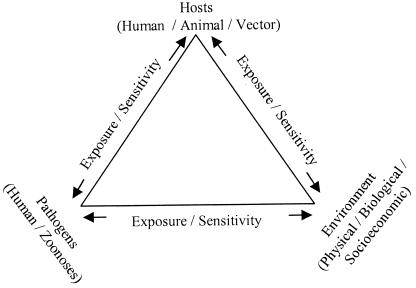
FIG. 1.
FIG. 1.
A host-pathogen-vector-environment framework for the assessment of risks to humans from vector-borne diseases under global change.
FIG. 2.
FIG. 2.
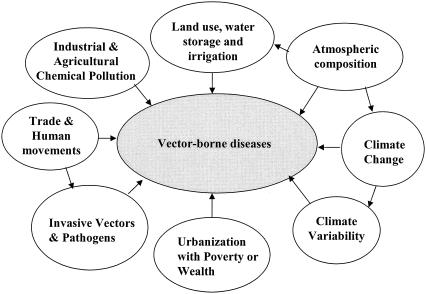
Drivers of global change considered in relation to potential changes in the status of vector-borne diseases.
FIG. 3.
FIG. 3.
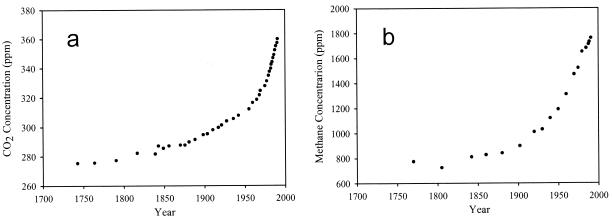
Changes in the concentration of the key greenhouse gases carbon dioxide (a) and methane (b) since preindustrial times. Reprinted from http://www.ipcc.ch/press/sp-cop6/sld5.jpg with permission from Intergovernmental Panel on Climate Change (data archived at the Hadley Centre for Climate Prediction and Research).
FIG. 4.
FIG. 4.
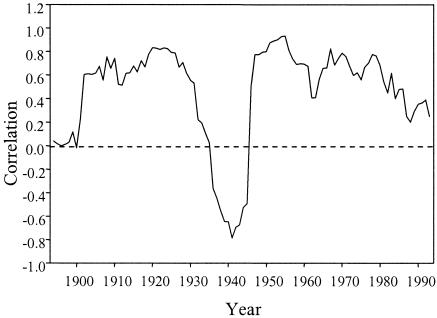
Long-term variation in the relationship between the ENSO index and summer rainfall in north-eastern Australia. Modified from reference 51 with permission.
FIG. 5.
FIG. 5.
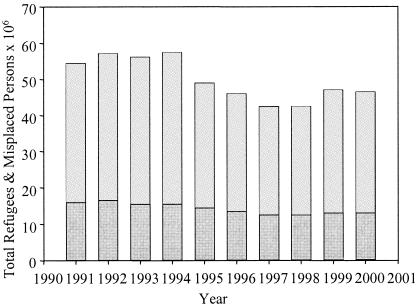
Numbers of refugees (light shading) and internally displaced people (darker shading) in the world in 2000. Reprinted from reference 13 with permission.
FIG. 6.
FIG. 6.
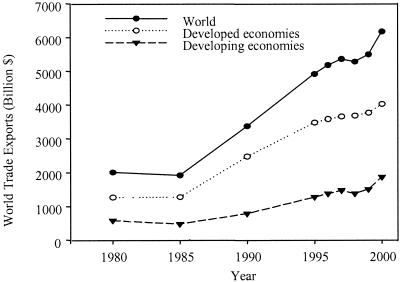
Volume of international trade between 1980 and 2000. Reprinted from http://www.wto.org/english/res_e/statis_e/webpub_e.xls with permission from the World Trade Organization.
FIG. 7.
FIG. 7.
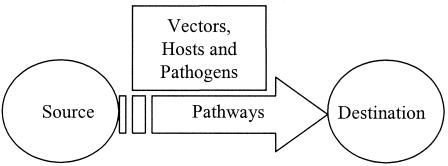
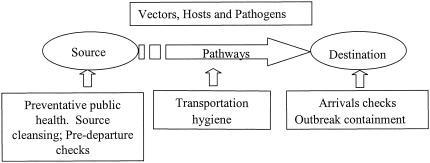
The plant and animal protection concept of sources, pathways, and destinations of exotic species translocations.
FIG. 8.
FIG. 8.
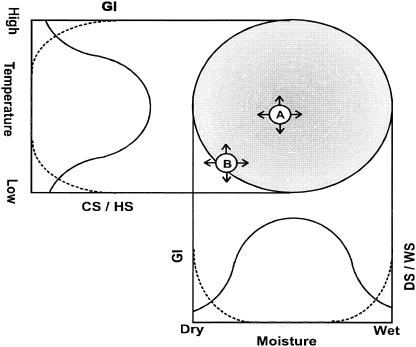
A conceptual model of the geographical distribution of a species related to its climatic envelope. A population (A) near the center of the climatic envelope will be subjected to variations in temperature and moisture in a more favorable range of values than will a population (B) at the edge of the envelope. GI is the CLIMEX model growth index, and CS, HS, DS, and WS are the cold, hot, dry, and wet stress indices, respectively. Reprinted from reference 305 with permission.
FIG. 9.
FIG. 9.
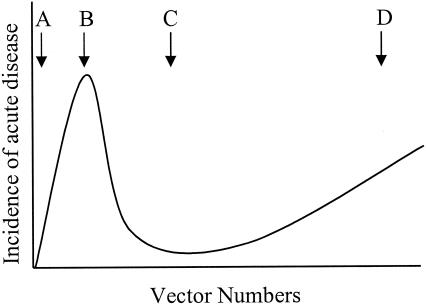
Conceptual model of the relationship between the incidence of human disease and disease transmission rates as determined by vector densities. A, establishment/extinction/eradication zone; B, epidemic/acute-disease zone; C, endemic stability/chronic-disease zone; D, overload/acute-disease zone.
FIG. 10.
FIG. 10.
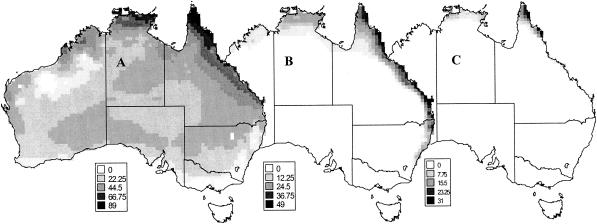
(A) Comparison of the estimates of areas at risk from P. falciparum malaria in Australia, based on the pathogen only, related to temperature for development. (B) As for panel A but including moisture limitation for mosquito breeding. (C) As for panel A but including the restriction imposed by the distribution of the only highly competent malaria vector, Anopheles farauti, as limited by climate. Modified from reference 304 with permission.
FIG. 11.
FIG. 11.
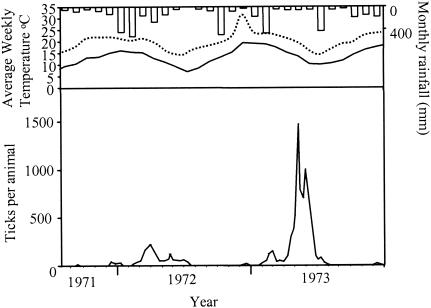
Numbers of the tick vector (Boophilus microplus) of the bovine malaria-like parasites Babesia spp., at Mt Tamborine, Australia, over 2 years with different temperatures in 1971 to 1973. Modified from reference 302 with permission.
FIG. 12.
FIG. 12.
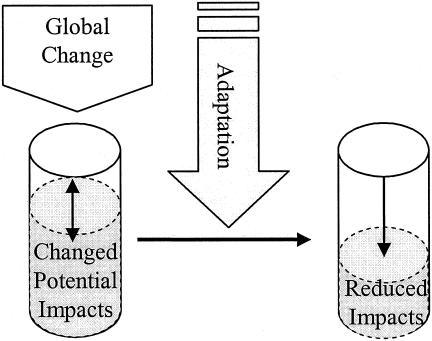
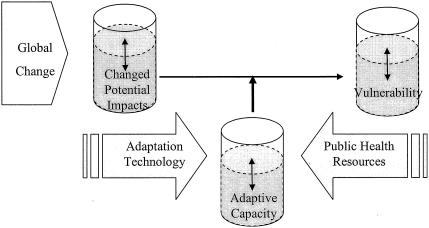
“Adaptation” reduces potential impacts by applying technology.
FIG. 13.
FIG. 13.
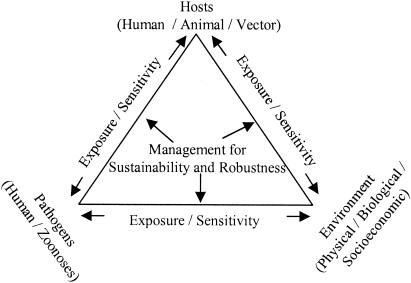
The host-pathogen-vector-environment triangle including management interventions to minimize the vulnerability of humans to vector-borne diseases under global change.
FIG. 14.
FIG. 14.
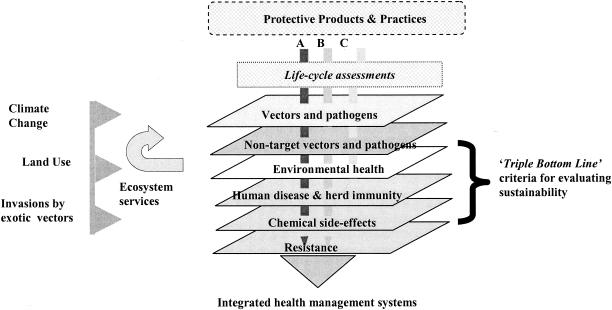
Decision support system to guide the design or sustainable and robust management strategies for adaptation to changes in the status of vector-borne diseases with global change.
FIG. 15.
FIG. 15.
The plant and animal protection concept of sources, pathways, and destinations with adaptation measures to manage the changes arising from global change drivers.
FIG. 16.
FIG. 16.
“Vulnerability” is determined by the extent of change in potential impacts and the adaptive capacity of the affected community.

References

    1. Abaru, D. E. 1985. Sleeping sickness in Busoga, Uganda, 1976-1983. Trop. Med. Parasitol. 36:72-76. - PubMed
    1. Agudelo-Silva, F., and A. Spielman. 1984. Paradoxical effects of simulated larviciding on production of adult mosquitoes. Am. J. Trop. Med. Hyg. 33:1267-1269. - PubMed
    1. Akhtar, R., and A. J. McMichael. 1996. Rainfall and malaria outbreaks in western Rajasthan. Lancet 348:1457-1458. - PubMed
    1. Akogbeto, M., and S. Yakoubou. 1999. Resistance of malaria vectors to pyrethroids used for impregnated bednets, Benin, West Africa. Bull. Soc. Pathol. Exot. 92:123-130. - PubMed
    1. Allan, R., J. Lindesay, and D. Parker. 1996. El Nińo southern oscillation and climatic variability. CSIRO Publishing, Collingwood, Australia.