Clinical Trial
. 2004 Jan;25(1):39-51.

Cerebral Aneurysm Multicenter European Onyx (CAMEO) trial: results of a prospective observational study in 20 European centers

Affiliations
Clinical Trial

Cerebral Aneurysm Multicenter European Onyx (CAMEO) trial: results of a prospective observational study in 20 European centers

Andrew J Molyneux et al. AJNR Am J Neuroradiol. 2004 Jan.

Abstract

Background and purpose: This study was designed to investigate the safety and efficacy of the Onyx liquid embolic system in treating a selected population of patients with intracranial aneurysms that presented difficulties for surgical or endovascular alternatives.

Methods: A prospective observational study was conducted in 20 European centers enrolling a consecutive series of 119 patients with 123 aneurysms judged suitable for Onyx treatment. The series consists of findings collected in 97 of 119 patients with 100 of 123 aneurysms, because one center declined to provide data to the study sponsor or allow outside audit. Clinical and angiographic outcomes were recorded at discharge, 3 months, and 12 months. All adverse events and re-treatments were recorded. Seventy-nine aneurysms were large or giant.

Results: Twelve-month follow-up angiography findings were available for 71 aneurysms. This angiographic follow-up showed complete occlusion in 56 (79%) aneurysms, subtotal occlusion in nine (13%), and incomplete occlusion in six (8%). Procedure- or device-related permanent neurologic morbidity at final follow-up was present in eight of 97 patients. Seven patients died: two deaths were procedure related; one, disease related; and four, unrelated causes. Seventy-five of the 82 patients alive and with follow-up at 12 months were at Rankin 2 or better status. Delayed occlusion of the parent vessel occurred in nine patients; delayed occlusion was asymptomatic in five and resulted in permanent neurologic deficit in two.

Conclusion: In selected patients with aneurysms that are unsuitable for coil treatment or in whom previous treatment has failed to occlude the aneurysm, Onyx treatment offers an endovascular alternative. Aneurysm occlusion rates are superior to reported rates of coil occlusion, and treatment morbidity is comparable to that of published prospective data on endovascular results for this subgroup of patients.


Figures
F<sc>ig</sc> 1.
Fig 1.
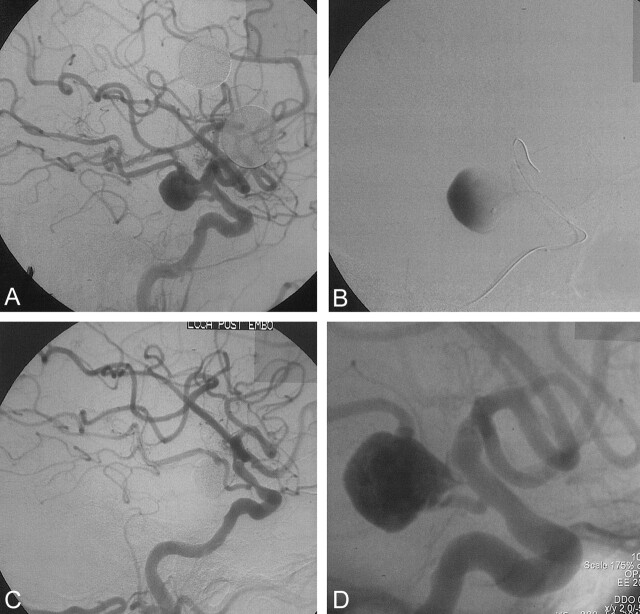
60-year-old male patient who presented with headache and in whom a large unruptured internal carotid aneurysm was found. Pretreatment, treatment, and follow-up images are presented. A, Large internal carotid aneurysm before treatment. B, Seal test before treatment of the aneurysm with Onyx. Microcatheter and balloon are in place with gentle contrast material injection into the aneurysm C, Angiographic result immediately after Onyx treatment. D, Follow-up angiogram 6 months after treatment, showing complete occlusion and intervening soft thickened tissue between vessel lumen and Onyx cast in the aneurysm
F<sc>ig</sc> 2.
Fig 2.
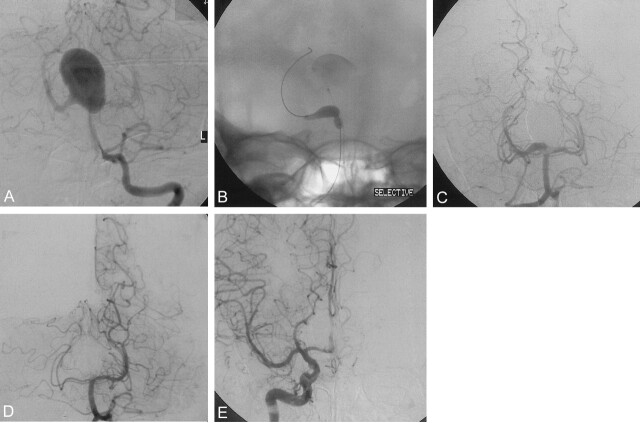
28-year-old hemophiliac patient with severe headaches but no evidence of subarachnoid hemorrhage has a wide-neck basilar bifurcation aneurysm involving the proximal right postcerebral artery. A, Large basilar bifurcation and proximal posterior cerebral aneurysms. B, Seal test, showing highly compliant Equinox balloon inflated in the basilar tip and in the right posterior cerebral artery with the balloon protecting the aneurysm neck, which takes up most of the proximal P1-segment vessel. C, Immediate posttreatment image, showing reconstruction of the posterior cerebral artery segment. D, Three-month follow-up angiogram, showing occlusion of the proximal posterior cerebral artery and the aneurysm. E, Three-month right carotid angiogram, showing posterior cerebral perfusion via the posterior communicating artery. (Images courtesy of Mike Nelson, Leeds.)
F<sc>ig</sc> 3.
Fig 3.
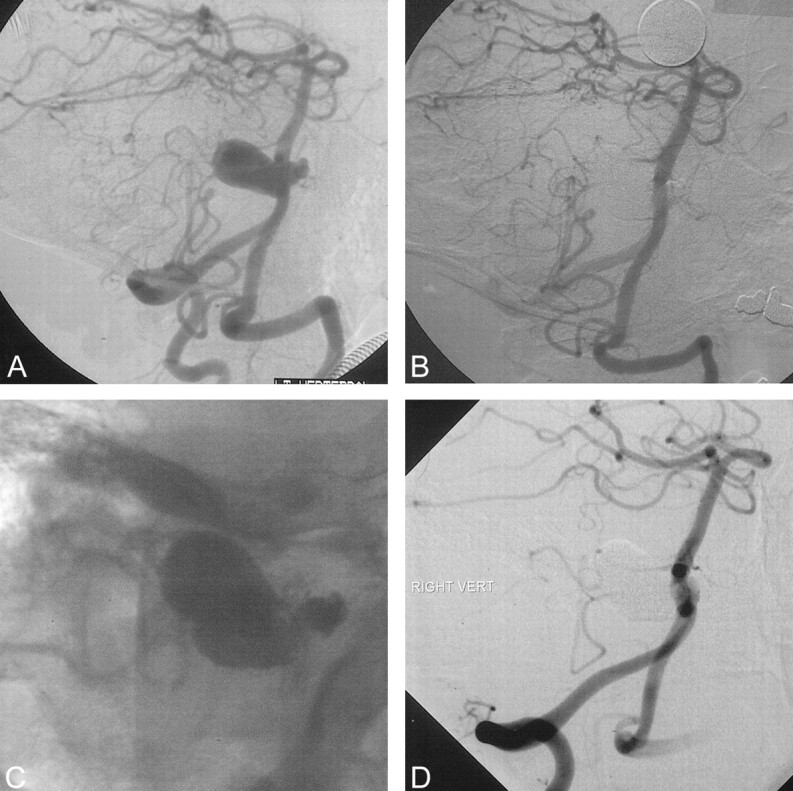
50-year-old male patient with leg weakness and a possible history of subarachnoid hemorrhage. This patient was found to have a vertebral basilar junction aneurysm compressing the medulla. A, Pretreatment angiogram showing a large vertebrobasilar junction aneurysm treated on two occasions (treated with an INX stent at the second procedure after recurrence). Complete occlusion was noted at 6-month and 1-year follow-up after second procedure. B, Angiogram obtained after second treatment at 3 months after early recurrence and after placement of an INX stent and re-treatment with Onyx. C, Unsubtracted image obtained after second procedure, showing INX stent and second cast of Onyx in inferior recurrent aneurysm pocket. D, Follow-up angiogram obtained 6 months after second treatment.
F<sc>ig</sc> 4.
Fig 4.
45-year-old patient presenting with a partial cranial nerve III palsy and headache. No anterior cerebral artery was present on the left side and the carotid only supplied the left middle cerebral territory. A, Lateral arterial phase carotid angiogram obtained immediately before treatment. B, Final angiography obtained after Onyx treatment balloon catheter still present in vessel. C, Follow-up angiography 3 months after procedure. Patient developed a complete ophthalomoplegia immediately after the procedure, which had resolved entirely by 3 months when she was asymptomatic. Note extensive orbital collaterals filling middle cerebral territory. (Images courtesy of Peter Flynn and Steven Mckinstry, Royal Victoria Hospital, Belfast.)

References

    1. Taki W, Yonekawa Y, Iwata H, et al. A new liquid material for embolization of arteriovenous malformations. AJNR Am J Neuroradiol 1990;11:163–168 - PMC - PubMed
    1. Muryama Y, Vinuela F, Ulhoa A, et al. Nonadhesive liquid embolic agent for cerebral arteriovenous malformations: preliminary histopathological studies in swine rete mirabile. Neurosurgery 1998;43:1164–1175 - PubMed
    1. Chalouopka JC, Huddle DC, Alderman J, et al. A re-examination of the superselective injection of DMSO in swine rete mirabile embolization model. AJNR Am J Neuroradiol 1999;20:401–410 - PMC - PubMed
    1. Jahan R, Murayama Y, Gobin YP, et al. Embolization of arteriovenous malformations with ONYX, clinico-pathological experience in 23 patients. Neurosurgery 2001;984–997 - PubMed
    1. Molyneux AJ, Coley SC. Embolization of spinal cord arteriovenous malformations with ethyl vinyl alcohol coplolymer dissolved in DMSO (ONYX liquid embolic system): report of 2 cases. J Neurosurg (Spine) 2000;93:304–308 - PubMed

MeSH terms