Case Reports
Isolated translocation of Wernicke's area to the right hemisphere in a 62-year-man with a temporo-parietal glioma
Affiliations
- PMID: 14729542
- PMCID: PMC7974177
Item in Clipboard
Case Reports
Isolated translocation of Wernicke's area to the right hemisphere in a 62-year-man with a temporo-parietal glioma
AJNR Am J Neuroradiol.
2004 Jan.
Abstract
We describe a case of translocation of temporo-parietal language function (Wernicke's area) to the contralateral hemisphere in a right-handed patient with a left temporo-parietal glioma. This translocation was identified by functional MR imaging (fMRI) and validated by direct cortical stimulation during gross-total resection. The current case exemplifies how preoperative fMRI can identify unexpected language organization as a result of tumor growth, affording surgery to patients who may otherwise be deemed inoperable.
Figures
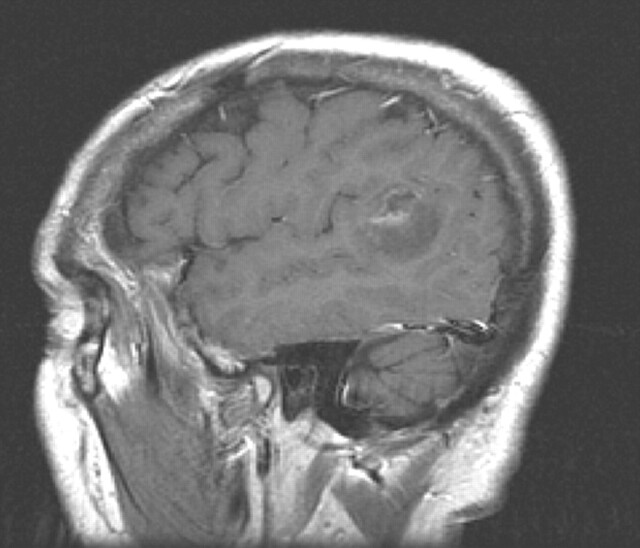
Postcontrast left sagittal image from a 62-year-old right-handed man, showing a mostly nonenhancing temporo-parietal neoplasm involving superior temporal gyrus and portions of the supramarginal and angular gyri and underlying white matter, the expected location of Wernicke’s area.
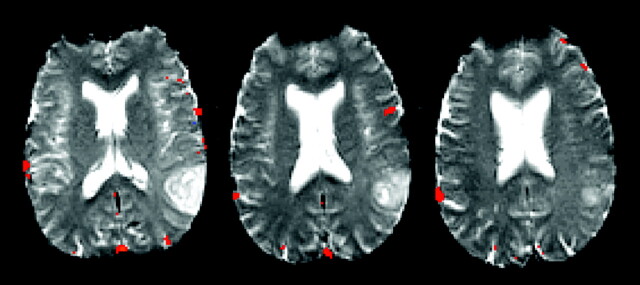
Axial fMRI results showing Broca’s area in the left hemisphere and activity most consistent with Wernicke’s area in the right hemisphere. The figure shows voxels at a correlation coefficient of 0.46 (P = 4.0 × 10⁻⁶) or higher. The language map is shown at this correlation coefficient, because it was the most robust representation of language activity in both hemispheres while minimizing the noise that would be seen at even lower thresholds.
References
-
- Oldfield RC. The assessment of handedness: the Edinburgh Inventory. Neuropsychologia 1971;9:97–113 - PubMed
-
- Kaplan EF, Goodglass H, Weintraub S. The Boston Naming Test. 2nd ed. Philadelphia: Lea & Febiger,1983
-
- Muller RA, Rothermel RD, Behen ME, et al. Brain organization of language after early unilateral lesion: A PET study. Brain Language 1998;62:422–451 - PubMed
-
- Staudt M, Lidzba K, Grodd W, et al. Right-hemispheric organization of language following early left-sided brain-lesions: functional MRI topography. Neuroimage 2002;16:954–967 - PubMed
-
- Rausch R, Walsh GO. Right-hemisphere dominance in right-handed epileptic patients. Arch Neurol 1984;41:1077–1080 - PubMed
Publication types
MeSH terms
LinkOut - more resources
Full Text Sources
Medical