


A mutant form of the Neisseria gonorrhoeae pilus secretin protein PilQ allows increased entry of heme and antimicrobial compounds
- PMID: 14729699
- PMCID: PMC321488
- DOI: 10.1128/JB.186.3.730-739.2004
A mutant form of the Neisseria gonorrhoeae pilus secretin protein PilQ allows increased entry of heme and antimicrobial compounds
Abstract
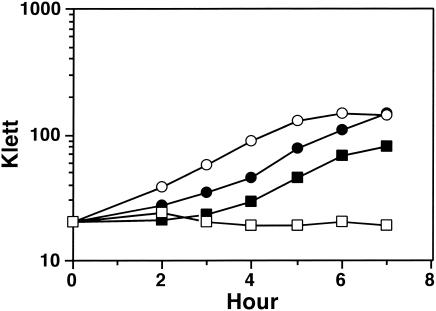
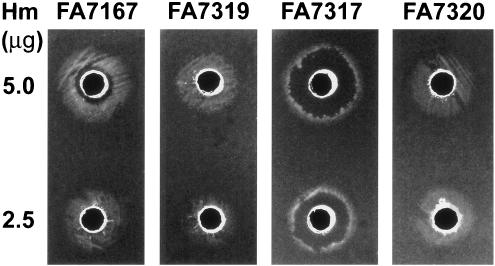
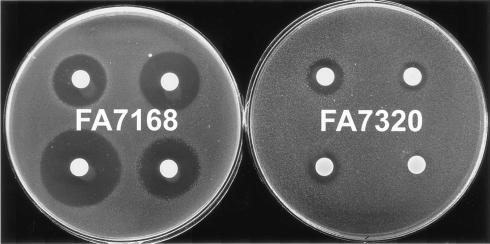
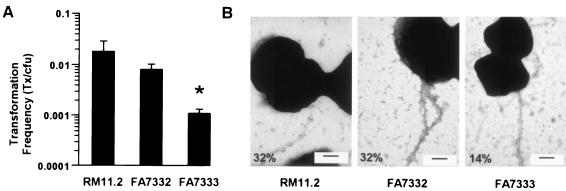
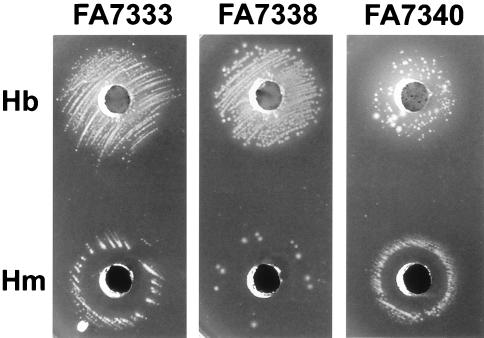
A spontaneous point mutation in pilQ (pilQ1) resulted in phenotypic suppression of a hemoglobin (Hb) receptor mutant (hpuAB mutant), allowing gonococci to grow on Hb as the sole source of iron. PilQ, formerly designated OMP-MC, is a member of the secretin family of proteins located in the outer membrane and is required for pilus biogenesis. The pilQ1 mutant also showed decreased piliation and transformation efficiency. Insertional inactivation of pilQ1 resulted in the loss of the Hb utilization phenotype and decreased entry of free heme. Despite the ability of the pilQ1 mutant to use Hb for iron acquisition and porphyrin, there was no demonstrable binding of Hb to the cell surface. The pilQ1 mutant was more sensitive to the toxic effect of free heme in growth medium and hypersensitive to the detergent Triton X-100 and multiple antibiotics. Double mutation in pilQ1 and tonB had no effect on these phenotypes, but a double pilQ1 pilT mutant showed a reduction in Hb-dependent growth and decreased sensitivity to heme and various antimicrobial agents. Insertional inactivation of wild-type pilQ also resulted in reduced entry of heme, Triton X-100, and some antibiotics. These results show that PilQ forms a channel that allows entry of heme and certain antimicrobial compounds and that a gain-of function point mutation in pilQ results in TonB-independent, PilT-dependent increase of entry.
Figures
References
-
- Anderson, J. E., M. M. Hobbs, G. D. Biswas, and P. F. Sparling. 2003. Opposing selective forces for expression of the gonococcal lactoferrin receptor. Mol. Microbiol. 48:1325-1337. - PubMed
-
- Anderson, J. E., P. A. Leone, W. C. Miller, C.-J. Chen, M. M. Hobbs, and P. F. Sparling. 2001. Selection of the gonococcal hemoglobin receptor during menses. J. Infect. Dis. 184:1621-1623. - PubMed
-
- Biswas, G. D., J. E. Anderson, and P. F. Sparling. 1997. Cloning and functional characterization of Neisseria gonorrhoeae tonB, exbB, and exbD genes. Mol. Microbiol. 24:169-179. - PubMed
Publication types
MeSH terms
Substances
Grants and funding
- R01 AI33493/AI/NIAID NIH HHS/United States
- R01 AI021150/AI/NIAID NIH HHS/United States
- R01 AI055977/AI/NIAID NIH HHS/United States
- R37 5-30837/PHS HHS/United States
- R01 AI044239/AI/NIAID NIH HHS/United States
- R37 AI021150/AI/NIAID NIH HHS/United States
- F32 AI010568/AI/NIAID NIH HHS/United States
- R01 AI44239/AI/NIAID NIH HHS/United States
- P01 AI045883/AI/NIAID NIH HHS/United States
- AI45883/AI/NIAID NIH HHS/United States
- AI21150/AI/NIAID NIH HHS/United States
- R01 AI033493/AI/NIAID NIH HHS/United States
- F32 AI10568/AI/NIAID NIH HHS/United States
- R37 5-31660/PHS HHS/United States
LinkOut - more resources
Full Text Sources
