. 2004 Jan 19;199(2):265-70.
doi: 10.1084/jem.20031831.

DNA polymerase eta is involved in hypermutation occurring during immunoglobulin class switch recombination

Affiliations

DNA polymerase eta is involved in hypermutation occurring during immunoglobulin class switch recombination

Ahmad Faili et al. J Exp Med. .

Abstract

Base substitutions, deletions, and duplications are observed at the immunoglobulin locus in DNA sequences involved in class switch recombination (CSR). These mutations are dependent upon activation-induced cytidine deaminase (AID) and present all the characteristics of the ones observed during V gene somatic hypermutation, implying that they could be generated by the same mutational complex. It has been proposed, based on the V gene mutation pattern of patients with the cancer-prone xeroderma pigmentosum variant (XP-V) syndrome who are deficient in DNA polymerase eta (pol eta), that this enzyme could be responsible for a large part of the mutations occurring on A/T bases. Here we show, by analyzing switched memory B cells from two XP-V patients, that pol eta is also an A/T mutator during CSR, in both the switch region of tandem repeats as well as upstream of it, thus suggesting that the same error-prone translesional polymerases are involved, together with AID, in both processes.


Figures
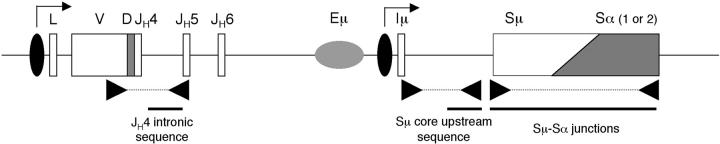
Figure 1.
Figure 1.
Schematic representation of the regions selected for mutation analysis at the Ig heavy chain locus. The configuration selected represents a VH gene rearranged to JH4 and switched to the α-constant region (α1 or α2). Horizontal arrows above the locus represent transcription initiation sites. Dotted lines between arrows mark the DNA regions amplified and the bold line represents the DNA regions sequenced. Eμ, heavy chain enhancer; L, leader; V, variable; D, diversity; and J, joining coding elements; Iμ, intronic leader exon; Sμ and Sα, core switch regions.
Figure 2.
Figure 2.
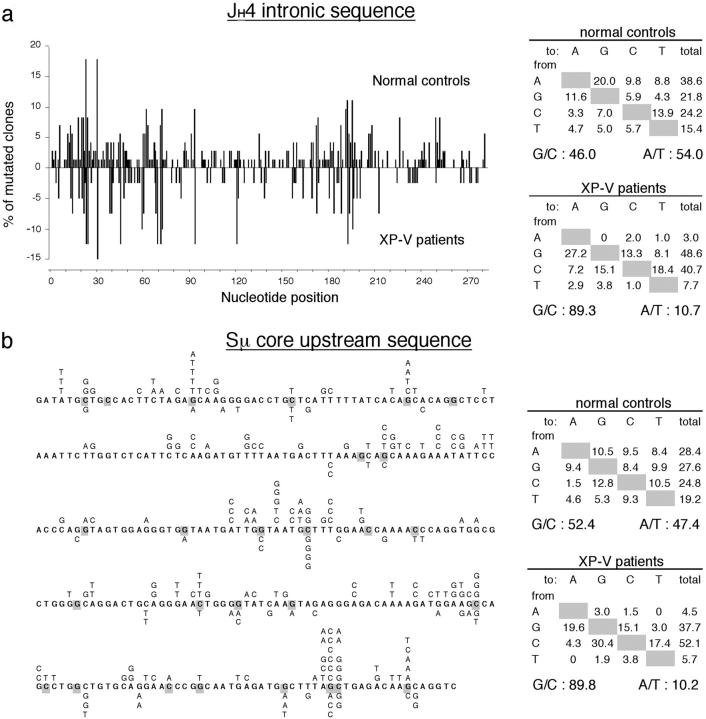
Mutation pattern of JH4 intronic sequences and Sμ core upstream regions in normal controls and XP-V patients. (a) Distribution and nucleotide substitution preference of mutations in JH4 intronic sequences. The distribution of mutations is represented along the 283 bp of intronic JH4 sequence, with the proportion of mutated clones in ordinates. Mutations from normal controls are represented above the nucleotide position, and those from XP-V patients are below. Nucleotide substitution preferences are corrected for base composition. A, 18.0%; G, 31.1%; C, 32.2%; T, 18.7%. (b) Distribution and nucleotide substitution preference of mutations in Sμ core upstream sequences. Mutations obtained for normal controls are represented above the 295 nucleotides of the Sμ core upstream sequence, and those from XP-V patients are below. The G position of the RGYW motif (and the C position of the complementary WRCY motif on the other strand) is highlighted in gray. Nucleotide substitution preferences are corrected for base composition. A, 28.5%; G, 28.8%; C: 20.0%; T, 22.7%.
Figure 3.
Figure 3.
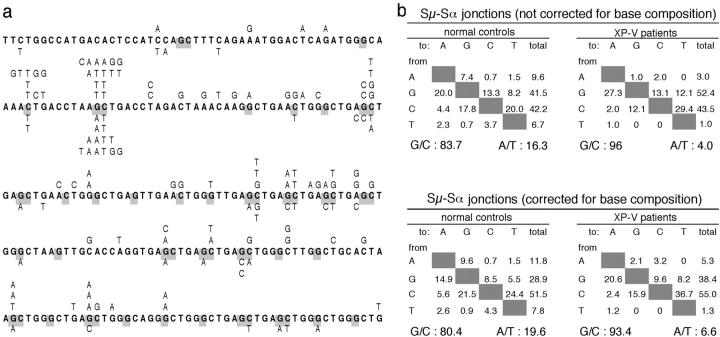
Mutation pattern of Sμ–Sα junctions in normal controls and XP-V patients. (a) Mutation distribution along the first 250 bp of the Sμ region in Sμ–Sα junctions. Mutations collected from normal controls are listed above the reference sequence, and mutations from XP-V patients are below. The G position of the RGYW motif (and the C position of the complementary WRCY motif on the other strand) is highlighted in gray. (b) Nucleotide substitution preference of mutations in Sμ–Sα junctions. Mutations collected on both Sμ and Sα regions are tabulated, first as raw proportions and then after correction for base composition, taking into account the base composition of the average region sequenced in each case. Sμ controls: 170 bp, 25.9% A, 30.0% G, 22.3% C, and 21.8% T; Sα controls: 211 bp, 12.6% A, 47.6% G, 18.6% C, and 21.2% T; Sμ-XP-V: 200 bp, 25.5% A, 31% G, 22% C, and 21.5% T; Sα-XP-V: 350 bp, 12.9% A, 46.1% G, 19.6% C, and 21.4% T.

References

    1. Honjo, T., K. Kinoshita, and M. Muramatsu. 2002. Molecular mechanism of class switch recombination: linkage with somatic hypermutation. Annu. Rev. Immunol. 20:165–196. - PubMed
    1. Martin, A., and M.D. Scharff. 2002. AID and mismatch repair in antibody diversification. Nat. Rev. Immunol. 2:605–614. - PubMed
    1. Goodman, M.F., and B. Tippin. 2000. Sloppier copier DNA polymerases involved in genome repair. Curr. Opin. Genet. Dev. 10:162–168. - PubMed
    1. Masutani, C., M. Araki, A. Yamada, N. Dohmae, M. Yokoi, M. Yuasa, M. Araki, S. Iwai, K. Takio, and F. Hanaoka. 1999. The XPV (xeroderma pigmentosum variant) gene encodes human DNA polymerase eta. Nature. 399:700–704. - PubMed
    1. Zeng, X., D.B. Winter, C. Kasmer, K.H. Kraemer, A.R. Lehmann, and P.J. Gearhart. 2001. DNA polymerase eta is an A-T mutator in somatic hypermutation of immunoglobulin variable genes. Nat. Immunol. 2:537–541. - PubMed

Publication types

MeSH terms