. 2004 Feb 3;101(5):1321-6.
doi: 10.1073/pnas.0308185100. Epub 2004 Jan 20.

Reduction of ischemia and reperfusion-induced myocardial damage by cytochrome P450 inhibitors

Affiliations

Reduction of ischemia and reperfusion-induced myocardial damage by cytochrome P450 inhibitors

David J Granville et al. Proc Natl Acad Sci U S A. .

Abstract

Ischemia and reperfusion both contribute to tissue damage after myocardial infarction. Although many drugs have been shown to reduce infarct size when administered before ischemia, few have been shown to be effective when administered at reperfusion. Moreover, although it is generally accepted that a burst of reactive oxygen species (ROS) occurs at the onset of reperfusion and contributes to tissue damage, the source of ROS and the mechanism of injury is unclear. We now report the finding that chloramphenicol administered at reperfusion reduced infarct size by 60% in a Langendorff isolated perfused rat heart model, and that ROS production was also substantially reduced. Chloramphenicol is an inhibitor of mitochondrial protein synthesis and is also an inhibitor of a subset of cytochrome P450 monooxygenases (CYPs). We could not detect any effect on mitochondrial encoded proteins or mitochondrial respiration in chloramphenicol-perfused hearts, and hypothesized that the effect was caused by inhibition of CYPs. We tested additional CYP inhibitors and found that cimetidine and sulfaphenazole, two CYP inhibitors that have no effect on mitochondrial protein synthesis, were also able to reduce creatine kinase release and infarct size in the Langendorff model. We also showed that chloramphenicol reduced infarct size in an open chest rabbit model of regional ischemia. Taken together, these findings implicate CYPs in myocardial ischemia/reperfusion injury.


Figures
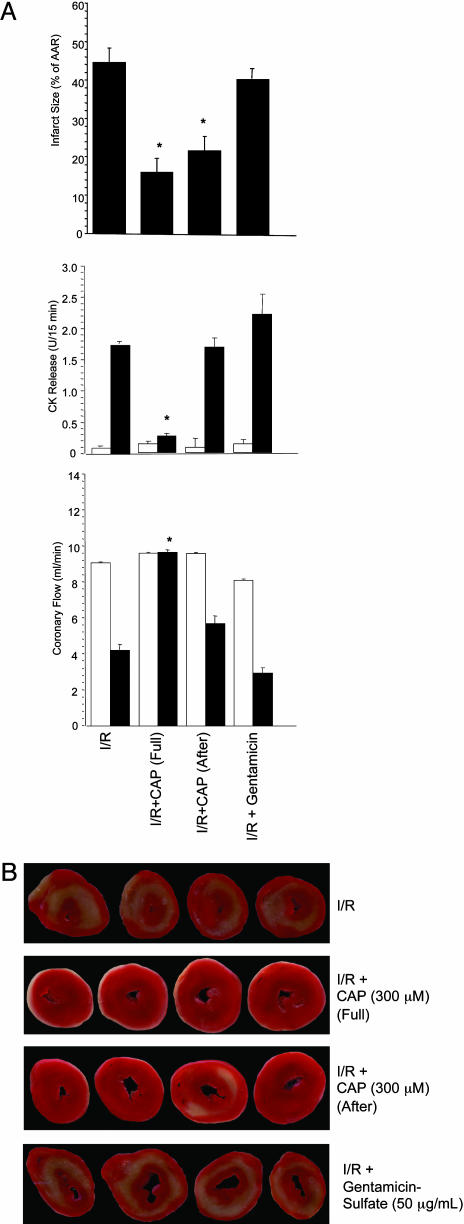
Fig. 1.
Fig. 1.
Effect of chloramphenicol on ischemia/reperfusion in the Langendorff model. Adult rat hearts were perfused in Langendorff mode for 20 min, then subjected to 30 min of no-flow ischemia followed by 2 h of reperfusion (I/R). Chloramphenicol (CAP), or gentamicin was added for the entire procedure. In CAP-After, chloramphenicol was added only during reperfusion. (A) After 2 h of reperfusion, hearts were frozen and assessed for infarct size. Coronary effluent was collected for 15 min immediately before and after ischemia and assessed for CK release. Error bars denote SEM. *, P < 0.01 (comparison to I/R). (B) Representative heart sections stained with triphenyl tetrazolium chloride.
Fig. 2.
Fig. 2.
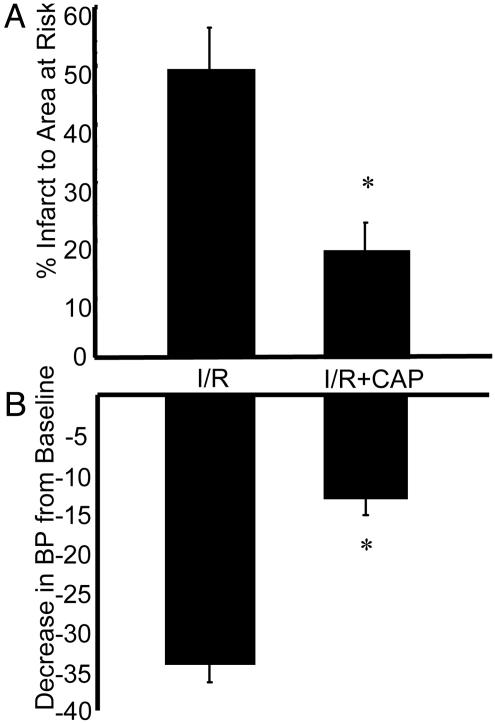
Effect of chloramphenicol in a surgical model of coronary artery ligation in rabbits. Rabbits were injected with or without chloramphenicol (20 mg/kg) for 30 min, and then the coronary artery was snare-occluded for 30 min followed by 4 h of reperfusion. (A) At 4 h, hearts were removed and immediately frozen and assessed for infarct size. (B) The decrease in left ventricular systolic pressure from baseline was assessed after ischemia. Error bars represent standard error of the mean (n = 6). *, P < 0.05.
Fig. 3.
Fig. 3.
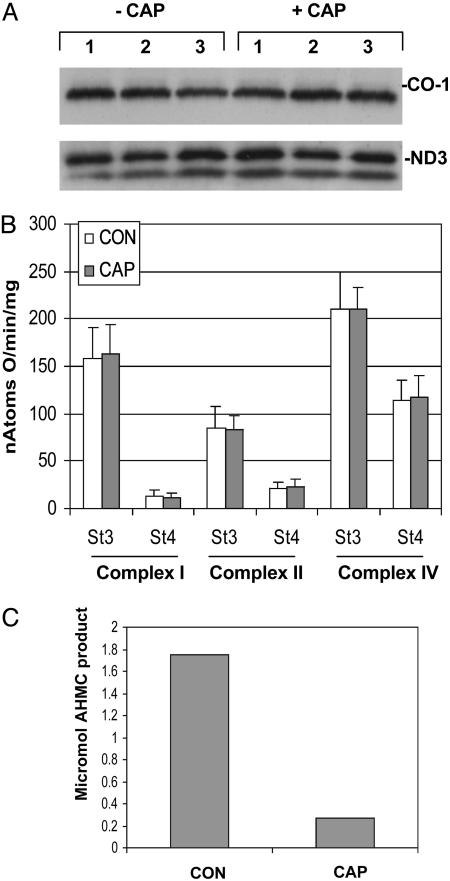
Effect of chloramphenicol infusion on mitochondria and CYP activity. (A) Mitochondria isolated from hearts perfused with or without chloramphenicol were assessed for expression levels of mitochondrial genome-encoded proteins cytochrome oxidase subunit I (CO-I) and complex I subunit 3 (ND3). (B) Mitochondrial respiration was measured by polarography. State 3 and state 4 respiration are shown for palmitoylcarnitine (complex I substrate), succinate (complex II substrate), and TMPD/ascorbate (complex IV substrate). Error bars represent standard deviation. (C) Cardiac microsomes were prepared from hearts perfused with or without chloramphenicol, and CYP activity was measured as the NADPH-dependent demethylation reaction of AMMC.
Fig. 4.
Fig. 4.
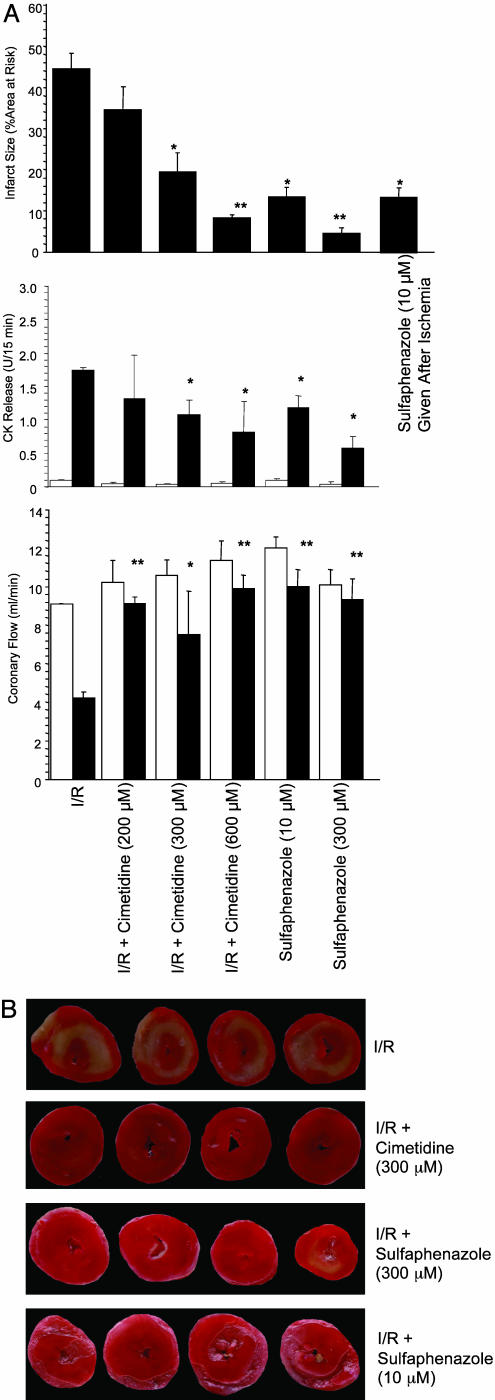
Effect of various CYP inhibitors on ischemia/reperfusion in the Langendorff model. Adult rat hearts were perfused in Langendorff mode for 20 min, then subjected to 30 min of no-flow ischemia followed by 2 h of reperfusion (I/R). Inhibitors were added for the entire procedure or only at reperfusion (Sulfaphenazole Given After Ischemia), at the specified concentrations. (A) After 2 h of reperfusion, hearts were frozen and assessed for infarct size. Coronary effluent was collected for 15 min immediately before and after ischemia and assessed for CK release. Coronary flow was measured during the first 15 min of reperfusion. Error bars denote SEM. *, P < 0.01; **, P < 0.001 (comparison to I/R). (B) Representative heart sections stained with triphenyl tetrazolium chloride.
Fig. 5.
Fig. 5.
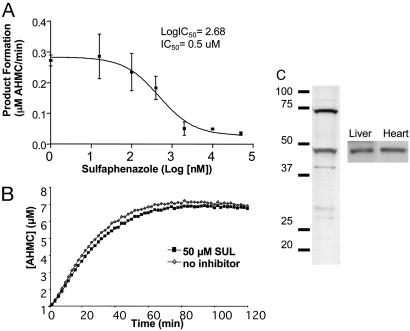
Effect of sulfaphenazole on AMMC demethylase activity. (A) The rate of AHMC product formation was assessed, and the IC50 value was calculated as described. (B) AHMC product formation was measured over2hin baculovirus-infected CYP2D2-specific supersomes treated in the presence or absence of sulfaphenazole (50 μM) (SUL). (C) Rat cardiac microsomes were resolved by SDS/PAGE and immunoblotted with anti-CYP2C9 antibody. (Right) Three micrograms of liver and 10 μg of cardiac microsomes.
Fig. 6.
Fig. 6.
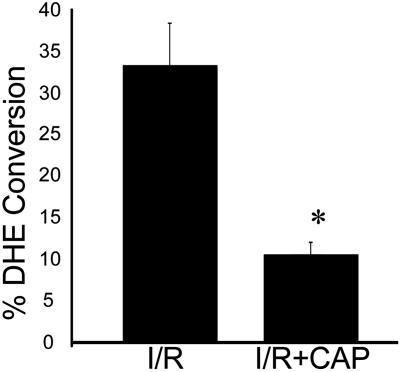
Effect of chloramphenicol on superoxide generation. Rat hearts were perfused in Langendorff mode with or without chloramphenicol (300 μM) (CAP) for 15 min and then subjected to 20 min of ischemia and 15 min of reperfusion with the same buffer. Superoxide levels were assessed by measuring dihydroethidium conversion to ethidium as described. The asterisk represents a P value <0.05. Error bars represent the standard error for ischemia/reperfusion (n = 5) and ischemia/reperfusion plus chloramphenicol (300 μM) (n = 4).

Comment in

References

    1. Flaherty, J. T. & Weisfeldt, M. L. (1988) Free Radical Biol. Med. 5, 409–419. - PubMed
    1. Horman, S., Browne, G., Krause, U., Patel, J., Vertommen, D., Bertrand, L., Lavoinne, A., Hue, L., Proud, C. & Rider, M. (2002) Curr. Biol. 12, 1419–1423. - PubMed
    1. He, H., Chen, M., Scheffler, N. K., Gibson, B. W., Spremulli, L. L. & Gottlieb, R. A. (2001) Circ. Res. 89, 461–467. - PubMed
    1. Fisslthaler, B., Popp, R., Kiss, L., Potente, M., Harder, D. R., Fleming, I. & Busse, R. (1999) Nature 401, 493–497. - PubMed
    1. Fleming, I. (2001) Circ. Res. 89, 753–762. - PubMed

Publication types

MeSH terms