. 2004 Feb 3;101(5):1392-6.
doi: 10.1073/pnas.0303472101. Epub 2004 Jan 20.

Control of calcium oscillations by membrane fluxes

Affiliations

Control of calcium oscillations by membrane fluxes

J Sneyd et al. Proc Natl Acad Sci U S A. .

Abstract

It is known that Ca(2+) influx plays an important role in the modulation of inositol trisphosphate-generated Ca(2+) oscillations, but controversy over the mechanisms underlying these effects exists. In addition, the effects of blocking membrane transport or reducing Ca(2+) entry vary from one cell type to another; in some cell types oscillations persist in the absence of Ca(2+) entry (although their frequency is affected), whereas in other cell types oscillations depend on Ca(2+) entry. We present theoretical and experimental evidence that membrane transport can control oscillations by controlling the total amount of Ca(2+) in the cell (the Ca(2+) load). Our model predicts that the cell can be balanced at a point where small changes in the Ca(2+) load can move the cell into or out of oscillatory regions, resulting in the appearance or disappearance of oscillations. Our theoretical predictions are verified by experimental results from HEK293 cells. We predict that the role of Ca(2+) influx during an oscillation is to replenish the Ca(2+) load of the cell. Despite this prediction, even during the peak of an oscillation the cell or the endoplasmic reticulum may not be measurably depleted of Ca(2+).


Figures

Fig. 1.
Fig. 1.
Schematic diagram of the model fluxes.
Fig. 2.
Fig. 2.
Blue lines are the bifurcation diagram of the closed-cell model with ct as the bifurcation parameter. Parameter values of the IPR model are taken from ref. . Other parameter values (adapted from ref. 22) are γ = 5.4, kf = 0.96 s–1, g1 = 0.002 s–1, Vs = 120 μM2·s–1, Ks = 0.18 μM, Vp = 28 μM·s–1, Kp = 0.42 μM, α1 = 0.03 μM·s–1, and α2 = 0.2 s–1. The dotted red line is a solution of the open-cell model superimposed on the bifurcation diagram of the closed-cell model and calculated by using p = 10 and δ = 0.01. ss, steady states; max osc, maximum of the oscillation.
Fig. 3.
Fig. 3.
The broken lines are the maximum (max) and minimum (min) of oscillations in the open-cell model for different values of δ. The curves labeled HC and SNP are two-parameter continuations of the points labeled HC and SNP in Fig. 2. Thus, for each value of δ, oscillations exist in the closed-cell model only for values of ct between the HC and SNP curves.
Fig. 4.
Fig. 4.
Two-parameter bifurcation diagram of the open-cell model. The lines (for three different values of δ) divide the α1p plane into regions for which oscillations do or do not exist.
Fig. 5.
Fig. 5.
Addition of La3+ to HEK293 cells after addition of CCh eliminates oscillations (Upper), whereas addition of La3+ before CCh does not prevent oscillations (Lower).
Fig. 6.
Fig. 6.
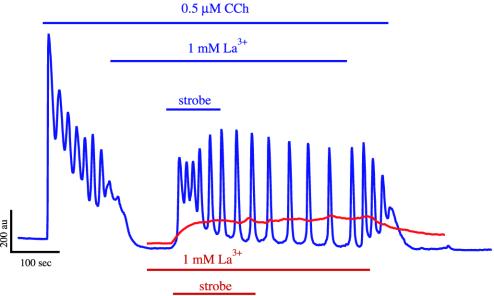
Addition of CCh initiates oscillations that terminate on addition of La3+. Increasing ct by strobed photorelease of cytosolic Ca2+ restores oscillations even during continued blockage of membrane transport (blue lines). This is equivalent to moving from point A to point B in Fig. 3. The red lines show the effect of the strobe in the presence of La3+ alone (done in a separate experiment, but plotted here on the same graph for ease of comparison). Note how, when the strobe is removed, [Ca2+] does not decline until the La3+ is removed.

References

    1. Sanderson, M. J., Charles, A. C., Boitano, S. & Dirksen, E. R. (1994) Mol. Cell. Endocrinol. 98, 173–187. - PubMed
    1. Clapham, D. (1995) Cell 80, 259–268. - PubMed
    1. Thomas, A. P., Bird, G. S. J., Hajnóczky, G., Robb-Gaspers, L. D. & Putney, J. W. J. (1996) FASEB J. 10, 1505–1517. - PubMed
    1. Berridge, M. J. (1997) J. Physiol. 499, 291–306. - PMC - PubMed
    1. Putney, J. W., Jr. (1990) Cell Calcium 11, 611–624. - PubMed

Publication types