


A randomised controlled trial of standing programme on bone mineral density in non-ambulant children with cerebral palsy
- PMID: 14736627
- PMCID: PMC1719782
- DOI: 10.1136/adc.2002.009316
A randomised controlled trial of standing programme on bone mineral density in non-ambulant children with cerebral palsy
Abstract
Background: Severely disabled children with cerebral palsy (CP) are prone to low trauma fractures, which are associated with reduced bone mineral density.
Aims: To determine whether participation in 50% longer periods of standing (in either upright or semi-prone standing frames) would lead to an increase in the vertebral and proximal tibial volumetric trabecular bone mineral density (vTBMD) of non-ambulant children with CP.
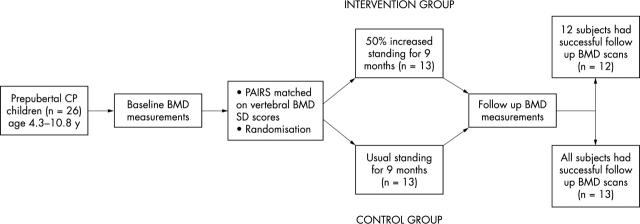
Methods: A heterogeneous group of 26 pre-pubertal children with CP (14 boys, 12 girls; age 4.3-10.8 years) participated in this randomised controlled trial. Subjects were matched into pairs using baseline vertebral vTBMD standard deviation scores. Children within the pairs were randomly allocated to either intervention (50% increase in the regular standing duration) or control (no increase in the regular standing duration) groups. Pre- and post-trial vertebral and proximal tibial vTBMD was measured by quantitative computed tomography (QCT).
Results: The median standing duration was 80.5% (9.5-102%) and 140.6% (108.7-152.2%) of the baseline standing duration in the control group and intervention group respectively. The mean vertebral vTBMD in the intervention group showed an increase of 8.16 mg/cm3 representing a 6% mean increase in vertebral vTBMD. No change was observed in the mean proximal tibial vTBMD.
Conclusion: A longer period of standing in non-ambulant children with CP improves vertebral but not proximal tibial vTBMD. Such an intervention might reduce the risk of vertebral fractures but is unlikely to reduce the risk of lower limb fractures in children with CP.
Similar articles
-
Low magnitude mechanical loading is osteogenic in children with disabling conditions.J Bone Miner Res. 2004 Mar;19(3):360-9. doi: 10.1359/JBMR.040129. Epub 2004 Jan 27. J Bone Miner Res. 2004. PMID: 15040823 Clinical Trial.
-
Effect of high-frequency, low-magnitude vibration on bone and muscle in children with cerebral palsy.J Pediatr Orthop. 2010 Oct-Nov;30(7):732-8. doi: 10.1097/BPO.0b013e3181efbabc. J Pediatr Orthop. 2010. PMID: 20864862 Free PMC article. Clinical Trial.
-
Bone status in cystic fibrosis.Arch Dis Child. 2001 Jun;84(6):516-20. doi: 10.1136/adc.84.6.516. Arch Dis Child. 2001. PMID: 11369574 Free PMC article.
-
Low bone mineral density in ambulatory persons with cerebral palsy? A systematic review.Disabil Rehabil. 2019 Oct;41(20):2392-2402. doi: 10.1080/09638288.2018.1470261. Epub 2018 May 22. Disabil Rehabil. 2019. PMID: 29783868
-
Effectiveness of assisted standing on bone mineral density in children with cerebral palsy. A systematic review.Arch Argent Pediatr. 2024 Dec 1;122(6):e202310251. doi: 10.5546/aap.2023-10251.eng. Epub 2024 Apr 4. Arch Argent Pediatr. 2024. PMID: 38527242 English, Spanish.
Cited by
-
Vigorous physical activity increases fracture risk in children irrespective of bone mass: a prospective study of the independent risk factors for fractures in healthy children.J Bone Miner Res. 2008 Jul;23(7):1012-22. doi: 10.1359/jbmr.080303. J Bone Miner Res. 2008. PMID: 18570539 Free PMC article.
-
Bone mass and density in preadolescent boys with and without Down syndrome.Osteoporos Int. 2013 Nov;24(11):2847-54. doi: 10.1007/s00198-013-2393-7. Epub 2013 May 17. Osteoporos Int. 2013. PMID: 23681086
-
The frequency of osteogenic activities and the pattern of intermittence between periods of physical activity and sedentary behaviour affects bone mineral content: the cross-sectional NHANES study.BMC Public Health. 2014 Jan 6;14:4. doi: 10.1186/1471-2458-14-4. BMC Public Health. 2014. PMID: 24393577 Free PMC article.
-
Clinical Guidelines for Management of Bone Health in Rett Syndrome Based on Expert Consensus and Available Evidence.PLoS One. 2016 Feb 5;11(2):e0146824. doi: 10.1371/journal.pone.0146824. eCollection 2016. PLoS One. 2016. PMID: 26849438 Free PMC article.
-
Puberty, statural growth, and growth hormone release in children with cerebral palsy.J Pediatr Rehabil Med. 2009;2(2):131-41. doi: 10.3233/PRM-2009-0072. J Pediatr Rehabil Med. 2009. PMID: 20216931 Free PMC article.
References
Publication types
MeSH terms
LinkOut - more resources
Full Text Sources
Medical
Miscellaneous
