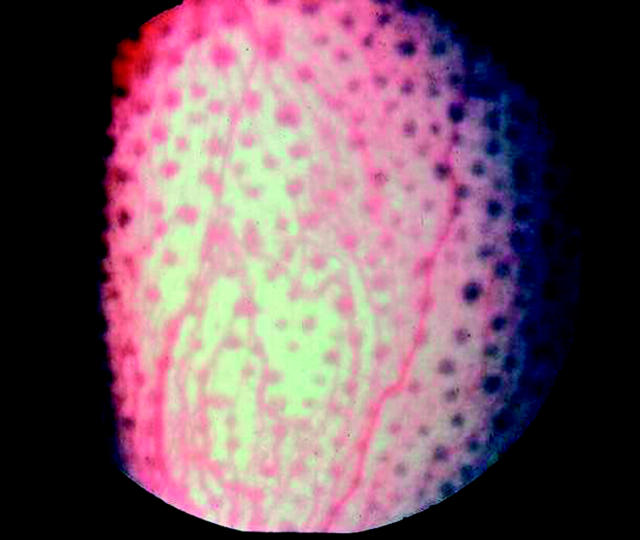
Leopard spot retinal pigmentation in infancy indicating a peroxisomal disorder
- PMID: 14736770
- PMCID: PMC1772012
- DOI: 10.1136/bjo.2003.023010
Leopard spot retinal pigmentation in infancy indicating a peroxisomal disorder
Abstract
Background: Neonatal adrenoleucodystrophy (NALD) is a rare disorder resulting from abnormal peroxisomal biogenesis. Affected patients present in infancy with developmental delay, hypotonia, and seizures. Blindness and nystagmus are prominent features. The authors suggest a characteristic leopard spot pigmentary pattern in the peripheral retina to be diagnostic.
Methods: Three patients are reported with this presentation; the characteristic retinal appearance resulted in early diagnosis for one of these.
Conclusion: Leopard spot retinopathy in an infant with hypotonia, seizures, developmental delay, with or without dysmorphic features and hearing impairment, is a clue to the diagnosis of NALD.
Figures
References
-
- Ulrich J, Herschkowitz N, Heitz P, et al. Adrenoleukodystrophy: preliminary report of a conatal case: light- and electron microscopical, immunohistochemical and biochemical findings. Acta Neuropathol (Berl) 1978;43:77–83. - PubMed
-
- Dimmick JE, Applegarth DA. Pathology of peroxisomal disorders. In: Landing BH, Haust MD, Bernstein J, Rosenberg HS, eds. Genetic metabolic diseases. Perspect Pediatr Pathol Basel Karger 1993;17:45–98. - PubMed
-
- Folz SJ, Trobe JD. The peroxisome and the eye. Surv Ophthalmol 1991;35:353–68. - PubMed
-
- Wanders RJA, Schuutgens RBH, Tabak HJ. Functions and biogenesis of peroxisomes. In: Applegarth DA, Dimmick JE, Hall JG, eds. Organelle diseases. London: Chapman and Hall Medical, 1997:147–67.
-
- Wray S, Cogan DG, Kuwabara T, et al. Adrenoleukodystrophy with disease of the eye and optic nerve. Am J Ophthalmol 83:480–5. - PubMed
Publication types
MeSH terms
LinkOut - more resources
Full Text Sources
Medical