. 2004 Feb;48(2):413-22.
doi: 10.1128/AAC.48.2.413-422.2004.

Orally active fusion inhibitor of respiratory syncytial virus

Affiliations

Orally active fusion inhibitor of respiratory syncytial virus

Christopher Cianci et al. Antimicrob Agents Chemother. 2004 Feb.

Abstract

BMS-433771 was found to be a potent inhibitor of respiratory syncytial virus (RSV) replication in vitro. It exhibited excellent potency against multiple laboratory and clinical isolates of both group A and B viruses, with an average 50% effective concentration of 20 nM. Mechanism-of-action studies demonstrated that BMS-433771 inhibits the fusion of lipid membranes during both the early virus entry stage and late-stage syncytium formation. After isolation of resistant viruses, resistance was mapped to a series of single amino acid mutations in the F1 subunit of the fusion protein. Upon oral administration, BMS-433771 was able to reduce viral titers in the lungs of mice infected with RSV. This new class of orally active RSV fusion inhibitors offers potential for clinical development.


Figures
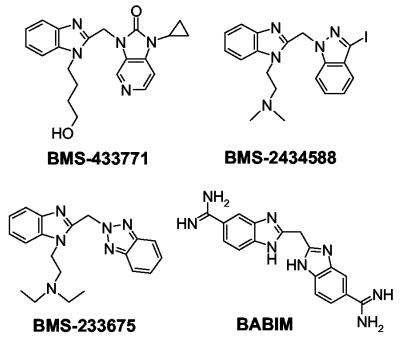
FIG. 1.
FIG. 1.
Structures of key fusion inhibitors used in this study.
FIG. 2.
FIG. 2.
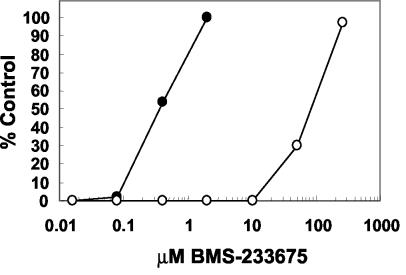
Levels of cell protection from RSV by BMS-233675 (EC50s; filled circles) and cytotoxicity of BMS-233675 (CC50s; open circles).
FIG. 3.
FIG. 3.
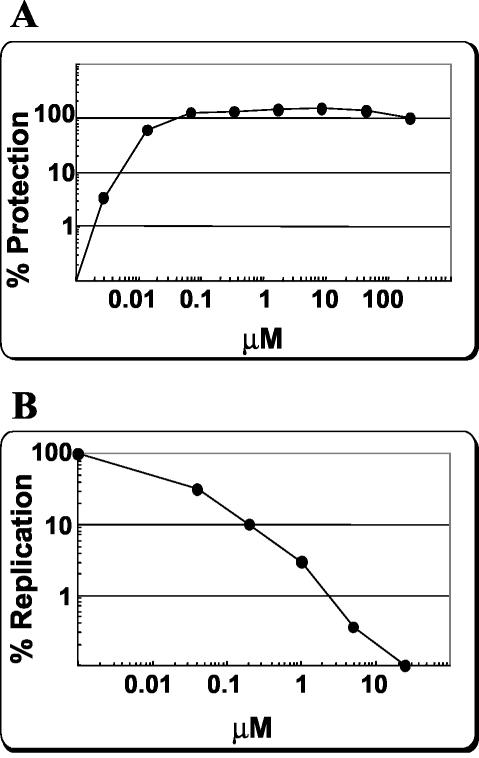
BMS-433771 inhibition of multiple-cycle RSV replication. (A) Measurement of BMS-433771-induced protection of HEp-2 cells from RSV-induced CPE. Data are plotted as the percent protection compared to the CPE for untreated, infected controls. (B) BMS-433771 inhibition of RSV multiple-cycle viral replication as measured by viral protein expression assay. Data are plotted as the percent replication compared to that of an untreated, infected control by quantitating the virus-expressed matrix protein.
FIG. 4.
FIG. 4.
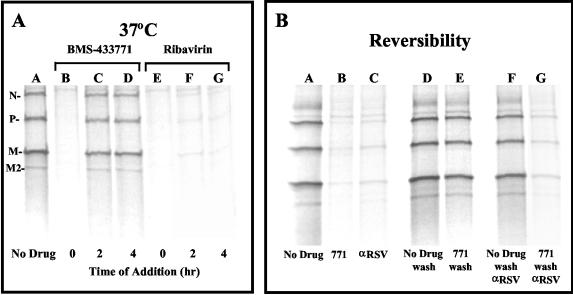
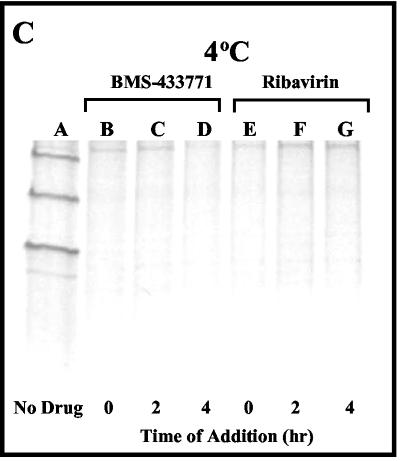
BMS-433771 mechanism-of-action studies. All samples were processed for evaluation as described in the text for the viral protection assay. (A) Effect of time of addition of BMS-433771 and ribavirin on RSV replication at 37°C. Samples were kept at 37°C, 5 μM compound was added postinfection at the times indicated below each lane, and incubation was continued for another 16 h at 37°C. (B) Reversible inhibition of RSV by BMS-433771. HEp-2 cells were infected with RSV at 37°C in the presence of 5 μM BMS-433771 (771) for 3 h and then placed at 4°C and treated as described below each lane before the samples were shifted to 37°C for 16 h. Five micrograms of anti-RSV antibody (α-RSV) was added to the specified samples. (C) Effect of time of addition of BMS-433771 on RSV replication at 4°C. Five micromolar BMS-433771 was added at the times postinfection indicated below each lane at 4°C before the samples were shifted to 37°C for 16 h.
FIG. 4.
FIG. 4.
BMS-433771 mechanism-of-action studies. All samples were processed for evaluation as described in the text for the viral protection assay. (A) Effect of time of addition of BMS-433771 and ribavirin on RSV replication at 37°C. Samples were kept at 37°C, 5 μM compound was added postinfection at the times indicated below each lane, and incubation was continued for another 16 h at 37°C. (B) Reversible inhibition of RSV by BMS-433771. HEp-2 cells were infected with RSV at 37°C in the presence of 5 μM BMS-433771 (771) for 3 h and then placed at 4°C and treated as described below each lane before the samples were shifted to 37°C for 16 h. Five micrograms of anti-RSV antibody (α-RSV) was added to the specified samples. (C) Effect of time of addition of BMS-433771 on RSV replication at 4°C. Five micromolar BMS-433771 was added at the times postinfection indicated below each lane at 4°C before the samples were shifted to 37°C for 16 h.
FIG. 5.
FIG. 5.
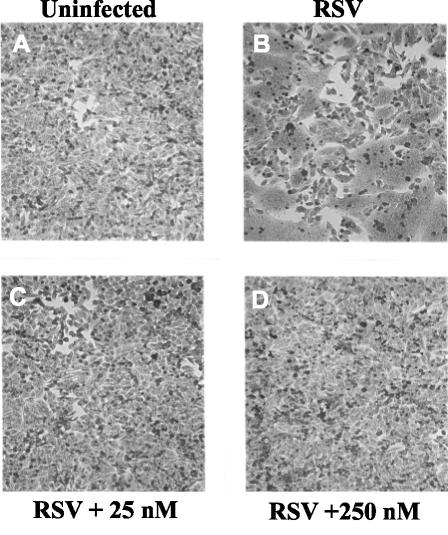
Effect of BMS-433771 on RSV-induced syncytium formation. HEp-2 cells were infected with RSV, and BMS-433771 was added at 16 h postinfection. The samples were evaluated for syncytium formation after an additional 12 h of incubation. (A) Uninfected HEp-2 cells; (B) infected cells with no drug treatment; large multinucleated cells (syncytia) are clearly seen and are the result of RSV-induced cell fusion; (C) infected HEp-2 cells to which 25 nM BMS-433771 was added; (D) infected HEp-2 cells to which 250 nM BMS-433771 was added.
FIG. 6.
FIG. 6.
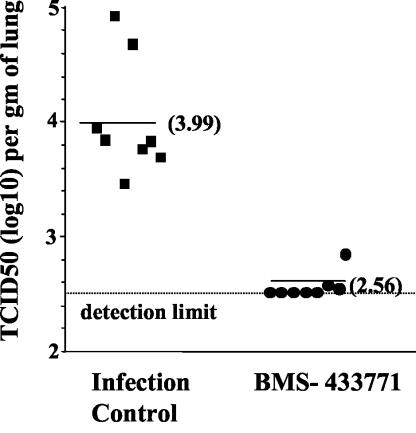
Oral activity of BMS-433771 in a mouse model of RSV infection. A 50-mg/kg/day BMS-433771 b.i.d. dose was administered to mice by oral gavage beginning 1 h prior to intranasal inoculation with 105 TCID50s of RSV. After 4 days, the mice were killed and TCID50 titers were determined by using lung homogenates. Each datum point represents the RSV titer for each animal in the respective treatment cohort. The horizontal line drawn for each cohort marks the geometric mean RSV titer for the group, and the viral titers are provided in parentheses. The horizontal dotted line represents the RSV titer at the limit of detection of the assay.

References

    1. Ausubel, F. M., R. Brent, R. E. Kingston, D. D. Moore, J. G. Seidman, and J. A. Smith. 1989. Current protocols in molecular biology. John Wiley & Sons, Inc., New York, N.Y.
    1. Byrd, L. G., and G. A. Prince. 1997. Animal models of respiratory syncytial virus infection. Clin. Infect. Dis. 25:1363-1368. - PubMed
    1. Calder, L. J., L. Gonzalez-Reyes, B. Garcia-Barreno, S. A. Wharton, J. J. Skehel, D. C. Wiley, and J. A. Melero. 2000. Electron microscopy of the human respiratory syncytial virus fusion protein and complexes that it forms with monoclonal antibodies. Virology 271:122-131. - PubMed
    1. Carr, C. M., and P. S. Kim. 1993. A spring-loaded mechanism for the conformational change of influenza hemagglutinin. Cell 73:823-832. - PubMed
    1. Chambers, P., C. R. Pringle, and A. J. Easton. 1992. Sequence analysis of the gene encoding the fusion glycoprotein of pneumonia virus of mice suggests possible conserved secondary structure elements in paramyxovirus fusion glycoproteins. J. Gen. Virol. 73:1717-1724. - PubMed

MeSH terms

LinkOut - more resources