


doi: 10.1128/AAC.48.2.641-643.2004.
Safety and efficacy of antimicrobial peptides against naturally acquired leishmaniasis
Affiliations
- PMID: 14742227
- PMCID: PMC321547
- DOI: 10.1128/AAC.48.2.641-643.2004
Item in Clipboard
Safety and efficacy of antimicrobial peptides against naturally acquired leishmaniasis
Antimicrob Agents Chemother.
2004 Feb.
Abstract
Leishmaniases, which are important causes of morbidity and mortality in humans and dogs, are extremely difficult to treat. Antimicrobial peptides are rarely used as alternative treatments for naturally acquired parasitic diseases. Here we report that the acylated synthetic antimicrobial peptide Oct-CA(1-7)M(2-9) is safe and effective for treating naturally acquired canine leishmaniasis.
Figures
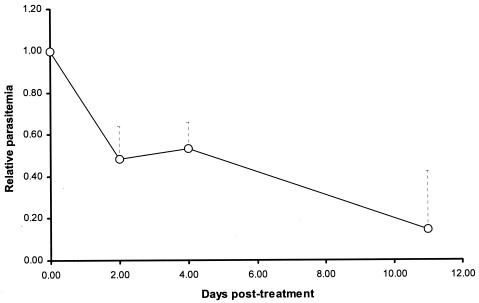
Relative L. infantum parasitemia after three doses of the acylated cecropin-melittin hybrid AP Oct-CA(1-7)M(2-9). The doses were administered on days 0, 2, and 4. Geometric mean and standard error of the mean (broken line) are shown.
References
-
- Akuffo, H., D. Hultmark, A. Engstom, D. Frohlich, and D. Kimbrell. 1998. Drosophila antibacterial protein, cecropin A, differentially affects non-bacterial organisms such as Leishmania in a manner different from other amphipathic peptides. Int. J. Mol. Med. 1:77-82. - PubMed
-
- Andreu, D., and L. Rivas. 1998. Animal antimicrobial peptides: an overview. Biopolymers 47:415-433. - PubMed
-
- Baneth, G., and S. E. Shaw. 2002. Chemotherapy of canine leishmaniosis. Vet. Parasitol. 106:315-324. - PubMed
-
- Bauer, R. J., M. L. White, N. Wedel, B. J. Nelson, N. Friedmann, A. Cohen, W. N. Hustinx, and A. H. Kung. 1996. A phase I safety and pharmacokinetic study of a recombinant amino terminal fragment of bactericidal/permeability-increasing protein in healthy male volunteers. Shock 5:91-96. - PubMed
Publication types
MeSH terms
Substances
LinkOut - more resources
Full Text Sources
Other Literature Sources
