


Two studies evaluating the safety and immunogenicity of a live, attenuated Shigella flexneri 2a vaccine (SC602) and excretion of vaccine organisms in North American volunteers
- PMID: 14742537
- PMCID: PMC321603
- DOI: 10.1128/IAI.72.2.923-930.2004
Two studies evaluating the safety and immunogenicity of a live, attenuated Shigella flexneri 2a vaccine (SC602) and excretion of vaccine organisms in North American volunteers
Abstract
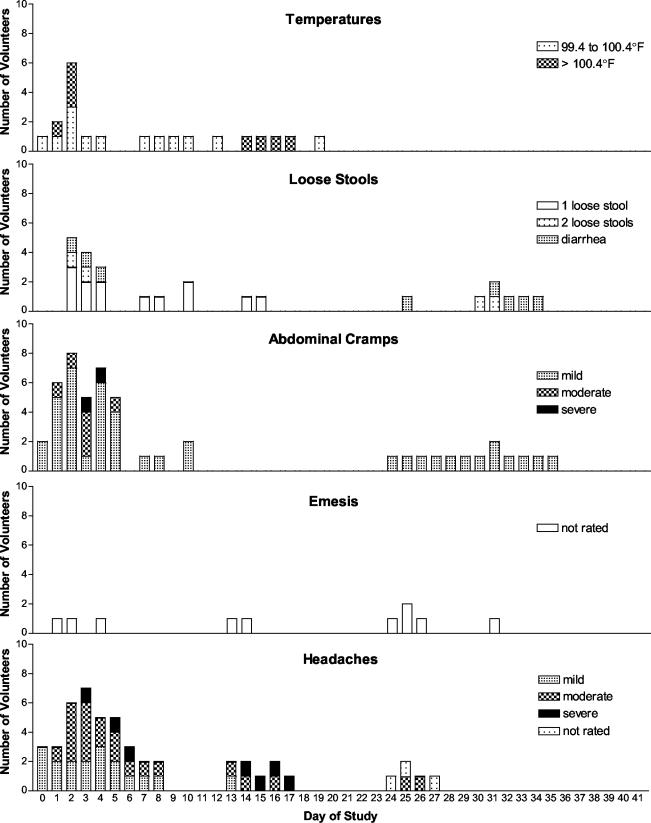
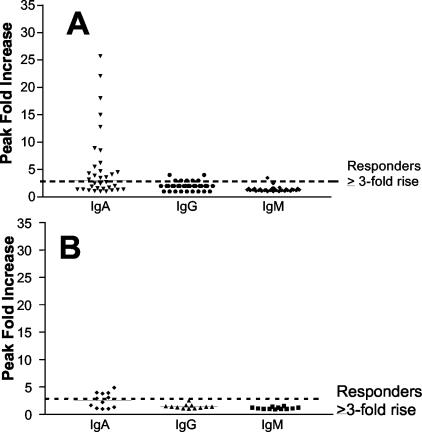
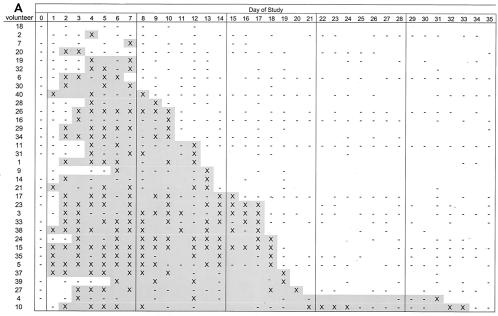
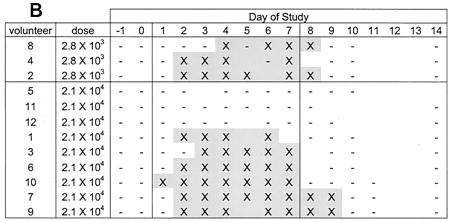
We report the first community-based evaluation of Shigella flexneri 2a strain SC602, a live, oral vaccine strain attenuated by deletion of the icsA (virG) plasmid virulence gene, given at 10(4) CFU. The primary objectives of this trial were to determine the safety and immunogenicity of the vaccine and to determine the duration of colonization. Four of 34 volunteers experienced transient fevers, and three reported diarrhea during the first 3 days of the study. Half of the volunteers mounted a positive serum immunoglobulin A (IgA) response to S. flexneri lipopolysaccharide. All but one of the volunteers excreted the vaccine in their stools for 1 to 33 days, and this excretion was often intermittent. Data from the community-based study were supplemented with an inpatient trial in which three volunteers received 10(3) and nine received 10(4) CFU. All volunteers who received 10(3) CFU excreted SC602 and had an IgA antibody-secreting cell response. Two of these had a serum IgA response. Six of the nine volunteers who received 10(4) CFU excreted SC602. One vaccinee had a transient fever and two met the definition of diarrhea. Six volunteers that received 10(4) CFU had an antibody-secreting cell response, and four had a serum IgA response. SC602 has now been tested at 10(4) CFU in a total of 58 volunteers. The cumulative results of these clinical trials, reported here and previously (Coster et al., Infect. Immun. 67:3437-3443, 1999), have demonstrated that SC602 is a substantially attenuated candidate vaccine that can evoke protection against the most severe symptoms of shigellosis in a stringent human challenge model of disease.
Figures
References
-
- Cohen, D., S. Ashkenazi, M. S. Green, M. Gdalevich, G. Robin, R. Slepon, M. Yavzori, N. Orr, C. Block, I. Ashkenazi, J. Shemer, D. N. Taylor, T. L. Hale, J. C. Sadoff, D. Pavliakova, R. Schneerson, and J. B. Robbins. 1997. Double-blind vaccine-controlled randomised efficacy trial of an investigational Shigella sonnei conjugate vaccine in young adults. Lancet 349:155-159. - PubMed
-
- DuPont, H. L., R. B. Hornick, A. T. Dawkins, M. J. Snyder, and S. B. Formal. 1969. The response of man to virulent Shigella flexneri 2a. J. Infect. Dis. 119:296-299. - PubMed
-
- Egile, C., T. P. Loisel, V. Laurent, R. Li, D. Pantaloni, P. J. Sansonetti, and M. F. Carlier. 1999. Activation of the CDC42 effector N-WASP by the Shigella flexneri IcsA protein promotes actin nucleation by Arp2/3 complex and bacterial actin-based motility. J. Cell Biol. 146:1319-1332. - PMC - PubMed
MeSH terms
Substances
LinkOut - more resources
Full Text Sources
Other Literature Sources
Miscellaneous
