. 2004 Feb 3;101(5):1386-91.
doi: 10.1073/pnas.0304264101. Epub 2004 Jan 23.

Antiinflammatory activity of soluble guanylate cyclase: cGMP-dependent down-regulation of P-selectin expression and leukocyte recruitment

Affiliations

Antiinflammatory activity of soluble guanylate cyclase: cGMP-dependent down-regulation of P-selectin expression and leukocyte recruitment

Amrita Ahluwalia et al. Proc Natl Acad Sci U S A. .

Abstract

Nitric oxide (NO) production by the vascular endothelium maintains an essential antiinflammatory, cytoprotective influence on the blood vessel wall. A key component of this activity is attributed to prevention of leukocyte-endothelial cell interactions, yet the underlying mechanisms remain unclear. The NO receptor, soluble guanylate cyclase (sGC), is expressed in endothelial cells but fulfils an unknown function. Therefore, we used intravital microscopy in mesenteric postcapillary venules from WT and endothelial nitric oxide synthase (eNOS) knockout (eNOS(-/-)) mice, and an sGC activator (BAY 41-2272), to investigate a potential role for sGC in the regulation of adhesion molecule expression and leukocyte recruitment. Leukocyte rolling and adhesion was 6-fold greater in eNOS(-/-) than WT animals. BAY 41-2272 and the NO-donor, diethylamine-NONOate, reduced leukocyte rolling and adhesion in eNOS(-/-) mice to levels observed in WT animals. These effects were blocked by the sGC inhibitor ODQ [1H-(1,2,4)oxadiazolo(4,3-a)quinoxalin-1-one], which itself caused a 6-fold increase in leukocyte rolling and adhesion in WT mice. Increased leukocyte rolling and adhesion in IL-1beta-treated mice was also inhibited by BAY 41-2272. Fluorescence-activated cell sorting analysis in vitro and a specific P-selectin neutralizing antibody in vivo revealed that selective down-regulation of P-selectin expression accounted for the antiadhesive effects of sGC activation. These data demonstrate that sGC plays a key antiinflammatory role by inhibiting P-selectin expression and leukocyte recruitment.


Figures
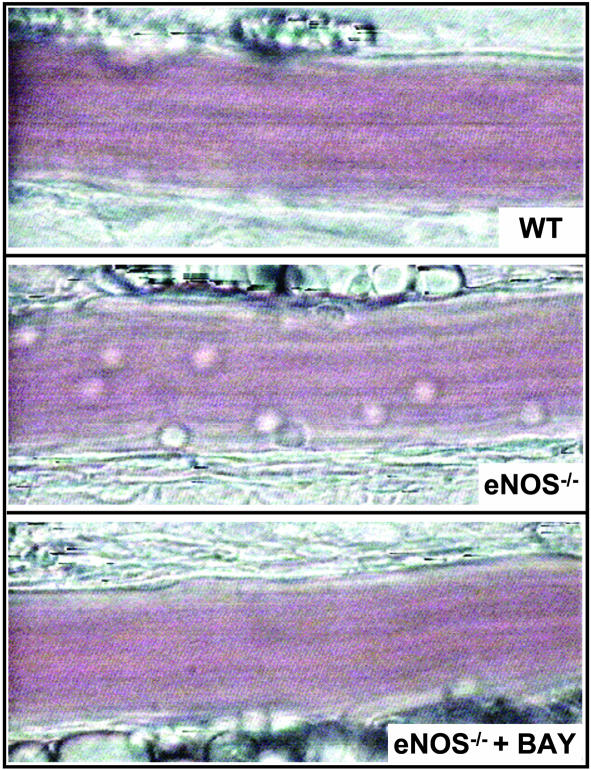
Fig. 1.
Fig. 1.
Video-microscopy images of leukocyte trafficking responses in mouse mesenteric postcapillary venules in vivo under basal conditions in WT mice (Top), eNOS–/– mice (Middle), and eNOS–/– mice in the presence of BAY 41–2272 (1 μM) (Bottom). The images are representative of at least five separate experiments.
Fig. 2.
Fig. 2.
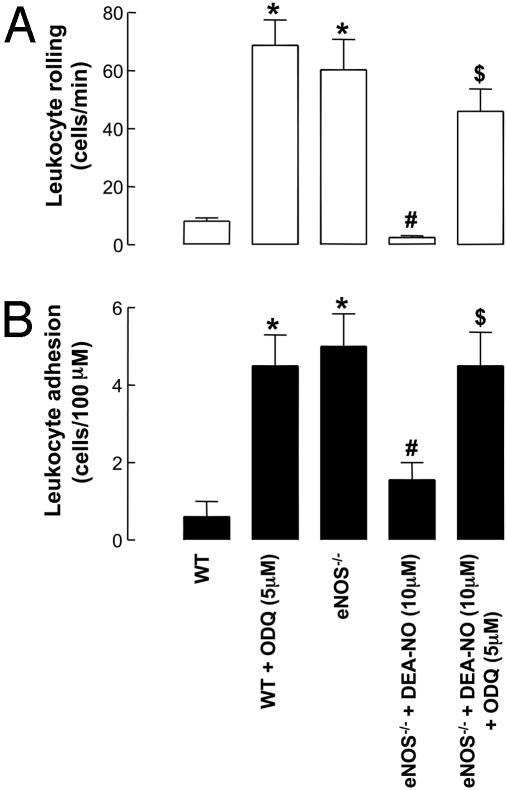
Leukocyte–endothelial cell interactions [rolling (A) and adhesion (B)] in mouse mesenteric postcapillary venules in vivo in WT and eNOS–/– mice in the absence and presence of DEA-NO (10 μM) and ODQ (5 μM). *, P < 0.05, significantly greater than WT animals; #, P < 0.05, significantly lower than eNOS–/– mice; $, P < 0.05, significantly greater than eNOS–/– mice with DEA-NO alone; n > 5.
Fig. 3.
Fig. 3.
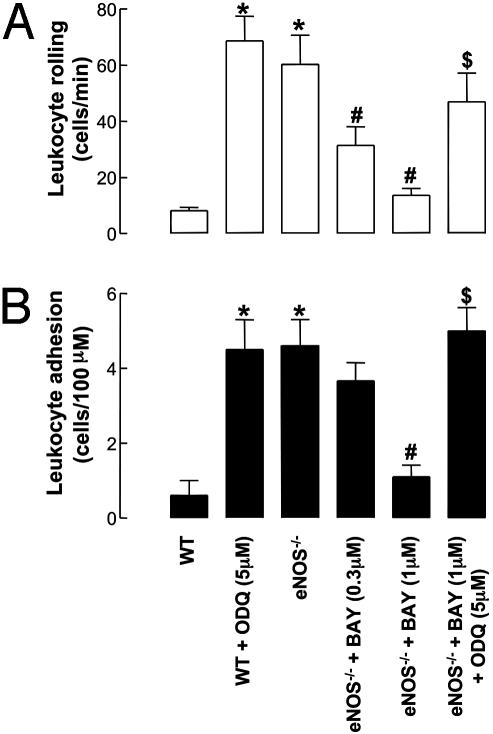
Leukocyte–endothelial cell interactions [rolling (A) and adhesion (B)] in mouse mesenteric postcapillary venules in vivo in WT and eNOS–/– mice in the absence and presence of BAY 41–2272 (0.3–1 μM) and ODQ (5 μM). *, P < 0.05, significantly greater than WT animals; #, P < 0.05, significantly lower than eNOS–/– mice; $, P < 0.05, significantly greater than eNOS–/– mice with BAY 41–2272 alone; n > 5.
Fig. 4.
Fig. 4.
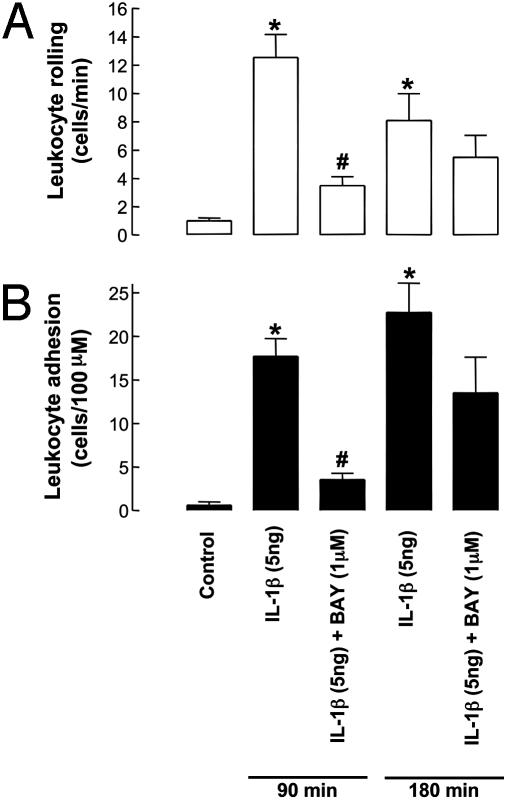
Leukocyte–endothelial cell interactions [rolling (A) and adhesion (B)] in mouse mesenteric postcapillary venules in vivo in WT mice in response to IL-1β (5 ng, 90- or 180-min exposure) in the absence and presence of BAY 41–2272 (1 μM). *, P < 0.05, significantly greater than control (saline-treated) animals; #, P < 0.05, significantly lower than IL-1β alone; n > 5.
Fig. 5.
Fig. 5.
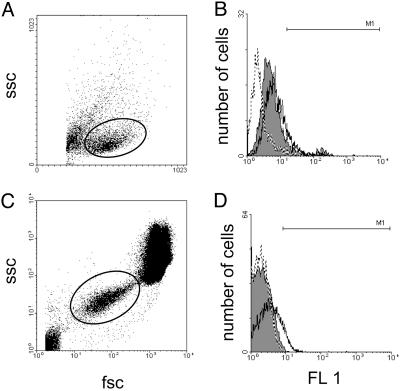
FACS analysis of P-selectin expression on HUVECs and platelets. (A and C) Dot plot analysis of the scatter characteristics of HUVECs grown in culture (A) and whole blood (C). Solid lines represent gating on live cells (A) and platelets (C). (B and D) P-selectin expression on gated HUVECs (B) and platelets (D) as demonstrated by fluorescence histograms. Broken outline, control cells; solid outline, cells stimulated with IL-1β (200 ng/ml); filled outline, cells stimulated with IL-1β (200 ng/ml) and treated with BAY 41–2272 (1 μM).
Fig. 6.
Fig. 6.
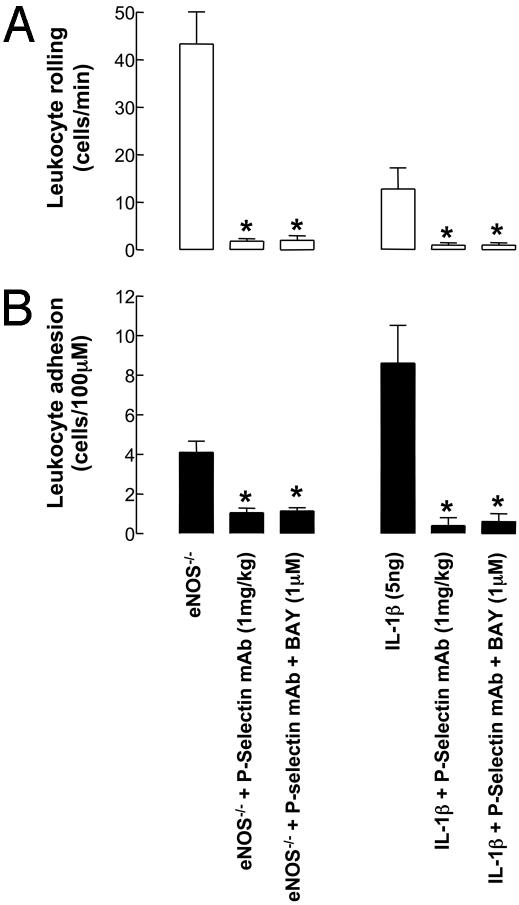
Leukocyte–endothelial cell interactions [rolling (A) and adhesion (B)] in mouse mesenteric postcapillary venules in vivo in eNOS–/– mice and in WT mice in response to IL-1β (5 ng, 90-min exposure) in the absence and presence of a P-selectin neutralizing antibody (RB40.34, 1 mg/kg) and BAY 41–2272 (1 μM). *, P < 0.05, significantly different from control; n ≥ 4.

References

    1. Granger, D. N. & Kubes, P. (1994) J. Leukocyte Biol. 55, 662–675. - PubMed
    1. Kubes, P., Suzuki, M. & Granger, D. N. (1991) Proc. Natl. Acad. Sci. USA 88, 4651–4655. - PMC - PubMed
    1. Gaboury, J., Woodman, R. C., Granger, D. N., Reinhardt, P. & Kubes, P. (1993) Am. J. Physiol. 265, H862–H867. - PubMed
    1. Radomski, M. W., Palmer, R. M. & Moncada, S. (1987) Lancet 2, 1057–1058. - PubMed
    1. Salas, E., Langford, E. J., Marrinan, M. T., Martin, J. F., Moncada, S. & de Belder, A. J. (1998) Heart 80, 146–150. - PMC - PubMed

Publication types

MeSH terms

LinkOut - more resources