. 2004 Feb;16(2):309-18.
doi: 10.1105/tpc.016725. Epub 2004 Jan 23.

Convergent evolution of disease resistance gene specificity in two flowering plant families

Affiliations

Convergent evolution of disease resistance gene specificity in two flowering plant families

Tom Ashfield et al. Plant Cell. 2004 Feb.

Abstract

Plant disease resistance (R) genes that mediate recognition of the same pathogen determinant sometimes can be found in distantly related plant families. This observation implies that some R gene alleles may have been conserved throughout the diversification of land plants. To address this question, we have compared R genes from Glycine max (soybean), Rpg1-b, and Arabidopsis thaliana, RPM1, that mediate recognition of the same type III effector protein from Pseudomonas syringae, AvrB. RPM1 has been cloned previously, and here, we describe the isolation of Rpg1-b. Although RPM1 and Rpg1-b both belong to the coiled-coil nucleotide binding site (NBS) Leu-rich repeat (LRR) class of R genes, they share only limited sequence similarity outside the conserved domains characteristic of this class. Phylogenetic analyses of A. thaliana and legume NBS-LRR sequences demonstrate that Rpg1-b and RPM1 are not orthologous. We conclude that convergent evolution, rather than the conservation of an ancient specificity, is responsible for the generation of these AvrB-specific genes.


Figures
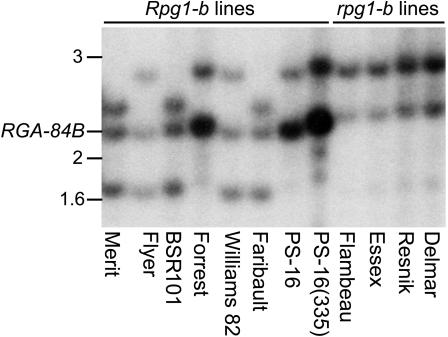
Figure 1.
Figure 1.
The NBS-LRR Gene RGA-84B Displays a Characteristic RFLP in Rpg1-b–Expressing Cultivars. Genomic DNA samples from a collection of G. max cultivars that express, or don't express, Rpg1-b specificity were digested with HindIII and analyzed by DNA gel blot hybridization with the RGA-84A probe (Ashfield et al., 2003). A band of ∼2.2 kb (representing the RGA-84B gene) was found only in the Rpg1-b–containing lines. Line PS-16(335) is an EMS mutant derived from line PS-16, which carries a mutation in the Rpg1-b gene. The positions of size markers are indicated at left in kilobases.
Figure 2.
Figure 2.
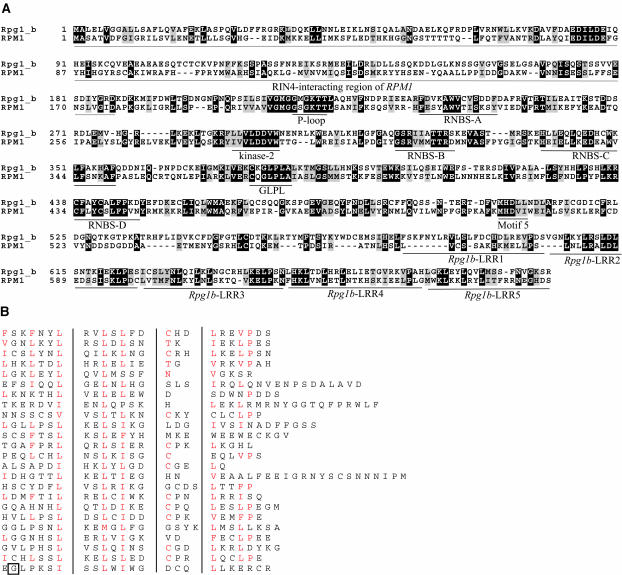
Sequence of RGA-84B and Comparison with the A. thaliana RPM1 Protein. (A) Alignment of the RPM1 and RGA-84B sequences from the first predicted Met to the end of the fifth LRR. Conserved motifs, as described by van der Biezen and Jones (1998b), are indicated. The region of RPM1 previously shown to interact with RIN4 is underlined (Mackey et al., 2002). (B) Alignment of the LRRs of Rpg1-b. Residues conforming to the intracellular LRR consensus are shown in red. The Gly (G) residue that is mutated to an Asp in the PS-16(335) allele is boxed.
Figure 3.
Figure 3.
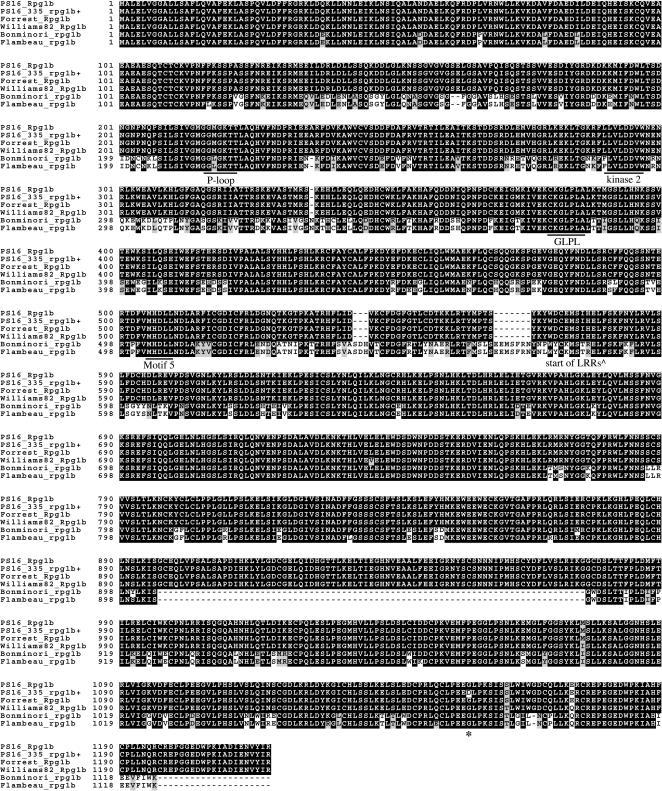
Alignment of Rpg1-b Homologs from G. max Cultivars That Express, or Don't Express, avrB Specificity Indicates Substantial Divergence between Functional and Nonfunctional Homologs. Cultivars PS-16, Williams 82, and Forrest all express the Rpg1-b phenotype; cultivars Flambeau and Bonminori do not. Line PS-16(335) was isolated from an EMS-mutagenized population derived from cultivar PS-16. The position of the mutation in the PS-16(335) allele is indicated with an asterisk. Sequences were aligned using ClustalX. Motifs conserved among NBS-LRR proteins are underlined. The rpg1b+ designation indicates a nonfunctional allele generated by chemical mutagenesis.
Figure 4.
Figure 4.
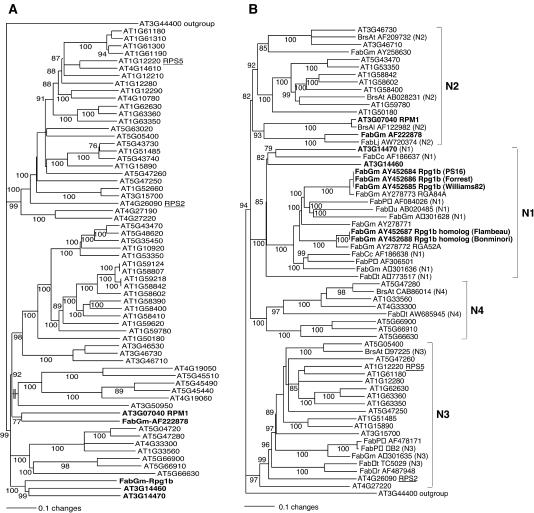
Phylogenetic Analysis Indicates That RPM1 and Rpg1-b Are Not Orthologous. (A) Maximum likelihood tree of Rpg1-b and the A. thaliana non-TIR-NBS-LRR sequences. The NBS domains from the entire set of A. thaliana non-TIR-NBS-LRR genes (http://niblrrs.ucdavis.edu) and from the G. max Rpg1-b protein were aligned using ClustalX, and a maximum likelihood tree was generated using MrBayes, a program for the Bayesian inference of phylogeny (see Methods). Numbers on branches indicate the probability that a given grouping is correct (only values >75 are shown). Sequence AF222878 is a G. max sequence included to allow comparison with the tree in (B). The tree was rooted using a TIR-NBS-LRR sequence. (B) Maximum likelihood tree of A. thaliana and legume non-TIR-NBS-LRR sequences, including RPM1 and Rpg1-b. The region between the P-loop and GLPL domains from the indicated sequences was aligned, and a tree was generated as described in (A). Sequences marked with N1, N2, N3, or N4 have been previously assigned to one of the four non-TIR-NBS-LRR major subgroups (Cannon et al., 2002). Sequences with the AT prefix are A. thaliana sequences also represented in (A). All other sequences are identified by an abbreviation indicating the family (Fab, Fabaceae; Brs, Brassicaceae), the genus and species of origin (Al, A. lyrata; At, A. thaliana; Cc, Cajunas cajan; Gm, G. max; Lj, Lotus japonicus; Mr, Medicago ruthenica; Mt, M. truncatulata; Pv, Phaseolus vulgaris), and the GenBank accession number.
Figure 5.
Figure 5.
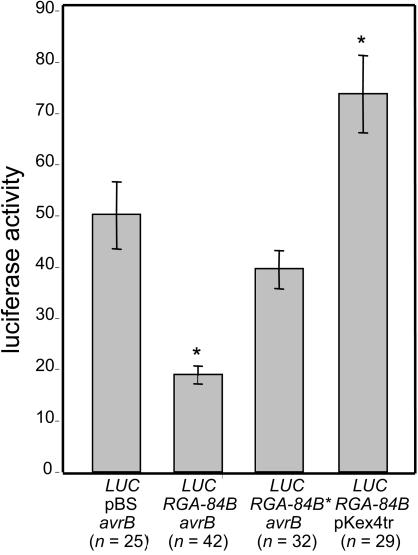
NBS-LRR Gene RGA-84B Conditions an avrB-Dependent Reduction in Reporter Gene Expression. Particle bombardment was used to transiently coexpress the LUC reporter gene with the indicated plasmids. RGA-84B* indicates RGA-84B containing the G-to-D substitution identified in the PS-16(335) mutant. pBS indicates pBluescript SK+, the empty vector for RGA-84B. pKex4tr is the empty vector control for the avrB plasmid. Leaves of G. max cv Flambeau (which does not express Rpg1-b) were used in all cases. Values represent the mean ± se of >25 samples, which were pooled from a minimum of three independent experiments. The asterisks indicate values that are significantly different (P < 0.05; Tukey multiple comparison test) from the avrB/Luc treatment.
Figure 6.
Figure 6.
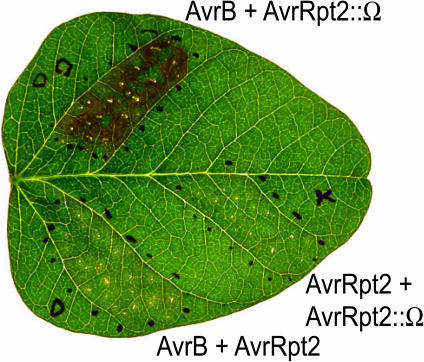
The Type III Effector Protein AvrRpt2 Suppresses Rpg1-b–Mediated Recognition of AvrB. Each leaf section was injected with a 1:1 mixture of P. syringae pv glycinea race 4 strains carrying the indicated avr genes. AvrRpt2::Ω is a nonfunctional allele generated by insertional disruption of the ORF. The black dots indicate the perimeter of the infiltrated region. The photograph was taken 24 h after inoculation.

References

    1. Ashfield, T., Bocian, A., Held, D., Henk, A.D., Marek, L.F., Danesh, D., Peñuela, S., Meksem, K., Lightfoot, D.A., Young, N.D., Shoemaker, R.C., and Innes, R.W. (2003). Genetic and physical localization of the soybean Rpg1-b disease resistance gene reveals a complex locus containing several tightly linked families of NBS-LRR genes. Mol. Plant Microbe Interact. 16, 817–826. - PubMed
    1. Ashfield, T., Danzer, J.R., Held, D., Clayton, K., Keim, P., Saghai Maroof, M.A., Webb, P.M., and Innes, R.W. (1998). Rpg1, a soybean gene effective against races of bacterial blight, maps to a cluster of previously identified disease resistance genes. Theor. Appl. Genet. 96, 1013–1021.
    1. Ashfield, T., Keen, N.T., Buzzell, R.I., and Innes, R.W. (1995). Soybean resistance genes specific for different Pseudomonas syringae avirulence genes are allelic, or closely linked, at the RPG1 locus. Genetics 141, 1597–1604. - PMC - PubMed
    1. Axtell, M.J., and Staskawicz, B.J. (2003). Initiation of RPS2-specified disease resistance in Arabidopsis is coupled to the AvrRpt2-directed elimination of RIN4. Cell 112, 369–377. - PubMed
    1. Bisgrove, S.R., Simonich, M.T., Smith, N.M., Sattler, A., and Innes, R.W. (1994). A disease resistance gene in Arabidopsis with specificity for two different pathogen avirulence genes. Plant Cell 6, 927–933. - PMC - PubMed

Publication types

MeSH terms

Substances