. 2004 Feb;16(2):450-64.
doi: 10.1105/tpc.018796. Epub 2004 Jan 23.

Mutations in the pale aleurone color1 regulatory gene of the Zea mays anthocyanin pathway have distinct phenotypes relative to the functionally similar TRANSPARENT TESTA GLABRA1 gene in Arabidopsis thaliana

Affiliations

Mutations in the pale aleurone color1 regulatory gene of the Zea mays anthocyanin pathway have distinct phenotypes relative to the functionally similar TRANSPARENT TESTA GLABRA1 gene in Arabidopsis thaliana

Charles C Carey et al. Plant Cell. 2004 Feb.

Abstract

The pale aleurone color1 (pac1) locus, required for anthocyanin pigment in the aleurone and scutellum of the Zea mays (maize) seed, was cloned using Mutator transposon tagging. pac1 encodes a WD40 repeat protein closely related to anthocyanin regulatory proteins ANTHOCYANIN11 (AN11) (Petunia hybrida [petunia]) and TRANSPARENT TESTA GLABRA1 (TTG1) (Arabidopsis thaliana). Introduction of a 35S-Pac1 transgene into A. thaliana complemented multiple ttg1 mutant phenotypes, including ones nonexistent in Z. mays. Hybridization of Z. mays genomic BAC clones with the pac1 sequence identified an additional related gene, mp1. PAC1 and MP1 deduced protein sequences were used as queries to build a phylogenetic tree of homologous WD40 repeat proteins, revealing an ancestral gene duplication leading to two clades in plants, the PAC1 clade and the MP1 clade. Subsequent duplications within each clade have led to additional WD40 repeat proteins in particular species, with all mutants defective in anthocyanin expression contained in the PAC1 clade. Substantial differences in pac1, an11, and ttg1 mutant phenotypes suggest the evolutionary divergence of regulatory mechanisms for several traits that cannot be ascribed solely to divergence of the dicot and monocot protein sequences.


Figures
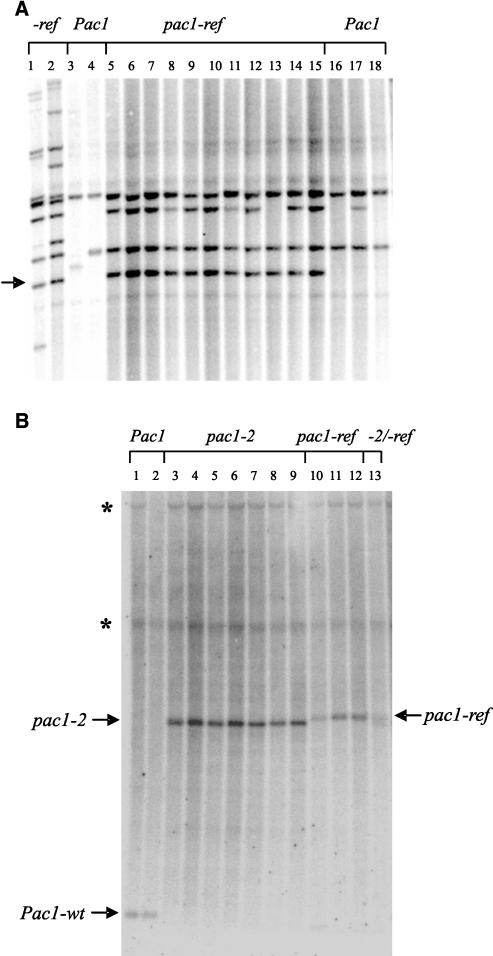
Figure 1.
Figure 1.
DNA Gel Blot Analysis of pac1 Mutant Alleles. DNA samples for both blots were digested with EcoRI and HindIII. (A) Identification of a 2.8-kb Mu1 hybridizing DNA fragment cosegregating with the pac1-ref mutant allele (arrow). Lanes 1 and 2, plants known to be pac1-ref; lanes 3 and 4, plants known to be Pac1; lanes 5 to 15, pac1-ref in family used for inverse PCR; lanes 16 to 18, Pac1 siblings of pac1-ref. An internal Mu1 fragment was used as the probe. (B) Identification of the insertion in the pac1-2 allele. Lanes 1 and 2, Pac1; lanes 3 to 9, pac1-2; lanes 10 to 12, pac1-ref; lane 13, pac1-2/pac1-ref. Hybridization was with the SacI/SmaI 700 probe and DNA flanking the Mu1 insertion (Figure 2). Asterisks indicate fragments cross-hybridizing with the SacI/SmaI 700 probe that are not from the pac1 locus.
Figure 2.
Figure 2.
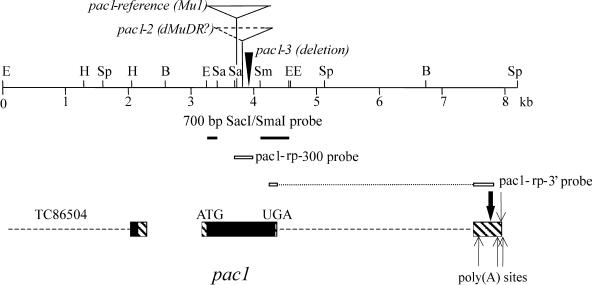
The pac1 Locus and Probes. All open reading frames in this genomic fragment are indicated by closed boxes, untranslated regions by hatched boxes, and introns by dashed lines. The pac1 transcription unit spans two exons separated by a 3017-bp intron (dashed line). Large and small arrows indicate relative abundance of sequenced poly(A) sites. The location of Mu insertions in the pac1-ref and pac1-2 alleles and the pac1-3 deletion are depicted at the top of the figure. The 9-bp duplication and Mu1 insertion for pac1-ref begins at codon 165. Sequence from pac1-2 indicates a Mu insertion at codon 192. The pac1-3 deletion begins at codon 203. The 700-bp SacI/SmaI probe was obtained by inverse PCR and is indicated by solid lines. Open boxes indicate probes for RNase protections. Part of a small putative zinc finger protein is located <1000 bp upstream of the pac1 initiator ATG site. Transcripts for this upstream gene are described in TIGR contig TC86504. B, BamHI; E, EcoRI; H, HindIII; Sa, SacI; Sm, SmaI; Sp, SpeI.
Figure 3.
Figure 3.
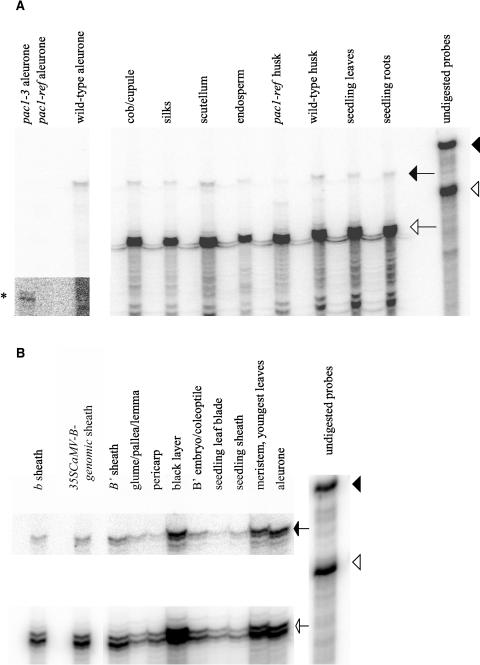
RNase Protections Using the pac1-rp-300 Probe. Arrowheads indicate undigested probes, and arrows indicate probes protected by sample RNA (closed, pac1; open; actin1). (A) The pac1-rp-300 probe was protected in the absence of the probe for actin1 for the first three samples, which are from aleurones of pac1-3, pac1-ref, and a wild-type control. The remaining samples include both actin1 and pac1 probes. The asterisk in the panel at left, which contains a longer exposure, shows the expected protected product for the pac1-3 allele. The pac1-ref and wild-type husks were from plants segregating in the same family. All other plant parts were from homozygous wild-type individuals. (B) All samples were from Pac1 wild-type individuals. The levels were adjusted upward in Adobe Photoshop for the pac1 protected probe because the signal was weak compared with actin1.
Figure 4.
Figure 4.
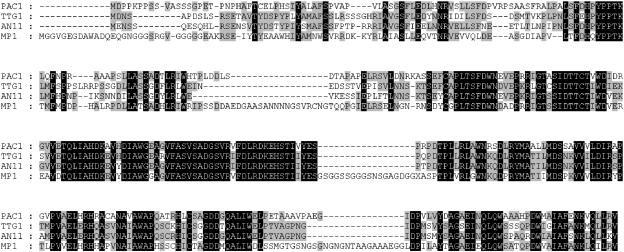
Alignment of PAC1, TTG1, AN11, and MP1. Amino acids conserved in all four proteins are indicated in black. Gray indicates identity in two or three of the proteins.
Figure 5.
Figure 5.
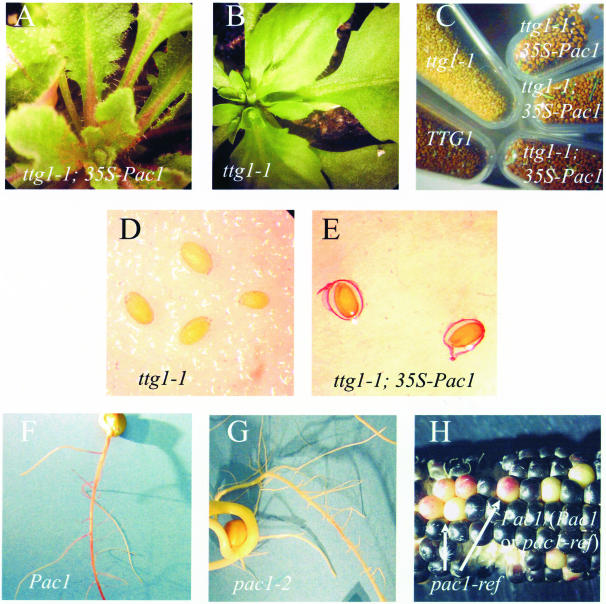
Phenotypes of 35S-Pac1 Complemented ttg1-1 Mutants and pac1 Mutants. (A) and (B) Anthocyanin, trichome, and leaf phenotypes are complemented by the 35S-Pac1 transgene. A ttg1-1 plant containing the 35S-Pac1 transgene (A) and a nontransgenic sibling (B). (C) The 35S-Pac1 transgene restores wild-type seed pigmentation to ttg1-1 mutants. Mature seed phenotypes of wild-type (TTG1) Columbia, ttg1-1 in the Columbia background (yellow seed), and three independent ttg1-1 lines containing the 35S-Pac1 transgene. (D) and (E) Mucilage production is restored by the 35S-Pac1 transgene. Ruthenium red staining of ttg1-1 Columbia (D) and ttg1-1; 35S-Pac1 seeds (E). (F) and (G) Root phenotypes in wild-type (F) and pac1-2 (G) sibling seedlings expressing the anthocyanin regulatory gene r. Plant in (F) received a root anthocyanin score of 8. Plant in (G) was from the most darkly pigmented seed in the pac1-2 category and received a root anthocyanin score of 4. (H) in1; pr1; R ear segregating Pac1/(Pac1 or pac1-ref) and pac1-ref kernels. All pac1-ref kernels were pale.
Figure 6.
Figure 6.
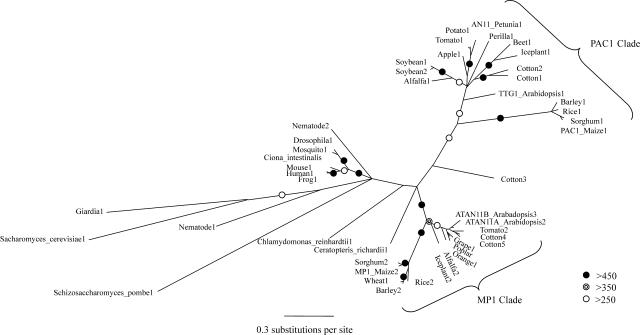
Phylogenetic Relationships of PAC1 and MP1 Homologs. Three major clades of PAC1 and MP1 homologs are apparent. The PAC1 clade consists of PAC1, AN11, and TTG1. The MP1 clade contains MP1, ATAN11A, and ATAN11B. A third clade consists of animal species within a grouping of non-plant species. The consensus unrooted tree is depicted, with leaf and branch lengths representing distance derived from maximum likelihood analysis. Leaves that were minimal in length have been exaggerated to emphasize position on branches. Five hundred trees were generated by bootstrapping. Number of trees supporting each branch point is as presented in the key, with the exception that branch points with <250 supporting trees are unmarked. The bar indicates a length representing 0.3 amino acid substitutions per site.

References

    1. Adachi, J., and Hasegawa, M. (1996). MOLPHY version 2.3: Programs for molecular phylogenetics based on maximum likelihood. Computer Science Monographs, No. 28. (Tokyo, Japan: Institute of Statistical Mathematics).
    1. Altschul, S.F., Madden, T.L., Schaffer, A.A., Zhang, J., Zhang, Z., Miller, W., and Lipman, D.J. (1997). Gapped BLAST and PSI-BLAST: A new generation of protein database search programs. Nucleic Acids Res. 25, 3389–3402. - PMC - PubMed
    1. Brown, D.E., Rashotte, A.M., Murphy, A.S., Normanly, J., Tague, B.W., Peer, W.A., Taiz, L., and Muday, G.K. (2001). Flavonoids act as negative regulators of auxin transport in vivo in arabidopsis. Plant Physiol. 126, 524–535. - PMC - PubMed
    1. Burr, F.A., Burr, B., Scheffler, B.E., Blewitt, M., Wienand, U., and Matz, E.C. (1996). The maize repressor-like gene intensifier1 shares homology with the r1/b1 multigene family of transcription factors and exhibits missplicing. Plant Cell 8, 1249–1259. - PMC - PubMed
    1. Chandler, V.L., Radicella, J.P., Robbins, T.P., Chen, J., and Turks, D. (1989). Two regulatory genes of the maize anthocyanin pathway are homologous: Isolation of B utilizing R genomic sequences. Plant Cell 1, 1175–1183. - PMC - PubMed

MeSH terms

LinkOut - more resources