. 2004 Feb;78(4):1706-17.
doi: 10.1128/jvi.78.4.1706-1717.2004.

Innate cellular response to virus particle entry requires IRF3 but not virus replication

Affiliations

Innate cellular response to virus particle entry requires IRF3 but not virus replication

Susan E Collins et al. J Virol. 2004 Feb.

Abstract

Mammalian cells respond to virus infections by eliciting both innate and adaptive immune responses. One of the most effective innate antiviral responses is the production of alpha/beta interferon and the subsequent induction of interferon-stimulated genes (ISGs), whose products collectively limit virus replication and spread. Following viral infection, interferon is produced in a biphasic fashion that involves a number of transcription factors, including the interferon regulatory factors (IRFs) 1, 3, 7, and 9. In addition, virus infection has been shown to directly induce ISGs in the absence of prior interferon production through the activation of IRF3. This process is believed to require virus replication and results in IRF3 hyperphosphorylation, nuclear localization, and proteasome-mediated degradation. Previously, we and others demonstrated that herpes simplex virus type 1 (HSV-1) induces ISGs and an antiviral response in fibroblasts in the absence of both interferon production and virus replication. In this report, we show that the entry of enveloped virus particles from diverse virus families elicits a similar innate response. This process requires IRF3, but not IRF1, IRF7, or IRF9. Following virus replication, the large DNA viruses HSV-1 and vaccinia virus effectively inhibit ISG mRNA accumulation, whereas the small RNA viruses Newcastle disease virus, Sendai virus, and vesicular stomatitis virus do not. In addition, we found that IRF3 hyperphosphorylation and degradation do not correlate with ISG and antiviral state induction but instead serve as a hallmark of productive virus replication, particularly following a high-multiplicity infection. Collectively, these data suggest that virus entry triggers an innate antiviral response mediated by IRF3 and that subsequent virus replication results in posttranslational modification of IRF3, such as hyperphosphorylation, depending on the nature of the incoming virus.


Figures
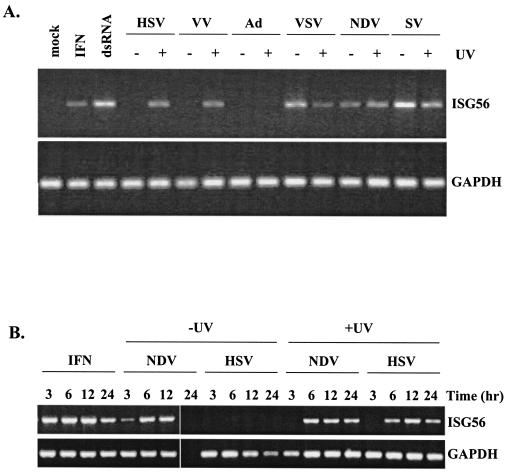
FIG. 1.
FIG. 1.
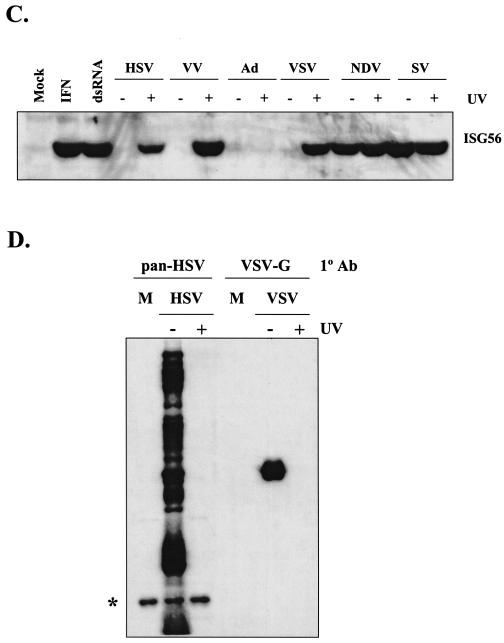
Induction of ISGs and a cellular antiviral state following virus infection does not require virus replication. HEL fibroblasts were left untreated (mock), treated with 1,000 U of human IFN-α per ml (IFN) or 100 μg of poly(I) · poly(C) per ml (dsRNA), or infected with wild-type or UV-inactivated virus. (A) Accumulation of ISG56 and GAPDH transcripts was determined by RT-PCR at 6 h posttreatment or postinfection. (B) Accumulation of ISG56 and GAPDH transcripts was determined by RT-PCR at different times posttreatment or postinfection. (C) Western blot analysis of 40 μg of whole-cell extract was performed at 12 h posttreatment or postinfection by use of a polyclonal ISG56 antibody. (D) Western blot analysis of the HSV and VSV samples from panel C with a pan-HSV-1 polyclonal antibody and a VSV-G monoclonal antibody to confirm the effectiveness of UV inactivation. *, location of a nonspecific band occurring with the pan-HSV-1 polyclonal antibody.
FIG. 1.
FIG. 1.
Induction of ISGs and a cellular antiviral state following virus infection does not require virus replication. HEL fibroblasts were left untreated (mock), treated with 1,000 U of human IFN-α per ml (IFN) or 100 μg of poly(I) · poly(C) per ml (dsRNA), or infected with wild-type or UV-inactivated virus. (A) Accumulation of ISG56 and GAPDH transcripts was determined by RT-PCR at 6 h posttreatment or postinfection. (B) Accumulation of ISG56 and GAPDH transcripts was determined by RT-PCR at different times posttreatment or postinfection. (C) Western blot analysis of 40 μg of whole-cell extract was performed at 12 h posttreatment or postinfection by use of a polyclonal ISG56 antibody. (D) Western blot analysis of the HSV and VSV samples from panel C with a pan-HSV-1 polyclonal antibody and a VSV-G monoclonal antibody to confirm the effectiveness of UV inactivation. *, location of a nonspecific band occurring with the pan-HSV-1 polyclonal antibody.
FIG. 2.
FIG. 2.
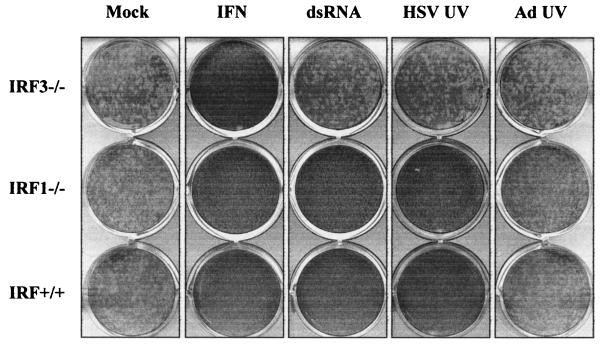
IRF3 is essential for induction of an antiviral state in fibroblasts in response to dsRNA or enveloped virus particles. MEFs derived from wild-type (IRF+/+), IRF1 null (IRF1−/−), or IRF3 null (IRF3−/−) mice were left untreated (mock), treated with 100 U of universal IFN-α/β per ml or 100 μg of poly(I) · poly(C) per ml (dsRNA), or infected with UV-inactivated HSV-1 or Ad. A wild-type VSV virus plaque reduction assay was performed 12 h later.
FIG. 3.
FIG. 3.
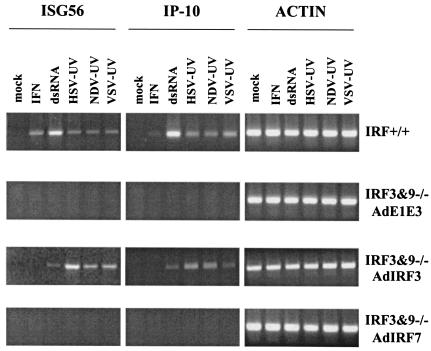
IRF3 is necessary to restore ISG induction in the absence of virus replication and IFN production. Wild-type (IRF+/+) MEFs were mock infected and IRF3−/− IRF9−/− MEFs (IRF3&9−/−) were infected with AdE1E3, AdIRF3, or AdIRF7 at a multiplicity of infection of 10. Twelve hours later, monolayers were treated with 100 U of universal IFN-α/β per ml or 100 μg of poly(I) · poly(C) per ml (dsRNA) or were infected with UV-inactivated HSV-1, NDV, or VSV. RT-PCR analysis was performed 6 h later to assess levels of ISG56, IP-10, and actin transcripts.
FIG. 4.
FIG. 4.
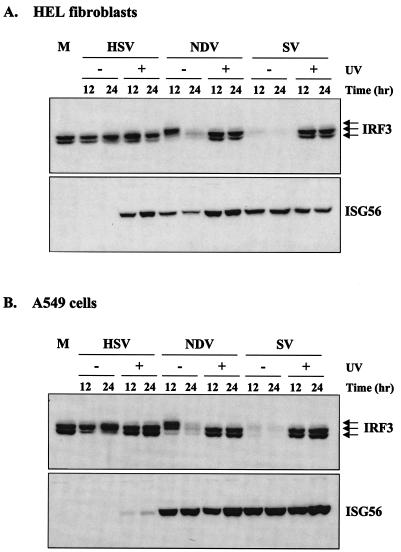
ISG56 protein production does not require virus replication and does not correlate with IRF3 hyperphosphorylation. Untransformed HEL fibroblasts (A) or immortalized A549 cells (B) were left untreated (M) or infected with wild-type or UV-inactivated HSV, NDV, or SV. Whole-cell extracts were harvested at 12 or 24 h postinfection, and 40 μg of sample was run on an sodium dodecyl sulfate-9% polyacrylamide gel electrophoresis (SDS-9% PAGE) gel, followed by Western blot analysis. All blots were reprobed with an antibody against β-actin to ensure equal loading (data not shown).
FIG. 5.
FIG. 5.
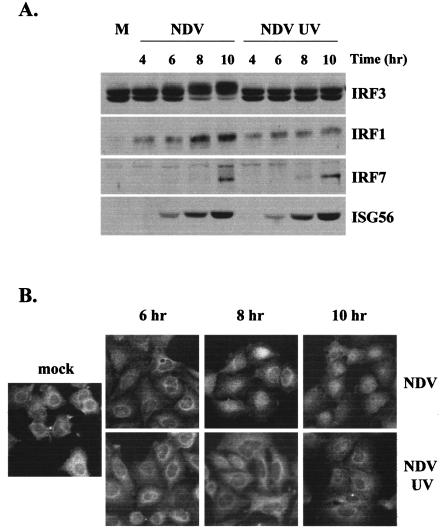
ISG induction does not correlate with IRF3 hyperphosphorylation or nuclear translocation. A549 cells were left untreated (M) or infected with wild-type or UV-inactivated NDV. (A) Whole-cell extracts were harvested at the indicated times postinfection, and 40 μg of sample was run on an SDS-9% PAGE gel, followed by Western blot analysis using antibodies specific for IRF3, IRF1, IRF7, or ISG56. (B) Immunofluorescence was performed with methanol-fixed A549 cells with an antibody specific for IRF3.
FIG. 6.
FIG. 6.
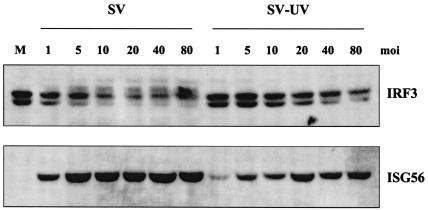
Low-multiplicity SV infection induces ISG56 in the absence of detectable IRF3 hyperphosphorylation. A549 cells were infected with replication-competent and UV-inactivated SV at the indicated multiplicities of infection (HAU per 106 cells). Whole-cell extracts were harvested at 8 h postinfection, and 40 μg of sample was run on an SDS-9% PAGE gel, followed by Western blot analysis using antibodies specific for IRF3 and ISG56.
FIG. 7.
FIG. 7.
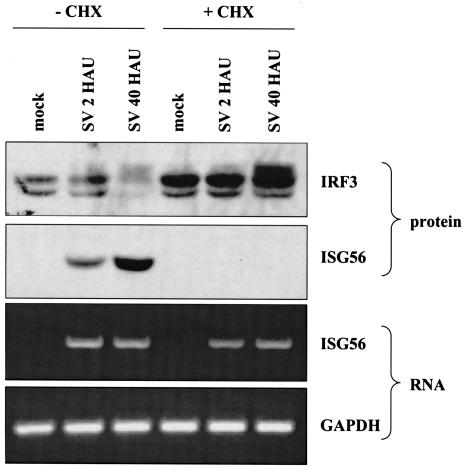
IRF3 is differentially modified following low- and high-multiplicity infections in the presence or absence of de novo protein synthesis. A549 cells were either mock infected or infected with SV at a low (2 HAU per 106 cells) or high (40 HAU per 106 cells) multiplicity of infection in the presence or absence of 100 μg of cycloheximide (CHX) per ml. Whole-cell extracts and total RNA were harvested at 8 h postinfection for use in Western blot and RT-PCR analyses, respectively.

References

    1. Bandyopadhyay, S. K., G. T. Leonaard, T. Bandyopadhyay, G. R. Stark, and G. C. Sen. 1995. Transcriptional induction by double-stranded RNA is mediated by interferon-stimulated response elements without activation of interferon-stimulated gene factor 3. J. Biol. Chem. 270:19624-19629. - PubMed
    1. Barnes, B., B. Lubyova, and P. M. Pitha. 2002. On the role of IRF in host defense. J. Interferon Cytokine Res. 22:59-71. - PubMed
    1. Basler, C. F., A. Mikulasova, L. Martinez-Sobrido, J. Paragas, E. Muhlberger, M. Bray, H. D. Klenk, P. Palese, and A. Garcia-Sastre. 2003. The Ebola virus VP35 protein inhibits activation of interferon regulatory factor 3. J. Virol. 77:7945-7956. - PMC - PubMed
    1. Basler, C. F., X. Wang, E. Muhlberger, V. Volchkov, J. Paragas, H. D. Klenk, A. Garcia-Sastre, and P. Palese. 2000. The Ebola virus VP35 protein functions as a type I IFN antagonist. Proc. Natl. Acad. Sci. USA 97:12289-12294. - PMC - PubMed
    1. Bett, A., W. Haddara, L. Prevec, and F. Graham. 1994. An efficient and flexible system for construction of adenovirus vectors with insertions or deletions in early regions 1 and 3. Proc. Natl. Acad. Sci. USA 91:8802-8806. - PMC - PubMed

Publication types

MeSH terms