


Modulation of multiple ethanol withdrawal-induced anxiety-like behavior by CRF and CRF1 receptors
- PMID: 14751471
- PMCID: PMC2864717
- DOI: 10.1016/j.pbb.2003.11.010
Modulation of multiple ethanol withdrawal-induced anxiety-like behavior by CRF and CRF1 receptors
Abstract
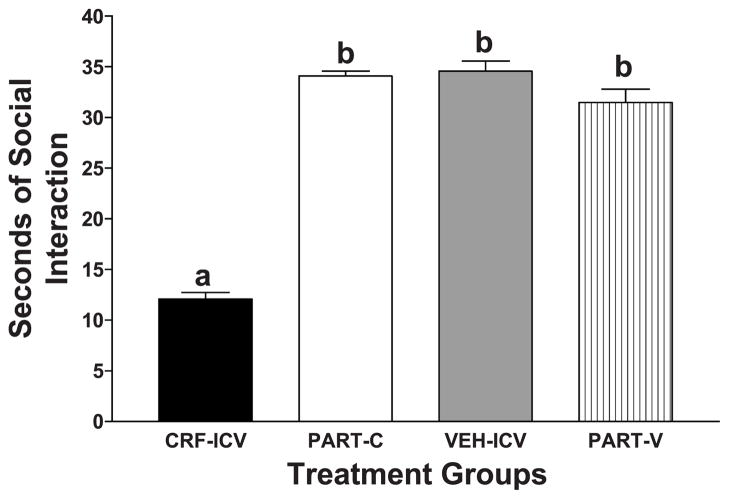
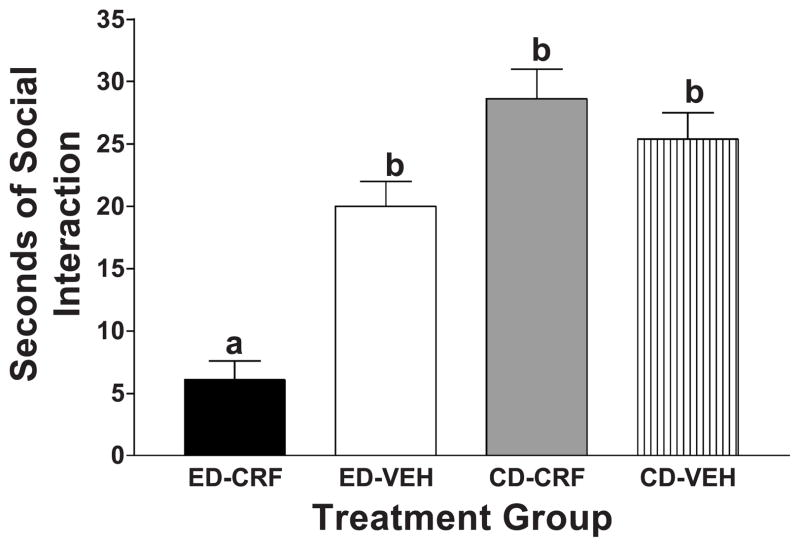
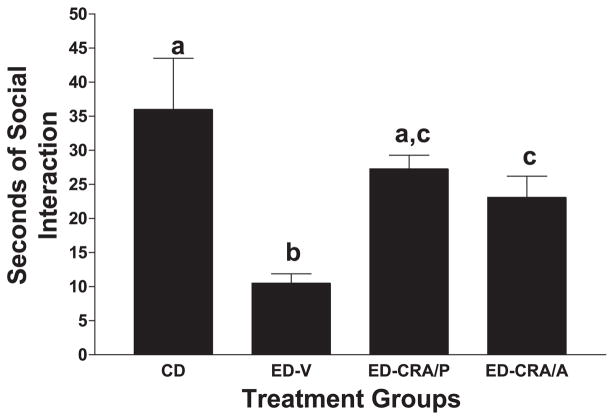
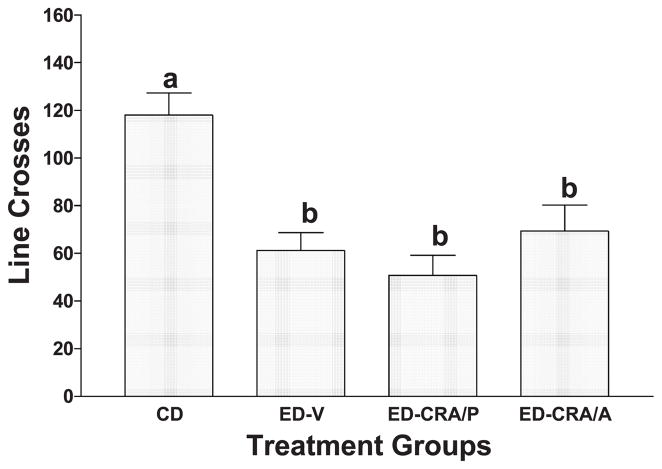
Previous work demonstrated that rats subjected to multiple withdrawals from chronic ethanol exhibit a sensitization of anxiety-like behavior compared to animals withdrawn from treatment with an equal but continuous amount of ethanol. This study sought to examine whether corticotropin-releasing factor (CRF) could modulate this ethanol-withdrawal-induced anxiety-like behavior. Initially, rats were administered with CRF (1 microg) or vehicle intraventricularly on two occasions 5 days apart while on control diet (CD) followed by exposure to 7% ethanol diet (ED) for 5 days, with social interaction assessed 5 h into withdrawal. Social interaction was significantly reduced in the CRF-treated animals compared to vehicle-treated rats and vehicle- and CRF-treated rats maintained on CD, indicative that CRF given before ethanol exposure was capable of inducing an adaptive change that sensitized withdrawal-induced anxiety-like behavior. Next, the CRF(1) receptor antagonist CRA1000 (3 mg/kg, systemically), the CRF(2) receptor antagonist antisauvagine-30 (20 microg intraventricularly), or vehicle was injected 4 h after the ethanol was removed following the first and second cycles of chronic ethanol exposure and the effect on the multiple-withdrawal-induced anxiety-like behavior determined after the third withdrawal cycle. The CRF(1) receptor antagonist blocked the reduced social interaction behavior, whereas the CRF(2) receptor antagonist was without effect. Similar pretreatment with another CRF(1) receptor antagonist CP-154,526 (10 mg/kg systemically) during the first and second withdrawals also counteracted anxiety-like behavior. These findings indicate that the CRF system and CRF(1) receptors play key roles in the adaptive change responsible for the anxiety-like behavior induced by repeated withdrawals from chronic ethanol.
Figures
References
-
- Andrews N, File SE, Fernandes C, Gonzalez LE, Barnes NM. Evidence that the median raphe nucleus–dorsal hippocampal pathway mediates diazepam withdrawal-induced anxiety. Psychopharmacology. 1997;130:228–34. - PubMed
-
- Archer J. Tests for emotionality in rats and mice. A review Anim Behav. 1973;21:205–35. - PubMed
-
- Barnes NM, Costall B, Kelly ME, Onaivi ES, Naylor RH. Ketotifen and its analogues reduce aversive responding in the rodent. Pharmacol Biochem Behav. 1990;37:785–93. - PubMed
-
- Battacharya SK, Satyan KS, Chakraharti A. Anxiogenic action of caffeine: an experimental study in rats. J Psychopharmacol. 1997;11:219–24. - PubMed
-
- Blizard DA, Adams N. The Maudsley reactive and nonreactive strains: a new perspective. Behav Genet. 2002;32:277–99. - PubMed
Publication types
MeSH terms
Substances
Grants and funding
LinkOut - more resources
Full Text Sources
Medical
Miscellaneous
