


Review
doi: 10.1172/JCI20986.
Central role of the P2Y12 receptor in platelet activation
Affiliations
- PMID: 14755328
- PMCID: PMC324551
- DOI: 10.1172/JCI20986
Item in Clipboard
Review
Central role of the P2Y12 receptor in platelet activation
J Clin Invest.
2004 Feb.
Abstract
Platelet activation occurs in response to vessel injury and is important for the arrest of bleeding. Platelet activation during disease states leads to vascular occlusion and ischemic damage. The P2Y(12) receptor, activated by ADP, plays a central role in platelet activation and is the target of P2Y(12) receptor antagonists that have proven therapeutic value.
Figures
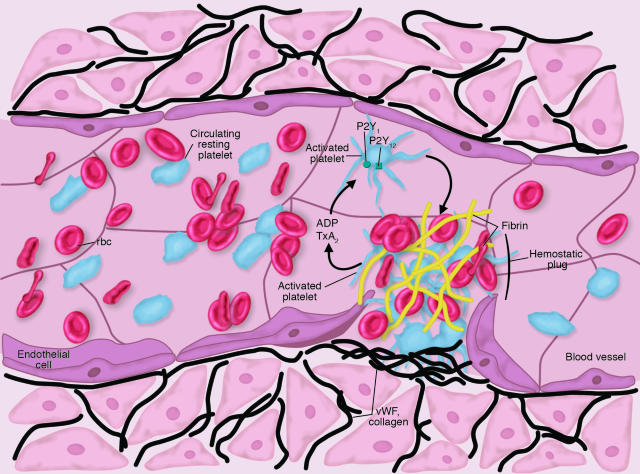
The hemostatic process. Upon vessel injury, platelets roll and become tethered to the vessel wall by interactions with vWF and collagen (noted as black strands). These interactions cause platelet shape change, and release of ADP from dense granules. The activated platelet also generates thromboxane A2 (TxA2). Both ADP and TxA2 are agonists that cause further platelet activation and accumulation of platelets at the site of injury. Vessel injury also causes exposure of tissue factor, which catalyzes the coagulation response. This response results in the formation of thrombin, which further activates platelets and cleaves fibrinogen to form fibrin. The combination of activated platelets and fibrin at the site of injury forms a stable hemostatic plug that arrests bleeding.
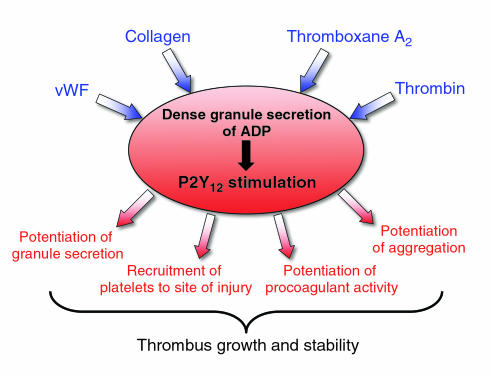
The central role of the P2Y12 receptor in platelet activation. Exposure of platelets to vWF and collagen results in the adhesion of platelets and subsequent release of ADP from dense granules. Similarly, activation of platelets by thrombin or thromboxane A2 also results in release of ADP. Secreted ADP activates the P2Y12 receptor (as depicted) and the P2Y1 receptor (not shown). P2Y12 receptor activation likely affects thrombus growth and stability by recruiting platelets to the site of injury, and by potentiating dense granule release, procoagulant activity, and aggregation.
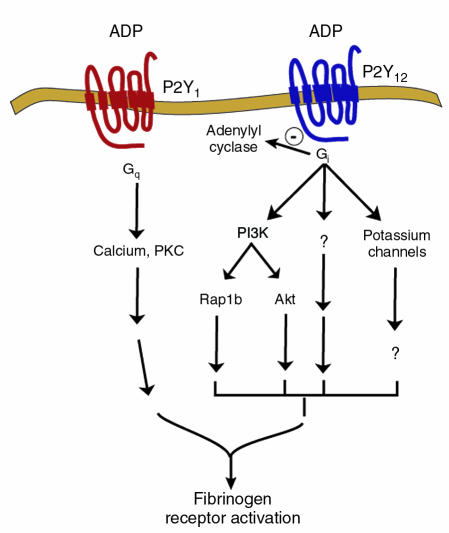
Intracellular signaling events downstream of the P2Y1 and P2Y12 receptors. ADP binds to the P2Y12 receptor and causes a number of intracellular signaling events downstream of the Gi pathway that contribute to fibrinogen receptor activation and platelet aggregation. The P2Y12 receptor–mediated inhibition of adenylyl cyclase is not directly responsible for fibrinogen receptor activation. Potassium channels and PI3K are also activated by the P2Y12 receptor. Both Rap1b and Akt are signaling mediators that contribute to platelet aggregation and are activated in a PI3K-dependent manner. Other mediators of P2Y12 signaling remain to be elucidated.
References
-
- Jackson SP, Nesbitt WS, Kulkarni S. Signaling events underlying thrombus formation. J. Thromb. Haemost. 2003;1:1602–1612. - PubMed
-
- Kunapuli SP, et al. ADP receptors: targets for developing antithrombotic agents. Curr. Pharm. Des. 2003;9:2303–2316. - PubMed
-
- Paul BZ, et al. Dynamic regulation of microtubule coils in ADP-induced platelet shape change by p160ROCK (Rho-kinase) Platelets. 2003;14:159–169. - PubMed
-
- Brass LF, Manning DR, Cichowski K, Abrams CS. Signaling through G proteins in platelets: to the integrins and beyond. Thromb. Haemost. 1997;78:581–589. - PubMed
Publication types
MeSH terms
Substances
LinkOut - more resources
Full Text Sources
Other Literature Sources
