. 2004 Feb;186(4):1165-74.
doi: 10.1128/JB.186.4.1165-1174.2004.

clpB, a novel member of the Listeria monocytogenes CtsR regulon, is involved in virulence but not in general stress tolerance

Affiliations

clpB, a novel member of the Listeria monocytogenes CtsR regulon, is involved in virulence but not in general stress tolerance

Arnaud Chastanet et al. J Bacteriol. 2004 Feb.

Abstract

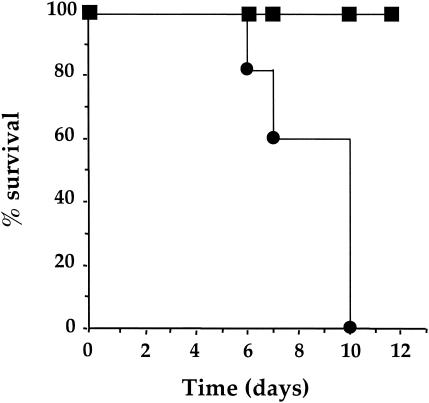
Clp-HSP100 ATPases are a widespread family of ubiquitous proteins that occur in both prokaryotes and eukaryotes and play important roles in the folding of newly synthesized proteins and refolding of aggregated proteins. They have also been shown to participate in the virulence of several pathogens, including Listeria monocytogenes. Here, we describe a member of the Clp-HSP100 family of L. monocytogenes that harbors all the characteristics of the ClpB subclass, which is absent in the closely related gram-positive model organism, Bacillus subtilis. Transcriptional analysis of clpB revealed a heat shock-inducible sigma(A)-type promoter. Potential binding sites for the CtsR regulator of stress response were identified in the promoter region. In vivo and in vitro approaches were used to show that expression of clpB is repressed by CtsR, a finding indicating that clpB is a novel member of the L. monocytogenes CtsR regulon. We showed that ClpB is involved in the pathogenicity of L. monocytogenes since the DeltaclpB mutant is significantly affected by virulence in a murine model of infection; we also demonstrate that this effect is apparently not due to a defect in general stress resistance. Indeed, ClpB is not involved in tolerance to heat, salt, detergent, puromycin, or cold stress, even though its synthesis is inducible by heat shock. However, ClpB was shown to play a role in induced thermotolerance, allowing increased resistance of L. monocytogenes to lethal temperatures. This work gives the first example of a clpB gene directly controlled by CtsR and describes the first role for a ClpB protein in induced thermotolerance and virulence in a gram-positive organism.


Figures

FIG. 1.
FIG. 1.
Alignment of the ClpB amino acid sequence of L. monocytogenes with those of E. coli and L. lactis. Numbers indicate positions in the amino acid sequence. Identical residues are shaded. The conserved nucleotide-binding regions are boxed. Conserved Walker motifs (A box and B box) and predicted ClpN and coiled-coil motifs are overlined.
FIG. 2.
FIG. 2.
clpB is negatively regulated by CtsR in the heterologous host B. subtilis. Levels of expression of clpB-bgaB (strain QB8060, clpB-bgaB ΔctsR pxylctsRLmo) in LB medium at 37°C in the presence (□) or absence (▪) of xylose are shown. Symbols indicate β-galactosidase activities expressed as Miller units/mg of protein as a function of time.
FIG. 3.
FIG. 3.
(A) Primer extension analysis of clpB expression at 37°C (lanes 1 and 2) or following a 10-min heat shock at 42°C (lanes 3 and 4). Total RNA (20 μg) extracted from L. monocytogenes L028 (lanes 1 and 3) and LM2001 (ΔctsR) (lanes 2 and 4), was used as a template for reverse transcriptase. The corresponding DNA sequence is shown on the left. (B) Nucleotide sequence of the L. monocytogenes L028 clpB promoter region. Potential −35 and −10 promoter sequences are overlined; the transcriptional start site is indicated by +1; the CtsR direct-repeat operator sequence is indicated by arrows; the potential RBS sequence is underlined; the translational start site is boxed, and the deduced amino acid sequence is indicated below the nucleotide sequence.
FIG. 4.
FIG. 4.
(A) CtsR binds specifically to the clpB promoter region. DNA-binding reactions were performed with radiolabeled DNA fragments (10,000 cpm) corresponding to the clpB promoter region. Lane 1, no protein; lane 2, 7 ng; lane 3, 70 ng; lane 4, 700 ng. (B and C) DNase I footprinting analysis of CtsR binding to the clpB promoter region. Each lane contains 50,000 cpm of radiolabeled DNA fragment corresponding to the nontemplate strand (panel B) or the template strand (panel C) of the L. monocytogenes clpB promoter region. Fragments were incubated with increasing amounts of purified CtsR. Lane 1, no protein; lane 2, 35 ng; lane 3, 350 ng; lane 4, 3,500 ng; lane 5, Maxam and Gilbert reactions of the corresponding DNA fragment. Brackets indicate regions protected by CtsR. (D) Nucleotide sequence of the clpB promoter region. The DNase I protected area is boxed, and arrows indicate the CtsR direct-repeat recognition sequence. Positions are numbered relative to the translational initiation codon.
FIG. 5.
FIG. 5.
ClpB is involved in virulence of L. monocytogenes. Survival curves for Swiss mice after intravenous inoculation with 5 × 10⁵ bacteria of the wild-type L028 (•) or the mutant strain ΔclpB (▪) are shown.
FIG. 6.
FIG. 6.
ClpB is not required for stress resistance. The L028 wild-type (WT) strain and the ΔclpB mutant strain were grown exponentially at 37°C with aeration in BHI medium until the OD600 reached 0.3. The culture was divided into two parts, one of which was subjected to various stresses. Stresses assayed were temperature shifts to 42, 44, 48, or 55°C; addition of puromycin to a final concentration of 15 (pmc15), 30 (pmc30), or 60 (pmc60) μg/ml; 0.01% SDS; or 2% NaCl. Values represent the percentage of cell growth with respect to the control culture performed in the absence of stress (grown in BHI at 37°C) 2 h after the stress was applied. In all cases, there was no significant difference in the growth curves between the wild-type and the mutant strains.
FIG. 7.
FIG. 7.
ClpB is required for induced thermotolerance. Cultures of wild-type L028 and ΔclpB mutant strains were grown exponentially until the OD600 reached 0.3. Half of the culture was preincubated for 20 min at the nonlethal temperature of 48°C, while the other half was maintained at 37°C. After preincubation, both cultures were incubated at 60°C, and cell survival was evaluated by plating diluted aliquots. White bars indicate CFU values before incubation at 60°C; black bars indicate CFU values after 5 min of stress.

References

    1. Allan, E., P. Mullany, and S. Tabaqchali. 1998. Construction and characterization of a Helicobacter pylori clpB mutant and role of the gene in the stress response. J. Bacteriol. 180:426-429. - PMC - PubMed
    1. Badger, J. L., B. M. Young, A. J. Darwin, and V. L. Miller. 2000. Yersinia enterocolitica ClpB affects levels of invasin and motility. J. Bacteriol. 182:5563-5571. - PMC - PubMed
    1. Barnett, M. E., A. Zolkiewska, and M. Zolkiewski. 2000. Structure and activity of ClpB from Escherichia coli. Role of the amino- and carboxyl-terminal domains. J. Biol. Chem. 275:37565-37571. - PMC - PubMed
    1. Chastanet, A., J. Fert, and T. Msadek. 2003. Comparative genomics reveal novel heat shock regulatory mechanisms in Staphylococcus aureus and other gram-positive bacteria. Mol. Microbiol. 47:1061-1073. - PubMed
    1. Chastanet, A., M. Prudhomme, J. P. Claverys, and T. Msadek. 2001. Regulation of Streptococcus pneumoniae clp genes and their role in competence development and stress survival. J. Bacteriol. 183:7295-7307. - PMC - PubMed

Publication types

LinkOut - more resources