Review
. 2004 Jul;53(7):567-79.
doi: 10.1007/s00262-003-0494-4. Epub 2004 Feb 5.

CD44v6: a target for antibody-based cancer therapy

Affiliations
Review

CD44v6: a target for antibody-based cancer therapy

Karl-Heinz Heider et al. Cancer Immunol Immunother. 2004 Jul.

Abstract

The human CD44 gene encodes type 1 transmembrane glycoproteins involved in cell-cell and cell-matrix interactions. The structural heterogeneity of the gene products is caused primarily by alternative splicing of at least 10 out of 20 exons. Certain CD44 variant isoforms, in particular those containing CD44 variant domain 6 (CD44v6), have been implicated in tumourigenesis, tumour cell invasion and metastasis. Here we will give an overview of immunohistochemically determined CD44v6 expression in human malignancies (primary epithelial and nonepithelial tumours as well as metastases) and normal tissues, and review several examples of the clinical use of CD44v6-specific antibodies. In nonmalignant tissues, CD44v6 expression is essentially restricted to a subset of epithelia. Intense and homogeneous expression of CD44v6 was reported for the majority of squamous cell carcinomas and a proportion of adenocarcinomas of differing origin, but was rarely seen in nonepithelial tumours. This expression pattern has made CD44v6 an attractive target for antibody-guided therapy of various types of epithelium-derived cancers.


Figures

Fig. 1A, B
Fig. 1A, B
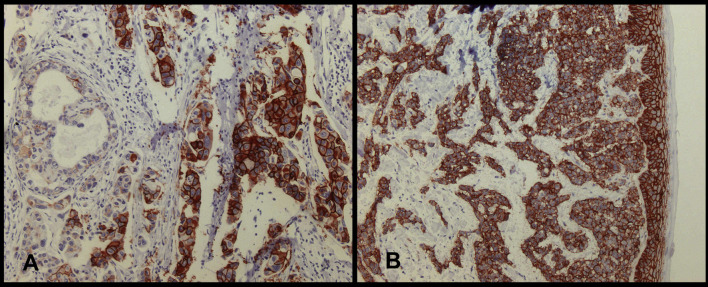
Immunostaining of CD44v6 with mAb VFF18 in formalin-fixed specimens from patients with invasive ductal breast cancer. A In addition to distinct membrane staining, cytoplasmic staining can also be observed in part of the tumour cells. Note the heterogeneous staining of the tumour cells with about 30% of cells displaying no reactivity with the antibody. B CD44v6 expression in normal skin keratinocytes adjacent to the tumour. Counter stain haematoxylin, original magnification x200
Fig. 2
Fig. 2
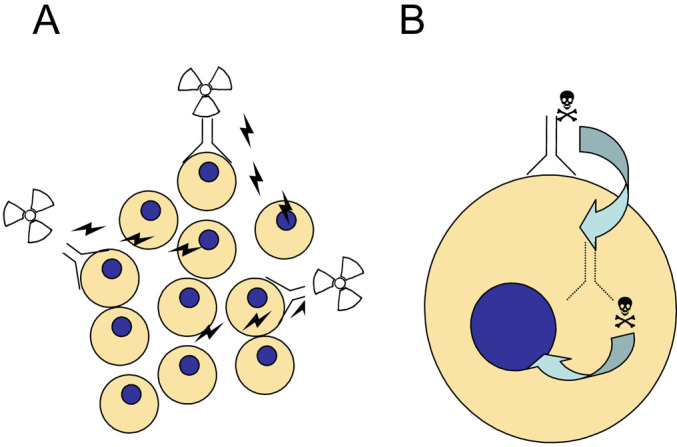
Scheme of CD44v6 antibody-based cancer therapy. A: Radioimmunotherapy with an anti-CD44v6 radioimmunoconjugate. The therapeutic radionuclide (e.g. 186Re) is coupled to the antibody via linker technology. The radioimmunoconjugate binds to CD44v6-positive tumour cells and may kill both antigen-positive and antigen-negative or inaccessible tumour cells. B: Antibody-drug conjugates may consist of the CD44v6-specific antibody covalently linked to a potent cytotoxic drug (e.g. a maytansinoid). After binding to CD44v6 on the cell surface the conjugate gets internalised. Inside the cell, the drug is released from the antibody and consequently can bind to its intracellular target, e.g. tubulin

References

    1. Aruffo Cell. 1990;61:1303. - PubMed
    1. Aruffo J Clin Invest. 1996;98:2191. - PMC - PubMed
    1. Ayhan Gynecol Oncol. 2001;83:569. - PubMed
    1. Ayhan Gynecol Oncol. 2001;80:355. doi: 10.1006/gyno.2000.6014. - DOI - PubMed
    1. Beham-Schmid J Pathol. 1998;186:383. doi: 10.1002/(SICI)1096-9896(199812)186:4<383::AID-PATH202>3.3.CO;2-1. - DOI - PubMed

LinkOut - more resources