


Training the next generation of informaticians: the impact of "BISTI" and bioinformatics--a report from the American College of Medical Informatics
- PMID: 14764617
- PMCID: PMC400513
- DOI: 10.1197/jamia.M1520
Training the next generation of informaticians: the impact of "BISTI" and bioinformatics--a report from the American College of Medical Informatics
Abstract
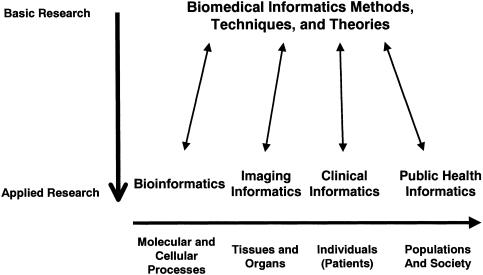
In 2002-2003, the American College of Medical Informatics (ACMI) undertook a study of the future of informatics training. This project capitalized on the rapidly expanding interest in the role of computation in basic biological research, well characterized in the National Institutes of Health (NIH) Biomedical Information Science and Technology Initiative (BISTI) report. The defining activity of the project was the three-day 2002 Annual Symposium of the College. A committee, comprised of the authors of this report, subsequently carried out activities, including interviews with a broader informatics and biological sciences constituency, collation and categorization of observations, and generation of recommendations. The committee viewed biomedical informatics as an interdisciplinary field, combining basic informational and computational sciences with application domains, including health care, biological research, and education. Consequently, effective training in informatics, viewed from a national perspective, should encompass four key elements: (1). curricula that integrate experiences in the computational sciences and application domains rather than just concatenating them; (2). diversity among trainees, with individualized, interdisciplinary cross-training allowing each trainee to develop key competencies that he or she does not initially possess; (3). direct immersion in research and development activities; and (4). exposure across the wide range of basic informational and computational sciences. Informatics training programs that implement these features, irrespective of their funding sources, will meet and exceed the challenges raised by the BISTI report, and optimally prepare their trainees for careers in a field that continues to evolve.
Figures
References
-
- BISTI. The Biomedical Information Science and Technology Initiative. Bethesda, MD: National Institutes of Health. Available at: http://www.nih.gov/about/director/060399.htm. June 1999. Accessed: Feb 25, 2004.
Publication types
MeSH terms
Grants and funding
LinkOut - more resources
Full Text Sources
