. 2004 Feb;70(2):1097-103.
doi: 10.1128/AEM.70.2.1097-1103.2004.

Aquatic plants stimulate the growth of and biofilm formation by Mycobacterium ulcerans in axenic culture and harbor these bacteria in the environment

Affiliations

Aquatic plants stimulate the growth of and biofilm formation by Mycobacterium ulcerans in axenic culture and harbor these bacteria in the environment

Laurent Marsollier et al. Appl Environ Microbiol. 2004 Feb.

Abstract

Mycobacterium ulcerans is the causative agent of Buruli ulcer, one of the most common mycobacterial diseases of humans. Recent studies have implicated aquatic insects in the transmission of this pathogen, but the contributions of other elements of the environment remain largely unknown. We report here that crude extracts from two green algae added to the BACTEC 7H12B culture medium halved the doubling time of M. ulcerans and promoted biofilm formation. Using the 7H12B medium, modified by the addition of the algal extract, and immunomagnetic separation, we also demonstrate that M. ulcerans is associated with aquatic plants in an area of the Ivory Coast where Buruli ulcer is endemic. Genotype analysis showed that plant-associated M. ulcerans had the same profile as isolates recovered in the same region from both aquatic insects and clinical specimens. These observations implicate aquatic plants as a reservoir of M. ulcerans and add a new potential link in the chain of transmission of M. ulcerans to humans.


Figures
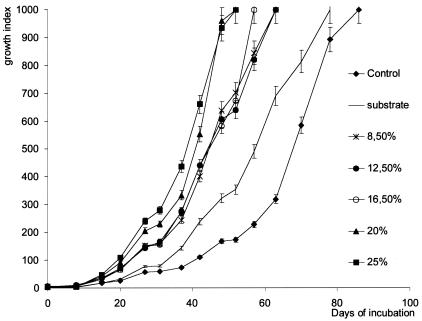
FIG. 1.
FIG. 1.
Kinetics of growth of M. ulcerans (strain 1G897) in 7H12B medium in the presence of various quantities of algal extract from the Rhizoclonium sp. (3.5 to 25%, vol/vol). Each point is the mean ± standard error for five vials per time point.
FIG. 2.
FIG. 2.
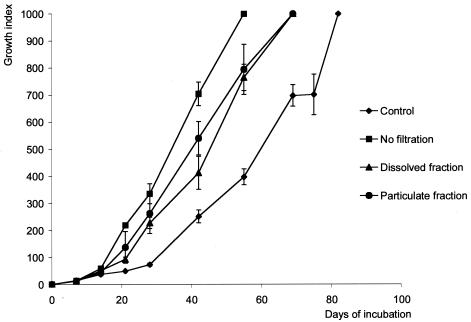
Kinetics of M. ulcerans (strain 1G897) growth, comparing filtered with nonfiltered preparations of the Rhizoclonium sp. Twenty-five percent (vol/vol) extract obtained from the Rhizoclonium sp. was added to 7H12B medium after filtration through membranes of 0.22-μm porosity. Each point is the mean ± standard error of five vials per time point.
FIG. 3.
FIG. 3.
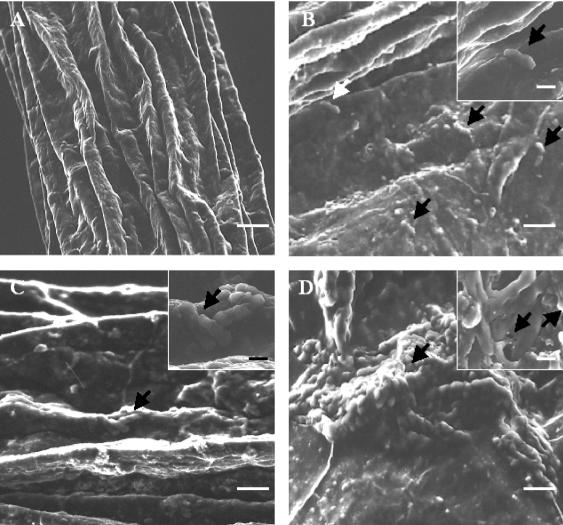
Formation of M. ulcerans biofilm on the Rhizoclonium sp. M. ulcerans was cultured in 7H12B vials supplemented by 25% (vol/vol) Rhizoclonium sp. extract. (A) Filaments of algae alone. (B) After 12 h, some individual bacilli (arrows) were attached on alga filaments. (C) After 15 days, the bacteria had multiplied and formed small clusters (arrow). (D) By day 40, large clusters of bacilli were forming (arrow) and evolving into microcolonies. Arrows in the insets, extracellular matrix. Scale bars: 30 (A), 2.5 (B, C, and insets), and 10 (D) μm.
FIG. 4.
FIG. 4.
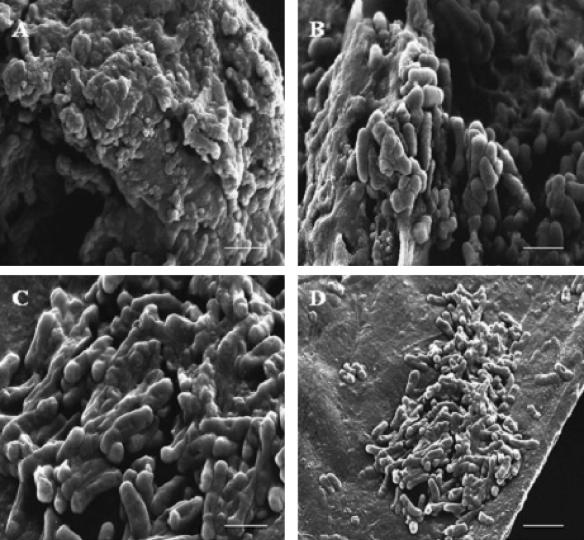
Formation of biofilms by four environmental mycobacteria on the Rhizoclonium sp. The mycobacteria were cultured in 7H12B vials supplemented by 25% (vol/vol) Rhizoclonium sp. extract for 25 days. (A) M. fortuitum biofilm; (B) M. chelonei biofilm; (C) M. marinum biofilm; (D) M. kansasii biofilm. Scale bars: 4 (A to C) and 10 (D) μm.
FIG. 5.
FIG. 5.
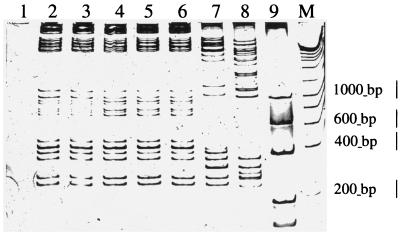
Silver-stained polyacrylamide gel showing the results of IS2426 PCR genotype analysis for M. ulcerans strains isolated from environmental and clinical sources. Lane identification is as follows. Lane 1, M. szulgai plant isolate; lane 2; M. ulcerans or M. szulgai plant isolate; lane 3, M. ulcerans insect isolate (Nau. CI. 002); lane 4, M. ulcerans clinical isolate (7ICEF99; Ivory Coast); lane 5, M. ulcerans clinical isolate (75ICO99; Ivory Coast); lane 6, M. ulcerans clinical isolate (01EIHGA99; Ghana); lane 7, M. ulcerans clinical isolate (1615; Malaysia); lane 8, M. ulcerans clinical isolate (NCTC 10417; Australian); lane 9, M. ulcerans clinical isolate (1G897; French Guiana); lane M, molecular size marker (Eurogentec).

References

    1. American Public Health Association. 1995. Standard methods for the examination of water and wastewater, 19th ed. American Public Health Association, Washington, D.C.
    1. Asiedu, K., R. Sherpbier, and M. C. Raviglione. 2000. Buruli ulcer Mycobacterium ulcerans infection. W. H. O. Global Buruli Ulcer Initiative. Report 2000. World Health Organization, Geneva, Switzerland.
    1. Charackis, W. G. 1990. Kinetics of microbial transformation, p. 233-264. In W. G. Charackis and K. C. Marshall (ed.), Biofilms. Wiley, New York, N.Y.
    1. Costerton, J. W., Z. Lewandowski, D. E. Caldwell, D. R. Korber, and H. M. Lappin-Scott. 1995. Microbial biofilms. Annu. Rev. Microbiol. 49:711-745. - PubMed
    1. Danese, P. N., L. A. Pratt, and R. Kolter. 2000. Exopolysaccharide production is required for development of Escherichia coli K-12 biofilm architecture. J. Bacteriol. 182:3593-3596. - PMC - PubMed

Publication types

MeSH terms

LinkOut - more resources