Viable but nonculturable bacteria are present in mouse and human urine specimens
- PMID: 14766848
- PMCID: PMC344478
- DOI: 10.1128/JCM.42.2.753-758.2004
Viable but nonculturable bacteria are present in mouse and human urine specimens
Abstract
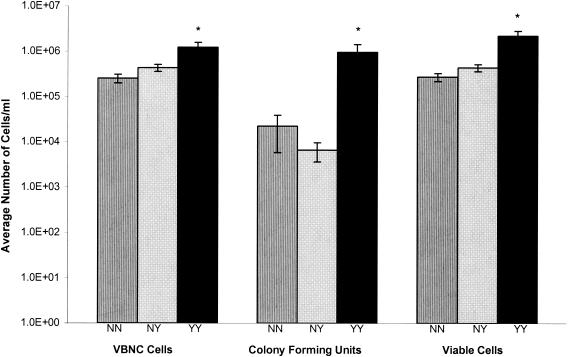
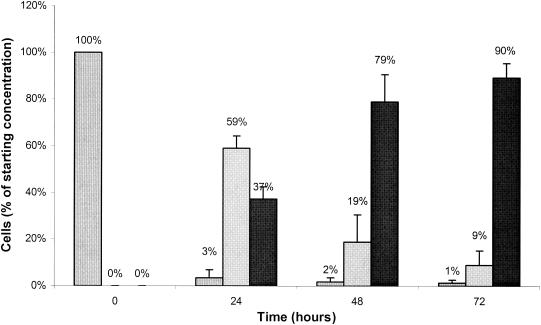
The presence of viable but nonculturable bacteria in human clean-catch and mouse bladder-isolated urine specimens was investigated. Viable but nonculturable bacteria are alive but do not give rise to visible growth under nonselective growth conditions. Urine specimens obtained from human female volunteers with or without an active urinary tract infection were found to contain, on average, significantly more viable than culturable forms of bacteria. Additional support for the presence of viable but nonculturable cells in urine specimens considered sterile was obtained from examination of urine specimens obtained directly from the bladder of healthy mice. Because the viability assay used to study the viable but nonculturable condition is by necessity growth independent, and hence indirect, the accuracy of this assay that scores cells with intact cell membranes as being viable was studied. Greater than 95% of Escherichia coli cells exposed to lethal doses of UV irradiation were found to lose their membrane integrity within a day, a time frame similar to that used to examine urine specimens. These data suggest that viable but nonculturable cells can occur within regions of the urinary tract previously considered sterile.
Figures
Comment in
-
The viable but nonculturable concept, bacteria in urine samples, and Occam's razor.J Clin Microbiol. 2004 Nov;42(11):5434; author reply 5434-5. doi: 10.1128/JCM.42.11.5434-5435.2004. J Clin Microbiol. 2004. PMID: 15528766 Free PMC article. No abstract available.
References
-
- Anderson, G. G., J. J. Palermo, J. D. Schilling, R. Roth, J. Heuser, and S. J. Hultgren. 2003. Intracellular bacterial biofilm-like pods in urinary tract infections. Science 301:105-107. - PubMed
-
- Appelbaum, P. C., and C. C. Olmstead. 1982. Evaluation of Gram-stain screen and Micro-ID methods for direct identification of Enterobacteriaceae from urine. Med. Microbiol. Immunol. 170:173-184. - PubMed
-
- Barnett, B. J., and D. S. Stephens. 1997. Urinary tract infection: an overview, Am. J. Med. Sci. 314:245-249. - PubMed
Publication types
MeSH terms
LinkOut - more resources
Full Text Sources
Medical