


doi: 10.1128/JCM.42.2.850-854.2004.
Identification of a new type of Babesia species in wild rats (Bandicota indica) in Chiang Mai Province, Thailand
Affiliations
- PMID: 14766871
- PMCID: PMC344436
- DOI: 10.1128/JCM.42.2.850-854.2004
Item in Clipboard
Identification of a new type of Babesia species in wild rats (Bandicota indica) in Chiang Mai Province, Thailand
J Clin Microbiol.
2004 Feb.
Abstract
A new type of rodent babesia, which resembled Babesia microti but was phylogenetically placed closest, with the highest level of statistical support, to Babesia canis, a canine babesia, was identified in Thai Bandicota indica in Thai provinces to which malaria is endemic. Close watch should be kept on human babesiosis in Thailand.
Figures
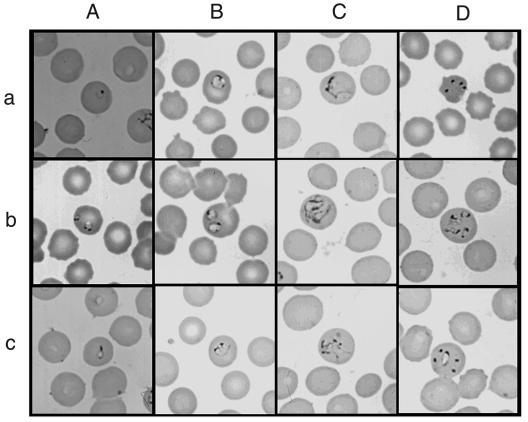
Photomicrographs of the Thai babesia on Giemsa-stained thin blood smear of babesia-positive Bandicota indica. (A) Panel a, a ring-shaped trophozoite consisting of a cytoplasmic rim with a chromatin dot; panel b, double infection of ring-shaped trophozoites with double chromatin dots and a vacuolated lesion on the cytoplasmic rim; panel c, a pyriform-shaped trophozoite. (B) Panel a, a large ring or annular form with three chromatin masses, two dot-like and one elongated; panel b, double infection of annular trophozoites; panel c, a trophozoite with bridge-like cytoplasms. (C) Panel a, an irregular large trophozoite; panel b, double infection of irregular large trophozoites; panel c, an irregular form with multiple chromatin dots. (D) Panel a, Maltese-cross-like form; panel b, four trophozoites, presumably developing independently; panel c, five trophozoites observed in one red blood cell.
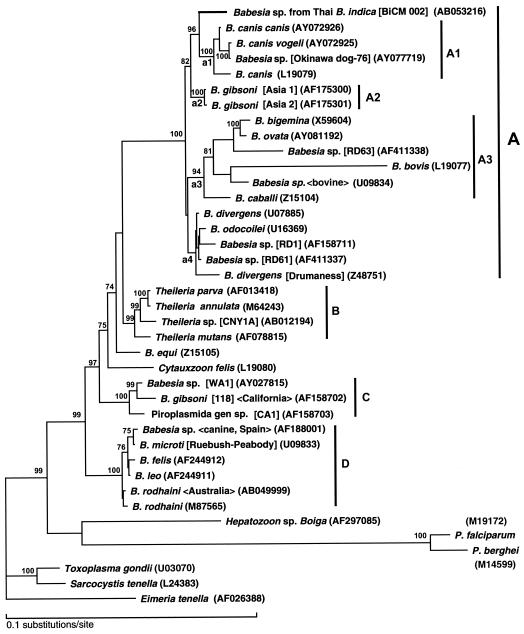
Phylogenetic tree of the SSUrDNA sequences of piroplasms. The best tree finally selected by the maximum-likelihood analysis is shown. Details of the phylogenetic analysis will be described elsewhere (A. Dantrakool, T. Hashimoto, A. Saito et al., unpublished data). Briefly, based on the result obtained by use of FASTA, in total 33 SSUrDNA sequences from Babesia spp., Theileria spp., Cytauxzoon spp., and unclassified piroplasms were included in the data set for the analysis, including the sequence of the Babesia spp. from Thai Bandicota indica. Two SSUrDNA sequences of Plasmodium spp. and the sequence of Hepatozoon sp. Boiga were added to the data set. Three sequences of other apicomplexan parasites, Toxoplasma gondii, Sarcocystis tenella, and Eimeria tenella, were also included as outgroups, and 1,378 unambiguously aligned positions were selected and used. Bootstrap proportions (percent) with more than 70% support are attached to the internal branches. Monophyletic groups and subgroups supported with more than 90% in the analysis are shown by vertical bars. The horizontal length of each branch is proportional to the estimated number of substitutions. GenBank accession numbers are given in parentheses. The name of the isolate, strain, clone or genotype is shown in brackets. The host origin or the isolation site is given within chevrons (<>).
References
-
- Dammin, G. S., A. Spielman, E. B. Mahoney, E. F. Bracker, and K. Kaplan. 1983. Clindamycin and quinine treatment for Babesia microti infections. Morb. Mortal. Wkly. Rep. 32:65-66, 72. - PubMed
-
- Friedhoff, K. T. 1997. Tick-borne diseases of sheep and goats caused by Babesia, Theileria or Anaplasma spp. Parassitologia 39:99-109. - PubMed
-
- Gorenflot, A., K. Moubri, E. Precigout, B. Carcy, and T. P. Schetters. 1998. Human babesiosis. Ann. Trop. Med. Parasitol. 92:489-501. - PubMed
-
- Lekagul, B., and A. M. Jeffrey. 1988. Mammals of Thailand, 2nd ed., p. 758. Damsutha Press, Bangkok, Thailand.
Publication types
MeSH terms
Substances
LinkOut - more resources
Full Text Sources
Molecular Biology Databases
