


Low acetylcholine during slow-wave sleep is critical for declarative memory consolidation
- PMID: 14766981
- PMCID: PMC357065
- DOI: 10.1073/pnas.0305404101
Low acetylcholine during slow-wave sleep is critical for declarative memory consolidation
Abstract
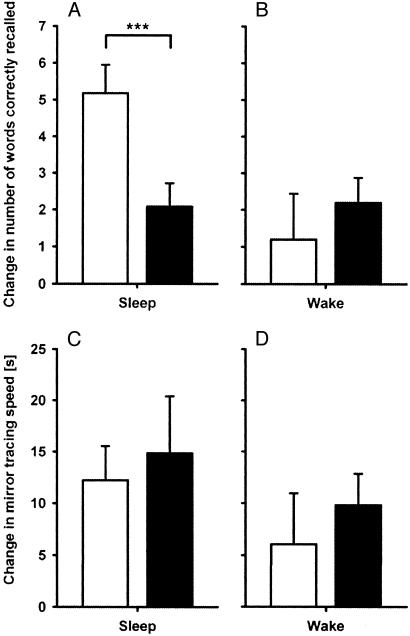
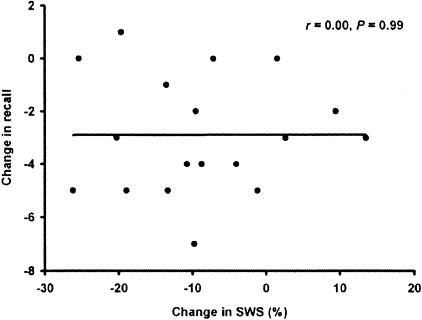
The neurotransmitter acetylcholine is considered essential for proper functioning of the hippocampus-dependent declarative memory system, and it represents a major neuropharmacological target for the treatment of memory deficits, such as those in Alzheimer's disease. During slow-wave sleep (SWS), however, declarative memory consolidation is particularly strong, while acetylcholine levels in the hippocampus drop to a minimum. Observations in rats led to the hypothesis that the low cholinergic tone during SWS is necessary for the replay of new memories in the hippocampus and their long-term storage in neocortical networks. However, this low tone should not affect nondeclarative memory systems. In this study, increasing central nervous cholinergic activation during SWS-rich sleep by posttrial infusion of 0.75 mg of the cholinesterase inhibitor physostigmine completely blocked SWS-related consolidation of declarative memories for word pairs in human subjects. The treatment did not interfere with consolidation of a nondeclarative mirror tracing task. Also, physostigmine did not alter memory consolidation during waking, when the endogenous central nervous cholinergic tone is maximal. These findings are in line with predictions that a low cholinergic tone during SWS is essential for declarative memory consolidation.
Figures
Comment in
-
Slow-wave sleep, acetylcholine, and memory consolidation.Proc Natl Acad Sci U S A. 2004 Feb 17;101(7):1795-6. doi: 10.1073/pnas.0400237101. Epub 2004 Feb 9. Proc Natl Acad Sci U S A. 2004. PMID: 14769926 Free PMC article. No abstract available.
References
-
- McGaugh, J. L. (2000) Science 287, 248-251. - PubMed
-
- Van Ormer, E. B. (1933) Psychol. Bull. 30, 415-439.
-
- Graves, E. A. (1936) J. Exp. Psychol. 19, 316-322.
-
- Plihal, W. & Born, J. (1997) J. Cognit. Neurosci. 9, 534-547. - PubMed
-
- Stickgold, R., Hobson, J. A., Fosse, R. & Fosse, M. (2001) Science 294, 1052-1057. - PubMed
Publication types
MeSH terms
Substances
LinkOut - more resources
Full Text Sources
Other Literature Sources
Medical
