


Comment
doi: 10.1073/pnas.0400237101.
Epub 2004 Feb 9.
Slow-wave sleep, acetylcholine, and memory consolidation
Affiliations
- PMID: 14769926
- PMCID: PMC357005
- DOI: 10.1073/pnas.0400237101
Item in Clipboard
Comment
Slow-wave sleep, acetylcholine, and memory consolidation
Proc Natl Acad Sci U S A.
.
Erratum in
- Proc Natl Acad Sci U S A. 2004 Mar 23;101(12):4331
No abstract available
Figures
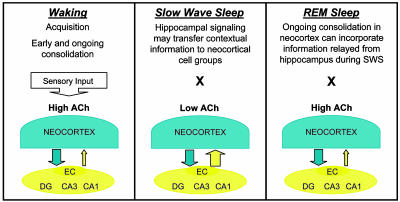
During waking, elevated acetylcholine (ACh) release from the cholinergic basal forebrain may enhance memory acquisition and consolidation (Left). The SWS release from ACh-mediated suppression of hippocampal feedback to the neocortex may then provide a privileged window for hippocampus to neocortex information transfer of memory traces recently encoded in the hippocampus (Center). A shift back to elevated ACh levels during REM sleep may facilitate savings in cortical circuits of information relayed during SWS (Right). Cortical cell groups send information to hippocampal circuitry, the dentate gyrus (DG) and area CA3, by means of the entorhinal cortex (EC). Hippocampal feedback signals to cortices are relayed back through the EC from area CA1.
Comment on
-
Low acetylcholine during slow-wave sleep is critical for declarative memory consolidation.Proc Natl Acad Sci U S A. 2004 Feb 17;101(7):2140-4. doi: 10.1073/pnas.0305404101. Epub 2004 Feb 6. Proc Natl Acad Sci U S A. 2004. PMID: 14766981 Free PMC article. Clinical Trial.
References
-
- Stickgold, R., Hobson, J. A., Fosse, R. & Fosse, M. (2001) Science 294, 1052–1057. - PubMed
-
- Hoffman, K. L. & McNaughton, B. L. (2002) Trends Neurosci. 25, 1–2. - PubMed
-
- Benington, J. H. & Frank, M. G. (2003) Prog. Neurobiol. 69, 71–101. - PubMed
-
- McGaugh, J. L. (2000) Science 287, 248–251. - PubMed
-
- Maquet, P. (2001) Science 294, 1048–1052. - PubMed
Publication types
MeSH terms
Substances
LinkOut - more resources
Full Text Sources
Medical
