. 2004 Feb 1;18(3):249-54.
doi: 10.1101/gad.1176004.

Requirement of protein phosphatase 5 in DNA-damage-induced ATM activation

Affiliations

Requirement of protein phosphatase 5 in DNA-damage-induced ATM activation

Ambereen Ali et al. Genes Dev. .

Abstract

The checkpoint kinase ATM is centrally involved in the cellular response to DNA double-strand breaks. However, the mechanism of ATM activation during genotoxic stress is only partially understood. Here we report a direct regulatory linkage between the protein serine-threonine phosphatase 5 (PP5) and ATM. PP5 interacts with ATM in a DNA-damage-inducible manner. Reduced expression of PP5 attenuated DNA-damage-induced activation of ATM. Expression of a catalytically inactive PP5 mutant inhibited the phosphorylation of ATM substrates and the autophosphorylation of ATM on Ser 1981, and caused an S-phase checkpoint defect in DNA-damaged cells. Together our findings indicate that PP5 plays an essential role in the activation and checkpoint signaling functions of ATM in cells that have suffered DNA double-strand breaks.


Figures
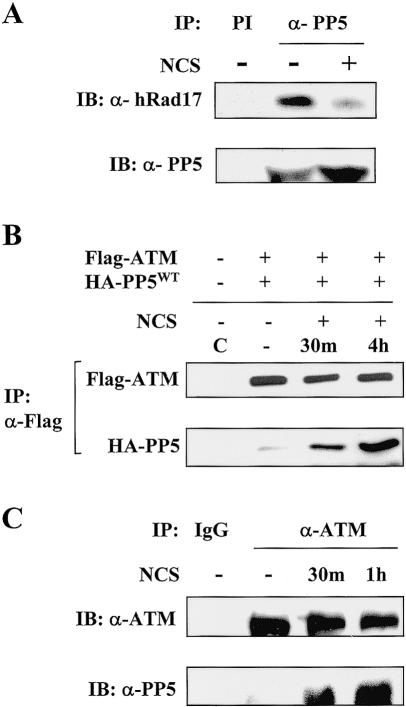
Figure 1.
Figure 1.
Association of PP5 with ATM and hRad17. (A) Coimmunoprecipitation of endogenous PP5 and hRad17. HEK 293T cells were left untreated or treated with 100 ng/mL NCS for 30 min prior to lysis. Preimmune serum (PI) was used in control immunoprecipitation as indicated. (B) DNA-damage-induced association of ectopically expressed PP5WT and ATM in HEK 293T cells was determined by α-Flag immunoprecipitation followed by α-HA immunoblotting (lower panel). (C) Association of endogenous ATM with PP5 was determined by immunoprecipitation assays with α-ATM monoclonal antibody with or without treatment of NCS as indicated. Normal mouse IgG (IgG) was used in the control immunoprecipitation.
Figure 2.
Figure 2.
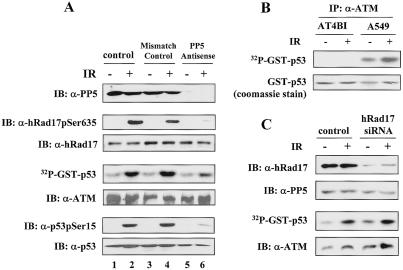
PP5 antisense attenuates DNA-damage-induced ATM kinase activity in A549 cells. (A) After transfection with PP5 antisense or mismatch control oligonucleotides, A549 cells were exposed to IR (20 Gy) and were harvested after 30 min. Cellular extracts were immunoprecipitated with α-ATM (Ab3) antibody, and ATM kinase assays were performed with GST-p53(1-70) as the substrate. Amounts of hRad17pSer635, total hRad17, p53pSer15, total p53, and PP5 were determined by immunoblotting with the respective antibodies and were shown in the indicated panels. IR treatment led to an increased level of ATM kinase activity in control, mismatch, or antisense oligonucleotide-transfected cells by 3.6-, 3.3-, and 1.3-fold, respectively. (B) The specificity of the ATM antibody used in the immune complex kinase assays were confirmed in A-T cells (AT4BI) and A549 cells. (C) Suppression of hRad17 expression by synthetic siRNA duplexes has no effect on ATM kinase activity. A549 cells were mock transfected or transfected with hRad17 siRNA for 48 h. Cells were then exposed to 20 Gy of IR followed by 30 min of incubation. The ATM kinase activity and expression levels of hRad17 and PP5 were determined. Consistent results were obtained among three independent experiments.
Figure 3.
Figure 3.
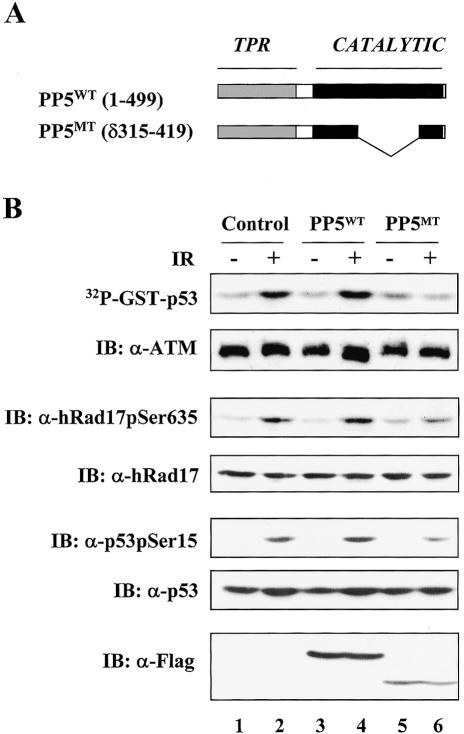
Expression of a catalytically inactive form of PP5 (PP5MT) inhibits ATM kinase activity. (A) A mutant form of PP5 was generated by deleting residues 315-419 of the catalytic domain. (B) Overexpression of PP5MT attenuates ATM kinase activity. After infection by recombinant adenoviruses, A549 cells were exposed to IR (20 Gy) and then incubated for 30 min. ATM immune complex kinase assays were performed with 1 μg of GST-p53(1-70) as the substrate. Cell lysates were immunoblotted as indicated. IR treatment led to an increased level of ATM kinase activity in control cells or PP5WT/PP5MT-expressing cells by 2.9-, 2.1-, and 0.8-fold, respectively. Consistent results were obtained among three independent experiments.
Figure 4.
Figure 4.
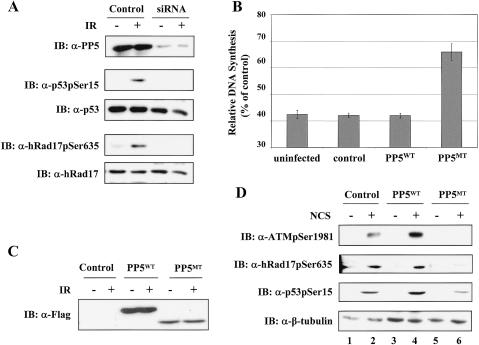
PP5 activity is required for IR-induced S-phase checkpoint activation in human BJ fibroblasts. (A) Down-regulation of PP5 by synthetic siRNA duplexes abrogates IR-induced phosphorylation of p53 and hRad17. After transfection, BJ cells were exposed to IR (20 Gy) and then harvested after 30 min. Cellular extracts were analyzed by immunoblotting with the indicated antibodies. (B) PP5MT induces radioresistant DNA synthesis in BJ cells. After infection with the indicated adenoviruses, BJ cells were exposed to 20 Gy of IR, and DNA synthesis rates were determined as described in Materials and Methods. (C) A fraction of the cells from B was analyzed by immunoblotting with α-Flag antibody. (D) PP5MT inhibits the autophosphorylation of ATM on Ser 1981. Adenovirus-infected BJ cells were either left untreated or treated with 100 ng/mL NCS for 30 min. Cells were then harvested and analyzed by immunoblotting with α-ATMpSer1981, α-hRad17pSer635, and α-p53pSer15. β-Tubulin was used as a loading control. Consistent results were obtained among three independent experiments.

References

    1. Abraham R.T. 2001. Cell cycle checkpoint signaling through the ATM and ATR kinases. Genes & Dev. 15: 2177-2196. - PubMed
    1. Bakkenist C.J. and Kastan, M.B. 2003. DNA damage activates ATM through intermolecular autophosphorylation and dimer dissociation. Nature 421: 499-506. - PubMed
    1. Bao S., Tibbetts, R.S., Brumbaugh, K.M., Fang, Y., Richardson, D.A., Ali, A., Chen, S.M., Abraham, R.T., and Wang, X.F. 2001. ATR/ATM-mediated phosphorylation of human Rad17 is required for genotoxic stress responses. Nature 411: 969-974. - PubMed
    1. Borthwick E.B., Zeke, T., Prescott, A.R., and Cohen, P.T. 2001. Nuclear localization of protein phosphatase 5 is dependent on the carboxy-terminal region. FEBS Lett. 491: 279-284. - PubMed
    1. Chen M.X. and Cohen, P.T. 1997. Activation of protein phosphatase 5 by limited proteolysis or the binding of polyunsaturated fatty acids to the TPR domain. FEBS Lett. 400: 136-140. - PubMed

Publication types