. 2004 Feb 11;24(6):1330-9.
doi: 10.1523/JNEUROSCI.3982-03.2004.

Enteric dopaminergic neurons: definition, developmental lineage, and effects of extrinsic denervation

Affiliations

Enteric dopaminergic neurons: definition, developmental lineage, and effects of extrinsic denervation

Z S Li et al. J Neurosci. .

Abstract

The existence of enteric dopaminergic neurons has been suspected; however, the innervation of the gut by sympathetic nerves, in which dopamine (DA) is the norepinephrine precursor, complicates analyses of enteric DA. We now report that transcripts encoding tyrosine hydroxylase (TH) and the DA transporter (DAT) are present in the murine bowel (small intestine > stomach or colon; proximal colon > distal colon). Because sympathetic neurons are extrinsic, transcripts encoding TH and DAT in the bowel are probably derived from intrinsic neurons. TH protein was demonstrated immunocytochemically in neuronal perikarya (submucosal >> myenteric plexus; small intestine > stomach or colon). TH, DA, and DAT immunoreactivities were coincident in subsets of neurons (submucosal > myenteric) in guinea pig and mouse intestines in situ and in cultured guinea pig enteric ganglia. Surgical ablation of sympathetic nerves by extrinsic denervation of loops of the bowel did not affect DAT immunoreactivity but actually increased numbers of TH-immunoreactive neurons, expression of mRNA encoding TH and DAT, and enteric DOPAC (the specific dopamine metabolite). The fetal gut contains transiently catecholaminergic (TC) cells. TC cells are the proliferating crest-derived precursors of mature neurons that are not catecholaminergic and, thus, disappear after embryonic day (E) 14 (mouse) or E15 (rat). TC cells appear early in ontogeny, and their development/survival is dependent on mash-1 gene expression. In contrast, the intrinsic TH-expressing neurons of the murine bowel appear late (perinatally) and are mash-1 independent. We conclude that the enteric nervous system contains intrinsic dopaminergic neurons that arise from a mash-1-independent lineage of noncatecholaminergic precursors.


Figures
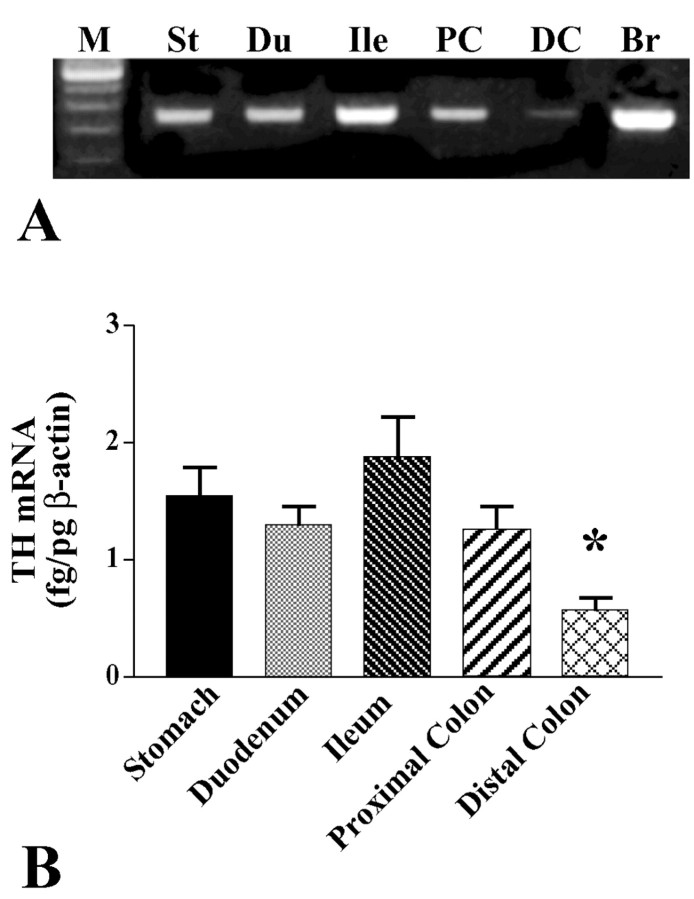
Figure 1.
Figure 1.
Transcripts encoding TH are expressed in the mouse gut. A, RNA was extracted from adult mouse stomach (St), duodenum (Du), ileum (Ile), proximal colon (PC), distal colon (DC), and brain (Br), which served as a positive control, and analyzed by RT-PCR. M, 100 bp size markers. B, The abundance of transcripts encoding TH in each region of the bowel relative to those encoding β-actin were determined by real-time PCR. The abundance of transcripts encoding TH is significantly lower in the distal colon than in other regions of the bowel (*p < 0.02).
Figure 2.
Figure 2.
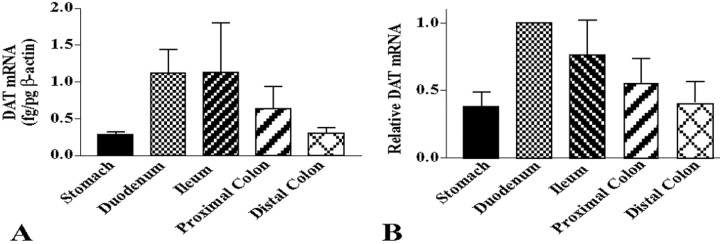
Transcripts encoding DAT are expressed in the mouse gut. A, The abundance of transcripts encoding DAT in each region of the bowel relative to those encoding β-actin were determined by real-time PCR. B, The relative abundance of transcripts encoding DAT in each region of the bowel were normalized to that in the duodenum of each animal. The abundance of transcripts encoding DAT is significantly higher in the duodenum than in the stomach or distal colon (*p < 0.05).
Figure 3.
Figure 3.
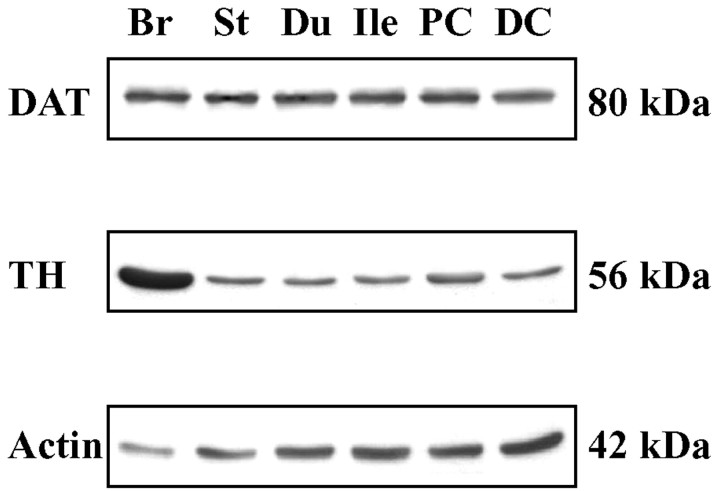
DAT and TH immunoreactivities are present in the mouse gut. A, The distributions of DAT and TH proteins in the stomach (St), duodenum (Du), ileum (Ile), proximal colon (PC), distal colon (DC), and brain (Br) (positive control) were analyzed by immunoblotting. Enteric DAT was concentrated by immunoprecipitation before immunoblotting. Actin was analyzed as a loading control.
Figure 4.
Figure 4.
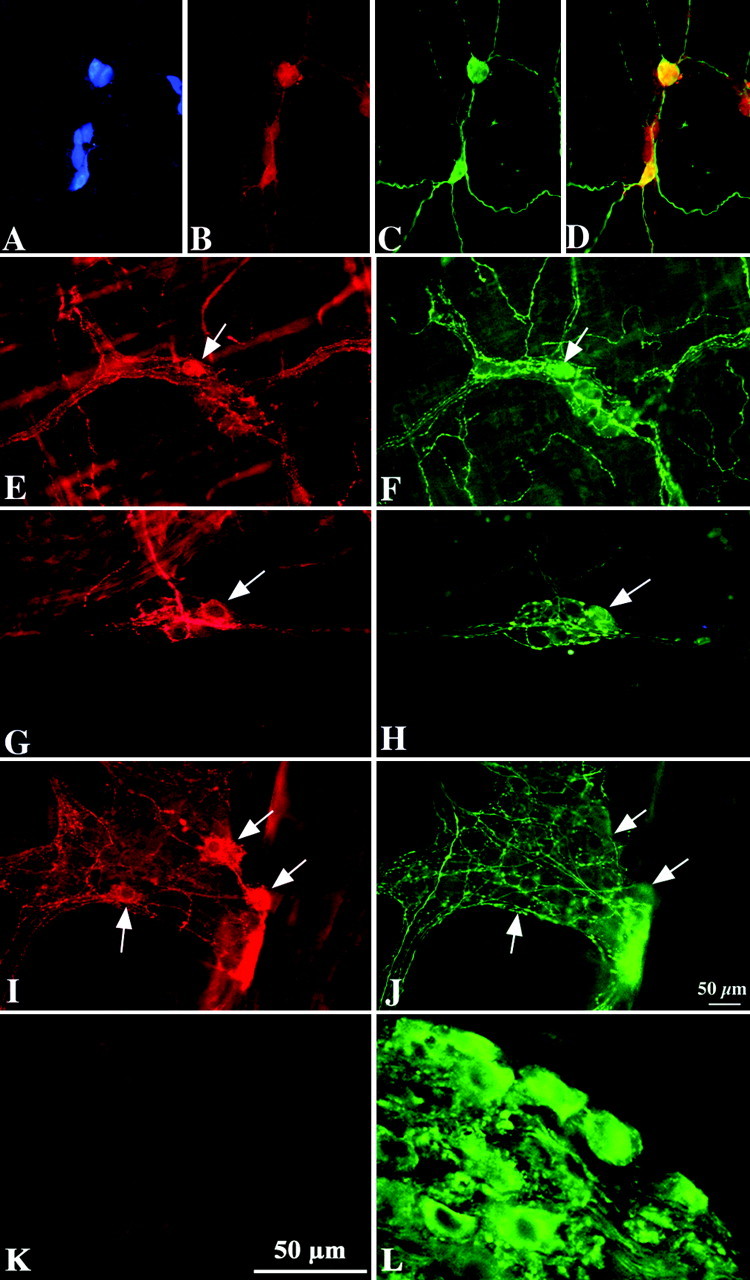
DAT and TH immunoreactivities are partially coincident in the mouse ileum and colon; sympathetic neurons of the celiac ganglion are TH immunoreactive but not DAT immunoreactive. Double-label or triple immunocytochemistry illuminated to reveal Hu (A; blue fluorescence), DAT (B, E, G, I, K; red fluorescence), and TH (C, F, H, J, L; green fluorescence) immunoreactivities in the same fields in submucosal and myenteric plexuses of the ileum and colon. Coincident labeling is apparent in the yellow cells in the merged image of TH and DAT immunoreactivities (D). The immunoreactivity of Hu was studied as a neuronal marker. A-D, Submucosal plexus of the ileum. E, F, Myenteric plexus of the ileum. G, H, Submucosal plexus of the colon. I, J, Myenteric plexus of the colon. K, L, Celiac (prevertebral sympathetic) ganglion. Arrows indicate the locations of individual cells in paired figures. Scale bar, 50 μm.
Figure 5.
Figure 5.
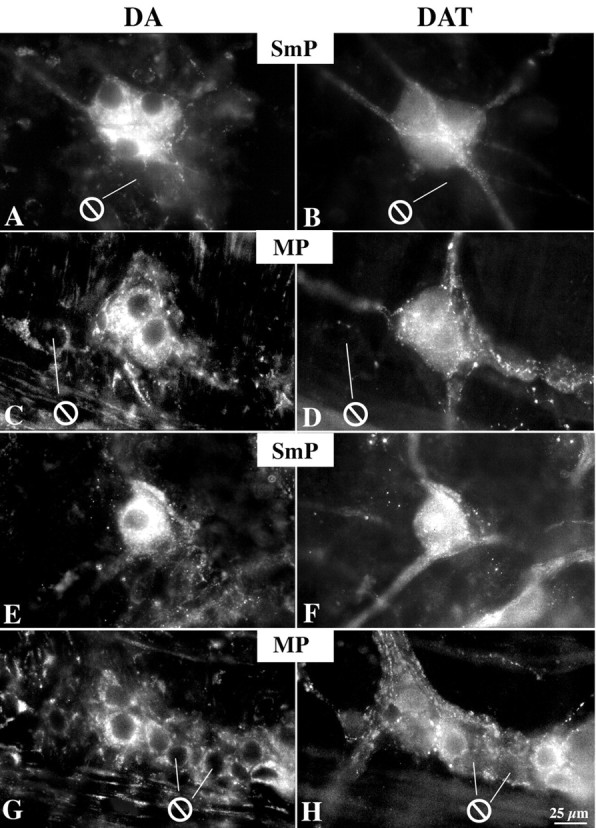
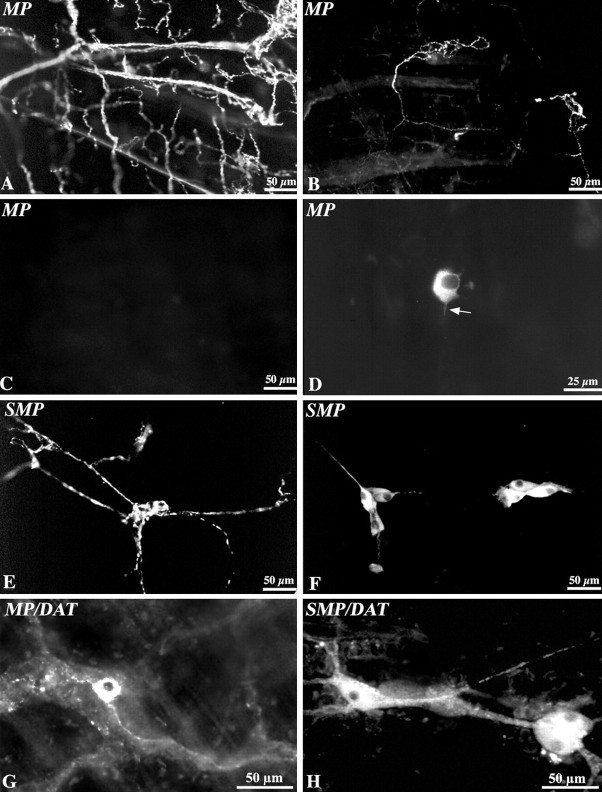
DA and DAT immunoreactivities are coincident in neurons of the mouse and guinea pig ileum. Double-label immunocytochemistry illuminated to reveal DA (left; Alexa 596) and DAT immunoreactivities (right; Alexa 488) in the same fields in submucosal plexus (SmP) and myenteric plexus (MP) of the mouse (A-D) and guinea pig (E-H) ileum. DA immunoreactivity in nerve cell bodies is greater than that in fibers. ⊖, Location of neurons that lack immunoreactivity. Scale bar, 25 μm.
Figure 6.
Figure 6.
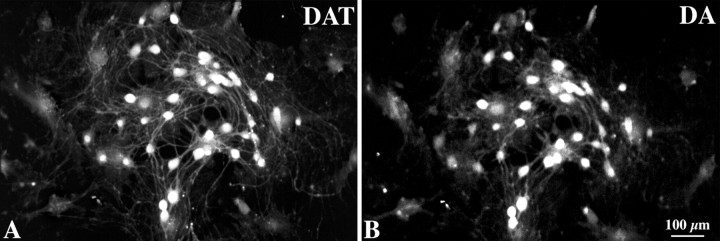
DA and DAT immunoreactivities are fully coincident in nerve cell bodies in cultured myenteric ganglia isolated from guinea pig ileum. Cultures were maintained for 1 week to allow extrinsic axons to degenerate. Scale bar, 100 μm.
Figure 7.
Figure 7.
Extrinsic denervation confirms that myenteric and submucosal TH-immunoreactive neurons are intrinsic. TH immunoreactivity demonstrated in laminar preparations of myenteric and submucosal plexuses. A, Myenteric plexus control. The sympathetic axons are characterized by large varicosities and are very abundant. B, Myenteric plexus at the border between denervated and innervated segments. A small number of varicose sympathetic axons remain in irregular clusters. C, Myenteric plexus within the denervated segment. No TH-immunoreactive sympathetic axons remain. D, Myenteric plexus within the denervated segment. An intrinsic TH-immunoreactive neuron can be discerned. Note the very fine axon extending from it. E, Submucosal plexus control. Sympathetic axons are again characterized by large varicosities. F, Submucosal plexus within the denervated segment. Several intrinsic TH-immunoreactive neurons can be discerned. Note their extension of fine nonvaricose axons. The varicose sympathetic axons are no longer visible. G, Myenteric plexus within the denervated segment showing DAT immunoreactivity. A DAT-immunoreactive neuron is apparent within a ganglion. H, Submucosal plexus within the denervated segment showing several DAT-immunoreactive neurons in interconnected ganglia. Scale bars: A-C, E-H, 50 μm; D, 25 μm.
Figure 8.
Figure 8.
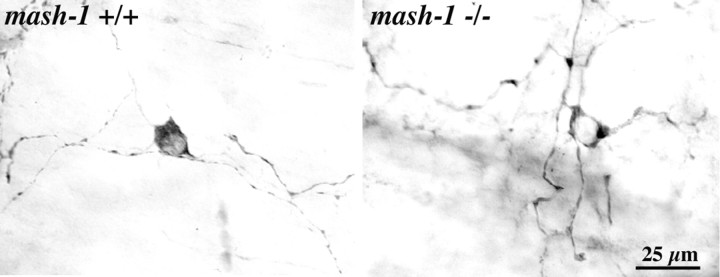
TH-immunoreactive neurons are present in the bowel of transgenic mice that lack mash-1.

References

    1. Baetge G, Gershon MD (1989) Transient catecholaminergic (TC) cells in the vagus nerves and bowel of fetal mice: relationship to the development of enteric neurons. Dev Biol 132: 189-211. - PubMed
    1. Baetge G, Pintar JE, Gershon MD (1990a) Transiently catecholaminergic (TC) cells in the bowel of fetal rats and mice: precursors of non-catecholaminergic enteric neurons. Dev Biol 141: 353-380. - PubMed
    1. Baetge G, Schneider KA, Gershon MD (1990b) Development and persistence of catecholaminergic neurons in cultured explants of fetal murine vagus nerves and bowel. Development 110: 689-701. - PubMed
    1. Bixby S, Kruger GM, Mosher JT, Joseph NM, Morrison SJ (2002) Cell-intrinsic differences between stem cells from different regions of the peripheral nervous system regulate the generation of neural diversity. Neuron 35: 643-656. - PubMed
    1. Blaugrund E, Pham TD, Tennyson VM, Lo L, Sommer L, Anderson DJ, Gershon MD (1996) Distinct subpopulations of enteric neuronal progenitors defined by time of development, sympathoadrenal lineage markers, and Mash-1-dependence. Development 122: 309-320. - PubMed

Publication types

MeSH terms

LinkOut - more resources