Benefits and harms associated with hormone replacement therapy: clinical decision analysis
- PMID: 14962874
- PMCID: PMC341383
- DOI: 10.1136/bmj.328.7436.371
Benefits and harms associated with hormone replacement therapy: clinical decision analysis
Abstract
Objective: To evaluate harms and benefits associated with use of combined hormone replacement therapy (HRT) for five years in women with different baseline risks for breast cancer.
Design: Probabilistic clinical decision analysis.
Setting: Hypothetical population of white UK women aged 50 years with different baseline risks for breast cancer.
Main outcome measure: Gain or loss in quality adjusted life years (QALYs).
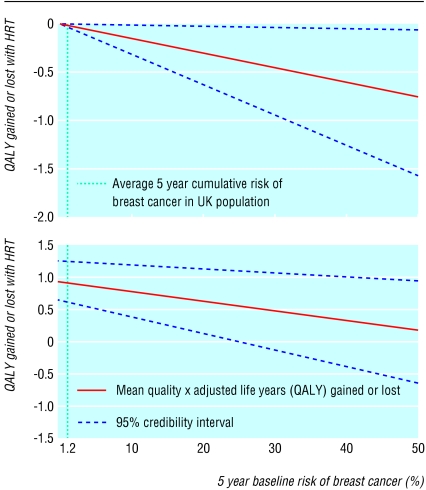
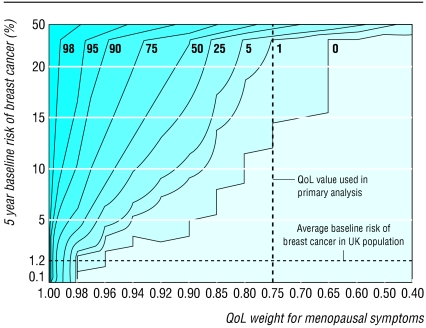
Results: Women free of menopausal symptoms showed a net harm from HRT use, which increased for increasing baseline risk of breast cancer. Those with a baseline risk of 1.2% would expect a loss in QALYs of 0.4 months (- 0.03 QALYs, 95% credibility interval - 0.05 to - 0.01). The main analysis showed HRT to be on average beneficial in women with symptoms, with benefit decreasing with increasing baseline risk of breast cancer. The results were sensitive to the assumed value of quality of life with menopausal symptoms, therefore a contour plot was developed to show the probability of net harm for a range of different values and baseline risks.
Conclusions: HRT for primary prevention of chronic diseases in women without menopausal symptoms is unjustified. Perceived quality of life in women with symptoms should be taken into account when deciding on HRT. Thus, a decision analysis tailored to an individual woman is more appropriate in clinical practice than a population based approach.
Figures
Comment in
-
Where are we now with hormone replacement therapy?BMJ. 2004 Feb 14;328(7436):357-8. doi: 10.1136/bmj.328.7436.357. BMJ. 2004. PMID: 14962850 Free PMC article. No abstract available.
References
-
- Torgerson DJ, Bell-Syer SE. Hormone replacement therapy and prevention of nonvertebral fractures: a meta-analysis of randomized trials. JAMA 2001;285: 2891-7. - PubMed
-
- Nelson HD, Humphrey LL, Nygren P, Teutsch SM, Allan JD. Postmenopausal hormone replacement therapy: scientific review. JAMA 2002;288: 872-81. - PubMed
-
- Beral V, Banks E, Reeves G. Evidence from randomised trials on the long-term effects of hormone replacement therapy. Lancet 2002;360: 942. - PubMed
-
- Hlatky MA, Boothroyd D, Vittinghoff E, Sharp P, Whooley MA. Quality-of-life and depressive symptoms in postmenopausal women after receiving hormone therapy: results from the Heart and Estrogen/Progestin Replacement Study (HERS) trial. JAMA 2002;287: 591-7. - PubMed
-
- Hogervorst E, Williams J, Budge M, Riedel W, Jolles J. The nature of the effect of female gonadal hormone replacement therapy on cognitive function in post-menopausal women: a meta-analysis. Neuroscience 2000;101: 485-512. - PubMed
MeSH terms
LinkOut - more resources
Full Text Sources
Medical