. 2004 Mar;78(5):2445-53.
doi: 10.1128/jvi.78.5.2445-2453.2004.

African swine fever virus multigene family 360 genes affect virus replication and generalization of infection in Ornithodoros porcinus ticks

Affiliations

African swine fever virus multigene family 360 genes affect virus replication and generalization of infection in Ornithodoros porcinus ticks

T G Burrage et al. J Virol. 2004 Mar.

Abstract

Recently, we reported that African swine fever virus (ASFV) multigene family (MGF) 360 and 530 genes are significant swine macrophage host range determinants that function by promoting infected-cell survival. To examine the function of these genes in ASFV's arthropod host, Ornithodoros porcinus porcinus, an MGF360/530 gene deletion mutant (Pr4Delta35) was constructed from an ASFV isolate of tick origin, Pr4. Pr4Delta35 exhibited a significant growth defect in ticks. The deletion of six MGF360 and two MGF530 genes from Pr4 markedly reduced viral replication in infected ticks 100- to 1,000-fold. To define the minimal set of MGF360/530 genes required for tick host range, additional gene deletion mutants lacking individual or multiple MGF genes were constructed. The deletion mutant Pr4Delta3-C2, which lacked three MGF360 genes (3HL, 3Il, and 3LL), exhibited reduced viral growth in ticks. Pr4Delta3-C2 virus titers in ticks were significantly reduced 100- to 1,000-fold compared to control values at various times postinfection. In contrast to the parental virus, with which high levels of virus replication were observed in the tissues of infected adults, Pr4Delta3-C2 replication was not detected in the midgut, hemolymph, salivary gland, coxal gland, or reproductive organs at 15 weeks postinfection. These data indicate that ASFV MGF360 genes are significant tick host range determinants and that they are required for efficient virus replication and generalization of infection. The impaired virus replication of Pr4Delta3-C2 in the tick midgut likely accounts for the absence of the generalized infection that is necessary for the natural transmission of virus from ticks to pigs.


Figures
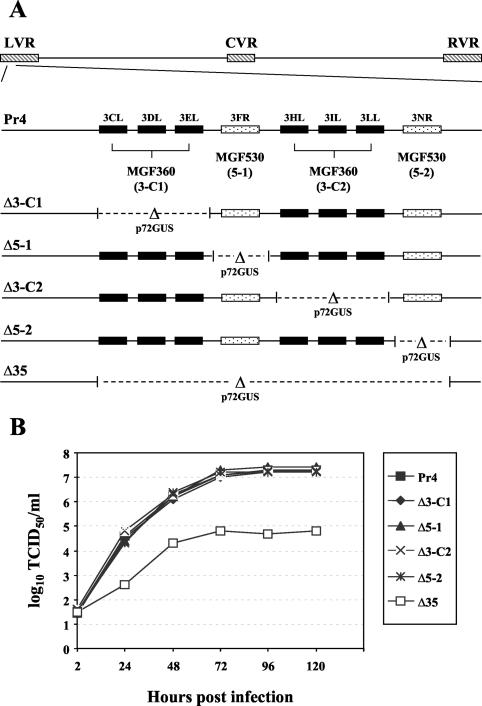
FIG. 1.
FIG. 1.
Characterization of ASFV MGF360 and MGF530 gene deletion mutants Pr4Δ3-C1, Pr4Δ5-1, Pr4Δ3-C2, Pr4Δ5-2, and Pr4Δ35. (A) Diagram of MGF360 and MGF530 gene regions in parental Pr4 and deletion mutants. Transfer vectors and recombinants with gene deletions were constructed as described in Materials and Methods. LVR, left variable region; CVR, central variable region; RVR, right variable region. (B) Growth characteristics of ASFV Pr4 and recombinant viruses Pr4Δ3-C1, Pr4Δ5-1, Pr4Δ3-C2, Pr4Δ5-2, and Pr4Δ35 in swine macrophage cell cultures. Primary macrophage cell cultures were infected (MOI = 1), and at the indicated times postinfection, duplicate samples were titrated for virus yield. These data are the means of results of two independent experiments. TCID50, 50% tissue culture infectious dose.
FIG. 2.
FIG. 2.
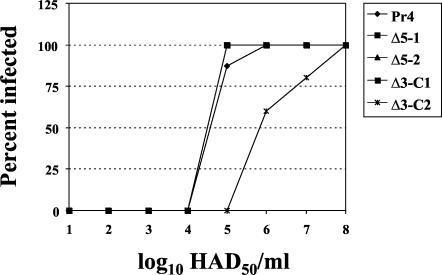
TID50 of Pr4 and MGF360/530 gene deletion mutants. N1 ticks (n = 8) were fed blood meals containing serial 10-fold dilutions of ASFVs, and virus isolation and/or titration was performed at 28 DPI. TID50 were expressed as log10 HAD50 of virus per milliliter that resulted in a 50% infection rate.
FIG.3.
FIG.3.
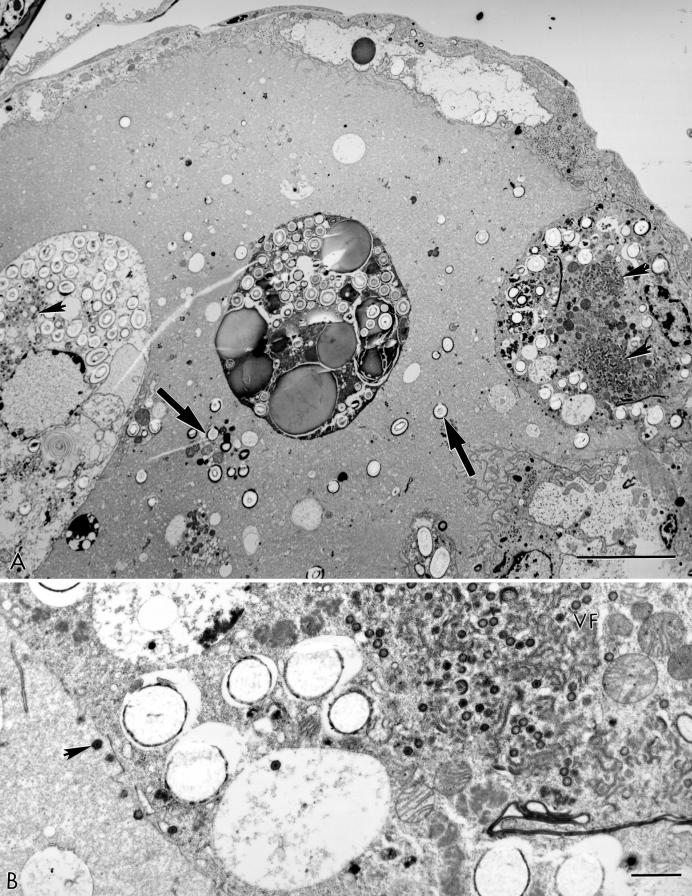
(A) Low-power electron micrograph of an N2 tick midgut after exposure to a blood meal containing 108 TCID50 of Pr4/ml at 3 weeks postfeeding. Two ASFV-infected PDC with virus factories (arrowheads) are present in the midgut lumen. Free granules (large arrows) are remnants of disrupted PDC. (B) A high-magnification view of the infected PDC attached to the midgut wall with an extensive virus factory (VF) and mature virus particles (arrowhead). Bars, 10 (A) and 1 (B) μm.
FIG.4.
FIG.4.
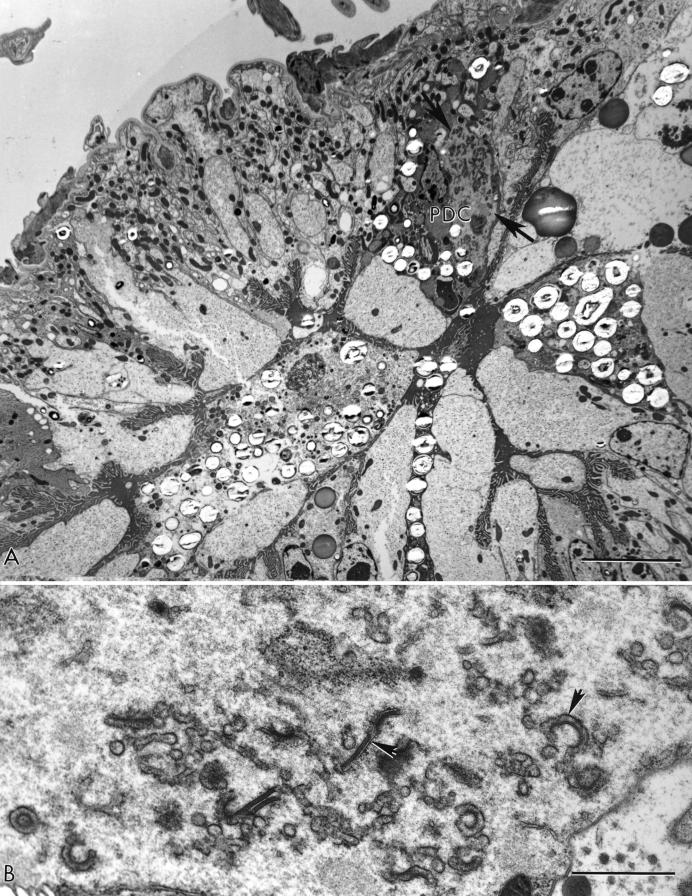
(A) Low-power electron micrograph of an N2 tick after exposure to a blood meal containing 108 TCID50 of Pr4Δ3-C2/ml at 3 weeks postfeeding. A single infected PDC is found among growing and expanding undifferentiated cells. The typical electron-lucent agranular area of a virus factory (arrows) is present. (B) A higher magnification of the factory region showing developing virus forms (arrowheads) but no mature virions. Bars, 10 (A) and 1 (B) μm.

References

    1. Afonso, C. L., M. E. Piccone, K. M. Zaffuto, J. G. Neilan, G. F. Kutish, Z. Lu, C. A. Balinsky, T. R. Gibb, T. J. Bean, L. Zsak, and D. L. Rock. 2004. African swine fever virus multigene family 360 and 530 genes affect host interferon response. J. Virol. 78:1858-1864. - PMC - PubMed
    1. Alcaraz, C., B. Pasamontes, G. F. Ruiz, and J. M. Escribano. 1989. African swine fever virus-induced proteins on the plasma membranes of infected cells. Virology 168:406-408. - PubMed
    1. Almazán, F., J. M. Rodríguez, G. Andrés, R. Pérez, E. Viñuela, and J. F. Rodriguez. 1992. Transcriptional analysis of multigene family 110 of African swine fever virus. J. Virol. 66:6655-6667. - PMC - PubMed
    1. Almendral, J. M., F. Almazán, R. Blasco, and E. Viñuela. 1990. Multigene families in African swine fever virus: family 110. J. Virol. 64:2064-2072. - PMC - PubMed
    1. Blasco, R., I. de la Vega, F. Almazán, A. Agüero, and E. Viñuela. 1989. Genetic variation of African swine fever virus: variable regions near the ends of the viral DNA. Virology 173:251-257. - PubMed

MeSH terms

LinkOut - more resources