Randomised controlled trial of effect of leaflets to empower patients in consultations in primary care
- PMID: 14966078
- PMCID: PMC344265
- DOI: 10.1136/bmj.37999.716157.44
Randomised controlled trial of effect of leaflets to empower patients in consultations in primary care
Abstract
Objective: To assess the impact of leaflets encouraging patients to raise concerns and to discuss symptoms or other health related issues in the consultation.
Design: Randomised controlled trial.
Setting: Five general practices in three settings in the United Kingdom.
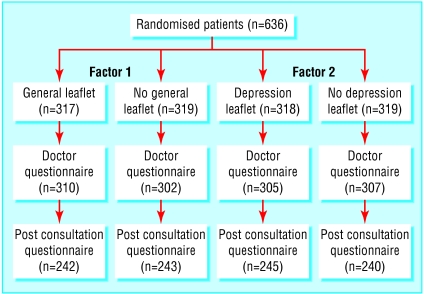
Participants: 636 consecutive patients, aged 16-80 years, randomised to receive a general leaflet, a depression leaflet, both, or neither.
Main outcomes: Mean item score on the medical interview satisfaction scale, consultation time, prescribing, referral, and investigation.
Results: The general leaflet increased patient satisfaction and was more effective with shorter consultations (leaflet 0.64, 95% confidence interval 0.19 to 1.08; time 0.31, 0.0 to 0.06; interaction between both -0.045, -0.08 to-0.009), with similar results for subscales related to the different aspects of communication. Thus for a 10 minute consultation the leaflet increased satisfaction by 7% (seven centile points) and for a five minute consultation by 14%. The leaflet overall caused a small non-significant increase in consultation time (0.36 minutes, -0.54 to 1.26). Although there was no change in prescribing or referral, a general leaflet increased the numbers of investigations (odds ratio 1.43, 1.00 to 2.05), which persisted when controlling for the major potential confounders of perceived medical need and patient preference (1.87, 1.10 to 3.19). Most of excess investigations were not thought strongly needed by the doctor or the patient. The depression leaflet had no significant effect on any outcome.
Conclusions: Encouraging patients to raise issues and to discuss symptoms and other health related issues in the consultation improves their satisfaction and perceptions of communication, particularly in short consultations. Doctors do, however, need to elicit expectations to prevent needless investigations.
Comment in
-
Patients' expectations of consultations.BMJ. 2004 Feb 21;328(7437):416-7. doi: 10.1136/bmj.328.7437.416. BMJ. 2004. PMID: 14976072 Free PMC article. No abstract available.
References
-
- Thompson S, Nanni C, Schwankovsky L. Patient oriented interventions to improve communication in a medical office visit. Health Psychol 1990;9: 390-404. - PubMed
-
- Albertson G, Lin C, Schilling L, Cyran S, Anderson S, Anderson R. Impact of a simple intervention to increase primary care provider recognition of patient referral concerns. Am J Managed Care 2002;8: 375-81. - PubMed
-
- Frederikson L, Bull P. Evaluation of a patient education leaflet designed to improve communication in medical consultations. Patient Educ Counsel 1995;25: 51-7. - PubMed
Publication types
MeSH terms
LinkOut - more resources
Full Text Sources
Medical