


Meta-analysis of diagnostic test accuracy assessment studies with varying number of thresholds
- PMID: 14969472
- PMCID: PMC10425262
- DOI: 10.1111/j.0006-341x.2003.00108.x
Meta-analysis of diagnostic test accuracy assessment studies with varying number of thresholds
Abstract
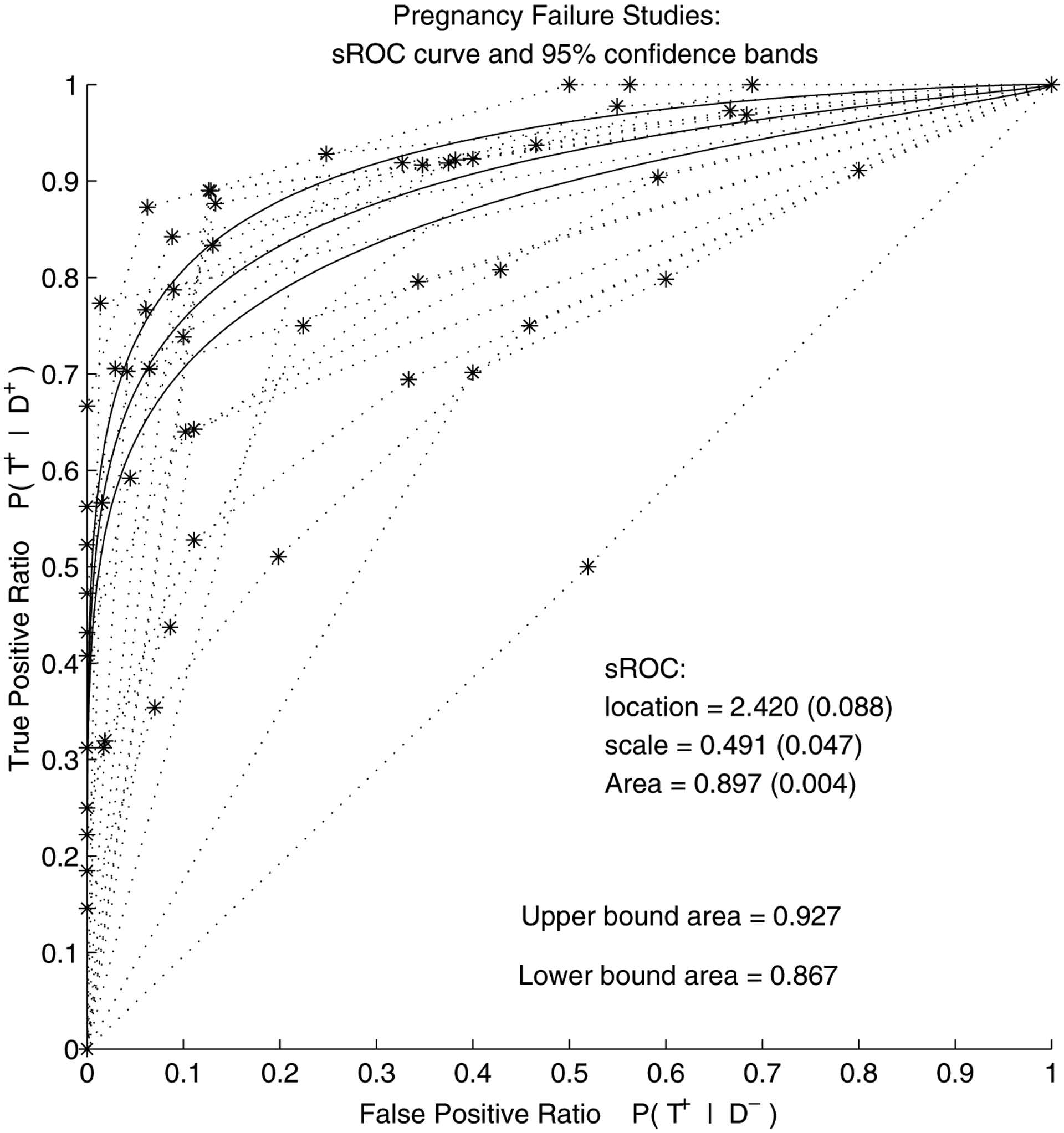
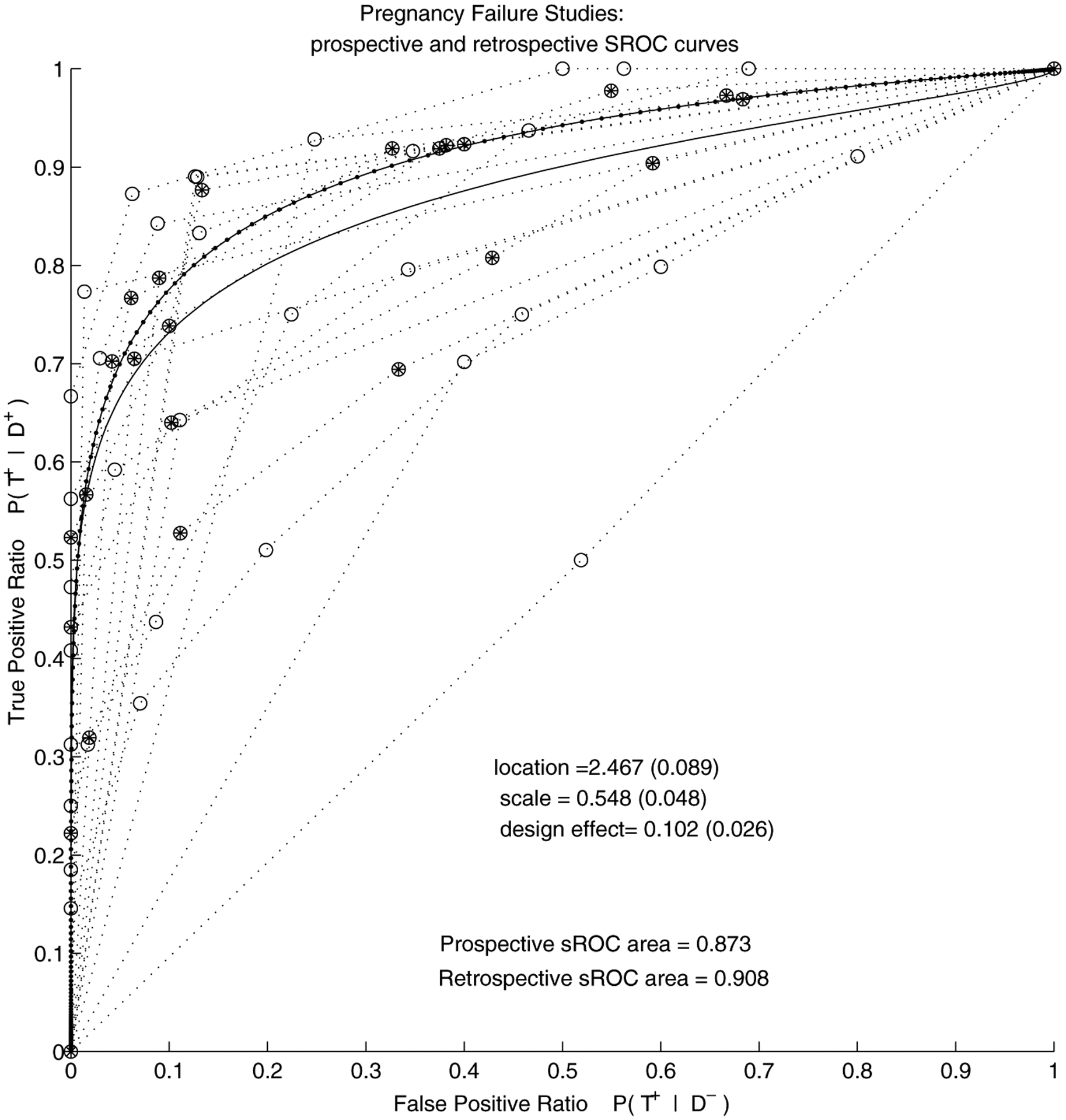
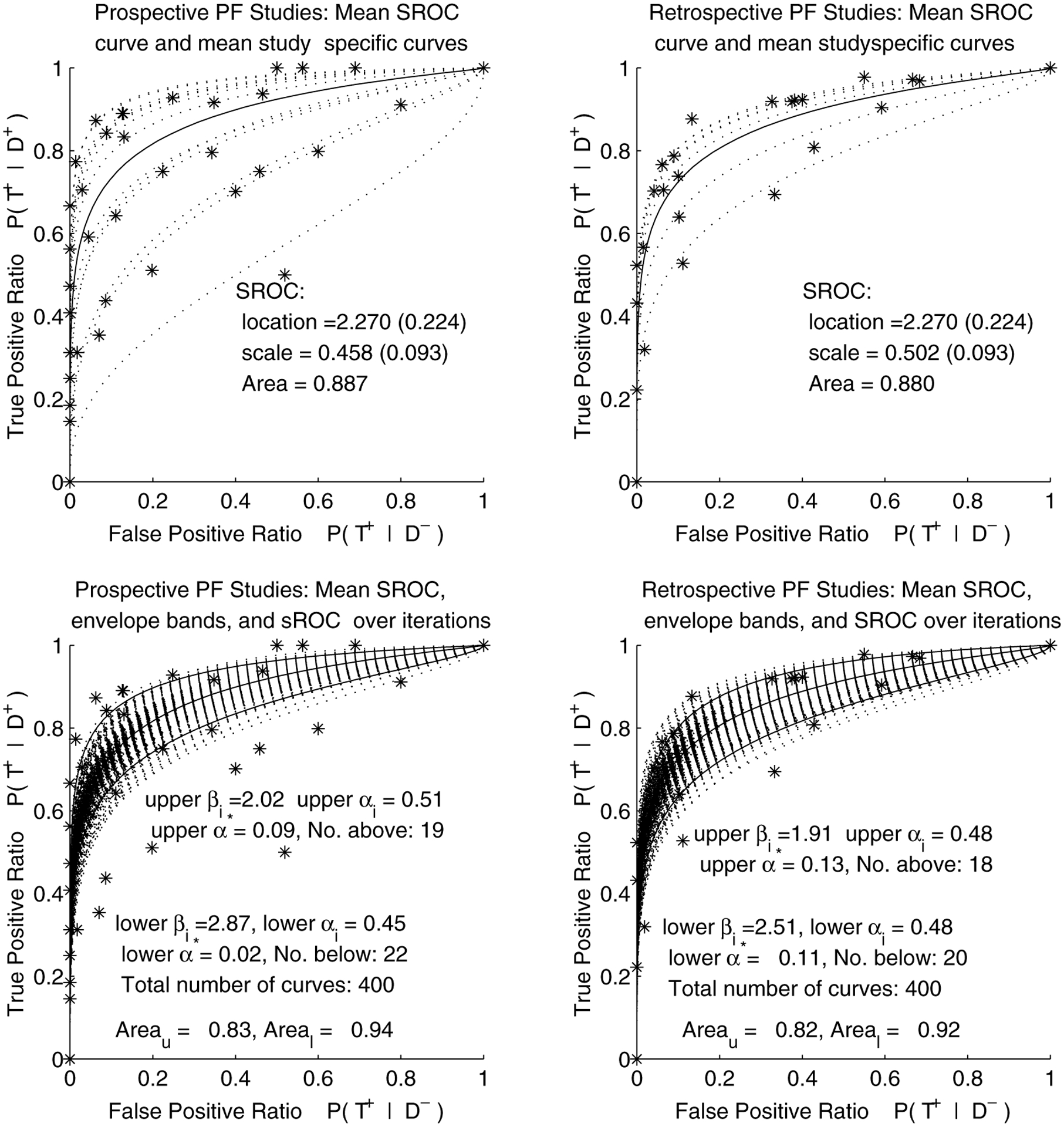
Current meta-analytic methods for diagnostic test accuracy are generally applicable to a selection of studies reporting only estimates of sensitivity and specificity, or at most, to studies whose results are reported using an equal number of ordered categories. In this article, we propose a new meta-analytic method to evaluate test accuracy and arrive at a summary receiver operating characteristic (ROC) curve for a collection of studies evaluating diagnostic tests, even when test results are reported in an unequal number of nonnested ordered categories. We discuss both non-Bayesian and Bayesian formulations of the approach. In the Bayesian setting, we propose several ways to construct summary ROC curves and their credible bands. We illustrate our approach with data from a recently published meta-analysis evaluating a single serum progesterone test for diagnosing pregnancy failure.
Les méthodes courantes de meta-analyse de la précision d’un test diagnostique s’appliquent en général à une sélection d’études rapportant seulement des estimations de la sensibilité et de la spécificité ou, au mieux, à des études dont les résultats sont présentés avec le même nombre de catégories ordonnées. Dans ce papier nous proposons une nouvelle méthode de méta-analyse pour évaluer la précision d’un test et aboutir à une courbe ROC globale pour un ensemble d’études évaluant des tests diagnostiques, même lorsque les résultats sont présentées avec des nombre inégaux de catégories non emboîtées. Nous discutons à la fois les formulations bayésienne et non-bayésienne de l’approche. Dans le cadre bayésien, nous proposons plusieurs moyens pour construire les courbes ROC globales et leur intervalle de crédibilité. Nous illustrons notre approche avec les données d’une meta-analyse récemment publiée évaluant un test de diagnostic d’échec d’une grossesse à partir de la progestérone sérique.
Figures
References
-
- Bamber D (1975). The area above the ordinal dominance graph and the area below the ROC graph. Journal of Mathematical Psychology 12, 387–415.
-
- Campbell G (1994). Advances in statistical methodology for the evaluation of diagnostic and laboratory tests. Statistics in Medicine 13, 499–508. - PubMed
-
- Carr R and Evans P (2000). Ectopic pregnancy. Primary Care 27, 169–183. - PubMed
-
- Cooper H and Hedges L (1994). The Handbook of Research Synthesis. New York: Russel Sage Foundation.
Publication types
MeSH terms
Grants and funding
LinkOut - more resources
Full Text Sources
