. 2004 Mar 2;101(9):3047-52.
doi: 10.1073/pnas.0400235101. Epub 2004 Feb 17.

Cysteinyl leukotriene 1 receptor controls the severity of chronic pulmonary inflammation and fibrosis

Affiliations

Cysteinyl leukotriene 1 receptor controls the severity of chronic pulmonary inflammation and fibrosis

Thomas C Beller et al. Proc Natl Acad Sci U S A. .

Abstract

The cysteinyl leukotrienes (cys-LTs), leukotriene (LT) C(4), LTD(4), and LTE(4), are smooth muscle constrictors that signal via the CysLT(1) receptor. Here we report that the cys-LTs play an important role in chronic pulmonary inflammation with fibrosis induced by bleomycin in mice. Targeted disruption of LTC(4) synthase, the pivotal enzyme for cys-LT biosynthesis, protected significantly against alveolar septal thickening by macrophages and fibroblasts and collagen deposition. In contrast, targeted disruption of the CysLT(1) receptor significantly increased both the concentration of cys-LTs in the bronchoalveolar lavage fluid and the magnitude of septal thickening as defined by morphology, digital image analysis, and deposition of reticular fibers. These findings change our understanding of the pathobiology mediated by the cys-LTs by revealing their role in chronic inflammation with fibrosis, likely via the CysLT(2) receptor, and by uncovering a dual role for the CysLT(1) receptor, namely proinflammatory acute constriction of smooth muscle and antiinflammatory counteraction of chronic injury.


Figures
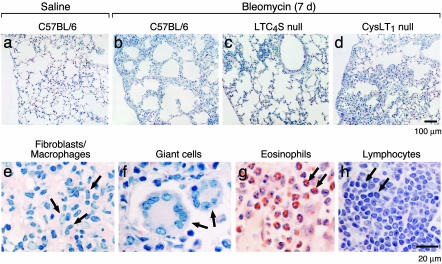
Fig. 1.
Fig. 1.
Histology of lungs 7 days after intratracheal injection of saline or bleomycin. Sections of lung from saline-treated wild-type mice (a) and bleomycin-treated wild-type (b), LTC4S null (c), and CysLT1 receptor null (d) mice are stained by chloroacetate esterase reaction with counterstaining with hematoxylin. High-power magnification views of cell types (e-h, arrow) observed in the pathobiologically condensed areas of the lung after bleomycin treatment. Eosinophils (g) are depicted by staining with Congo red.
Fig. 2.
Fig. 2.
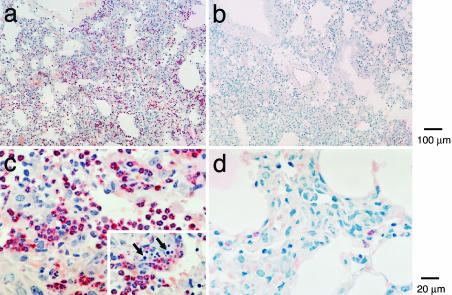
Neutrophil infiltration 7 days after injection of bleomycin. Low-power (a and b) and high-power (c and d) magnification views of two different wild-type mice with comparable septal thickening with or without neutrophil infiltration 7 days after bleomycin treatment in the same experiment. Sections are stained by chloroacetate esterase reaction with counterstaining with hematoxylin. (Inset) For the lung of the mouse depicted in c, numerous apoptotic bodies in areas of neutrophil accumulation are shown (arrow).
Fig. 3.
Fig. 3.
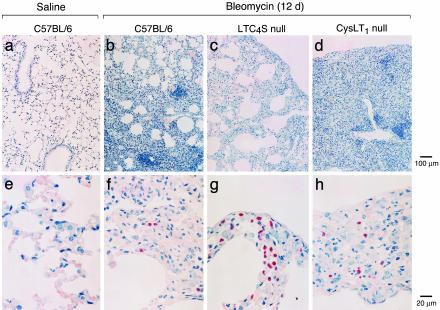
Histology of lungs 12 days after intratracheal injection of saline or bleomycin. Sections of lung from saline-treated wild-type mice (a, low power; e, high power) and bleomycin-treated wild-type (b, low power; f, high power), LTC4S null (c, low power; g, high power), and CysLT1 receptor null (d, low power; h, high power) mice are stained by chloroacetate esterase reaction with counterstaining with hematoxylin.
Fig. 4.
Fig. 4.
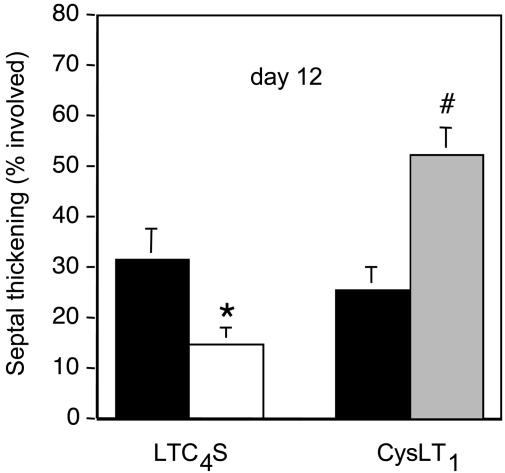
Septal thickening 12 days after bleomycin treatment quantitated by digital imaging. The percent area of the lower lobes with septal thickening in C57BL/6-backcrossed littermates (black) and LTC4S null mice (white) (Left) and in wild-type C57BL/6 (black) and CysLT1 receptor null mice (gray) (Right) are shown. Data are combined from three experiments. *, P < 0.05; #, P < 0.001 versus bleomycin-treated wild-type group.
Fig. 5.
Fig. 5.
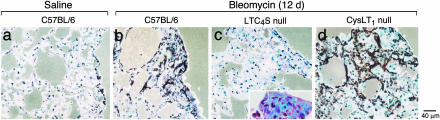
Extracellular matrix protein deposition in the lungs 12 days after intratracheal injection of saline or bleomycin. Sections of lung from saline-treated wild-type mice (a) and bleomycin-treated wild-type (b), LTC4S null (c), and CysLT1 receptor null (d) mice are stained with modified periodic acid-methenamine silver. Reticular fibers (type III collagen) and basement membranes are stained dark brown to black. A representative lung section from a LTC4S null mouse is stained by Masson's trichrome staining (Inset).
Fig. 6.
Fig. 6.
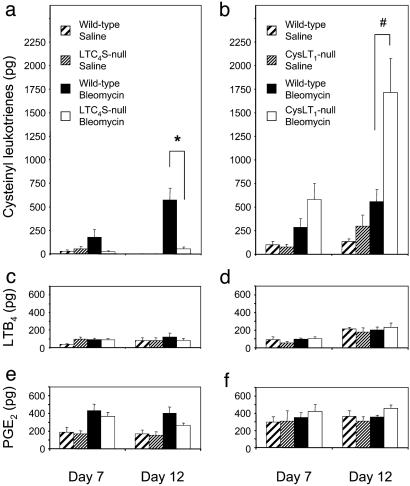
Levels of cys-LTs, LTB4, and PGE2 in BAL fluids. The amounts of cys-LTs (a and b), LTB4 (c and d), and PGE2 (e and f) are shown 7 and 12 days after saline or bleomycin treatment of controls and LTC4S null mice (Left) and of controls and CysLT1 receptor null mice (Right). *, P < 0.005; #, P < 0.05 versus bleomycin-treated wild-type group.

References

    1. Kellaway, C. H. & Trethewie, W. R. (1940) Q. J. Exp. Physiol. 30, 121-145.
    1. Brocklehurst, W. E. (1953) J. Physiol. 120, 16-17. - PubMed
    1. Brocklehurst, W. E. (1960) J. Physiol. 151, 416-435. - PMC - PubMed
    1. Murphy, R. C., Hammarstrom, S. & Samuelsson, B. (1979) Proc. Natl. Acad. Sci. USA 76, 4275-4279. - PubMed
    1. Lewis, R. A., Drazen, J. M., Austen, K. F., Clark, D. A. & Corey, E. J. (1980) Biochem. Biophys. Res. Commun. 96, 271-277. - PubMed

Publication types

MeSH terms