


doi: 10.1038/sj.bjc.6601588.
Identification and characterisation of constitutional chromosome abnormalities using arrays of bacterial artificial chromosomes
Affiliations
- PMID: 14970865
- PMCID: PMC2410171
- DOI: 10.1038/sj.bjc.6601588
Item in Clipboard
Identification and characterisation of constitutional chromosome abnormalities using arrays of bacterial artificial chromosomes
Br J Cancer.
.
Abstract
Constitutional chromosome deletions and duplications frequently predispose to the development of a wide variety of cancers. We have developed a microarray of 6000 bacterial artificial chromosomes for array-based comparative genomic hybridisation, which provides an average resolution of 750 kb across the human genome. Using these arrays, subtle gains and losses of chromosome regions can be detected in constitutional cells, following a single overnight hybridisation. In this report, we demonstrate the efficiency of this procedure in identifying constitutional deletions and duplications associated with predisposition to retinoblastoma, Wilms tumour and Beckwith-Wiedemann syndrome.
Figures
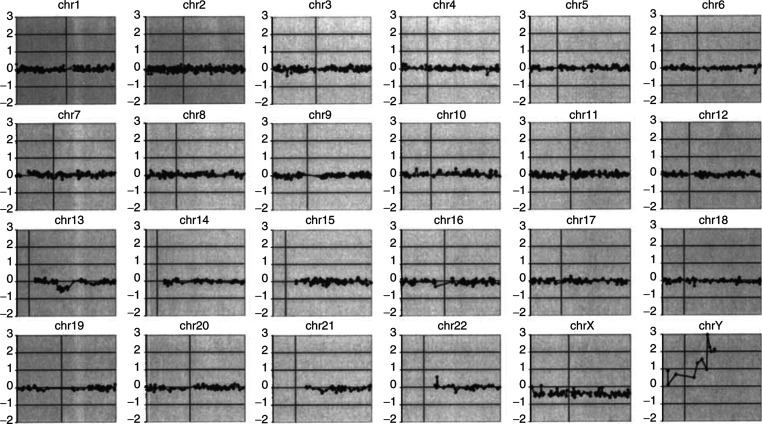
CGHa profile of constitutional DNA from patient GOS 115. The individual BACs for all chromosomes show a test/control ratio about a mean of 0 (no change, log scale), with the exception of the 13q14 region where the ratio is −0.5, indicating the presence of a heterozygous deletion (see text). The sex chromosome mismatch for this male patient was an XX control, which demonstrates a ratio or −0.5, which is expected in this experiment for a hemizygous deletion.
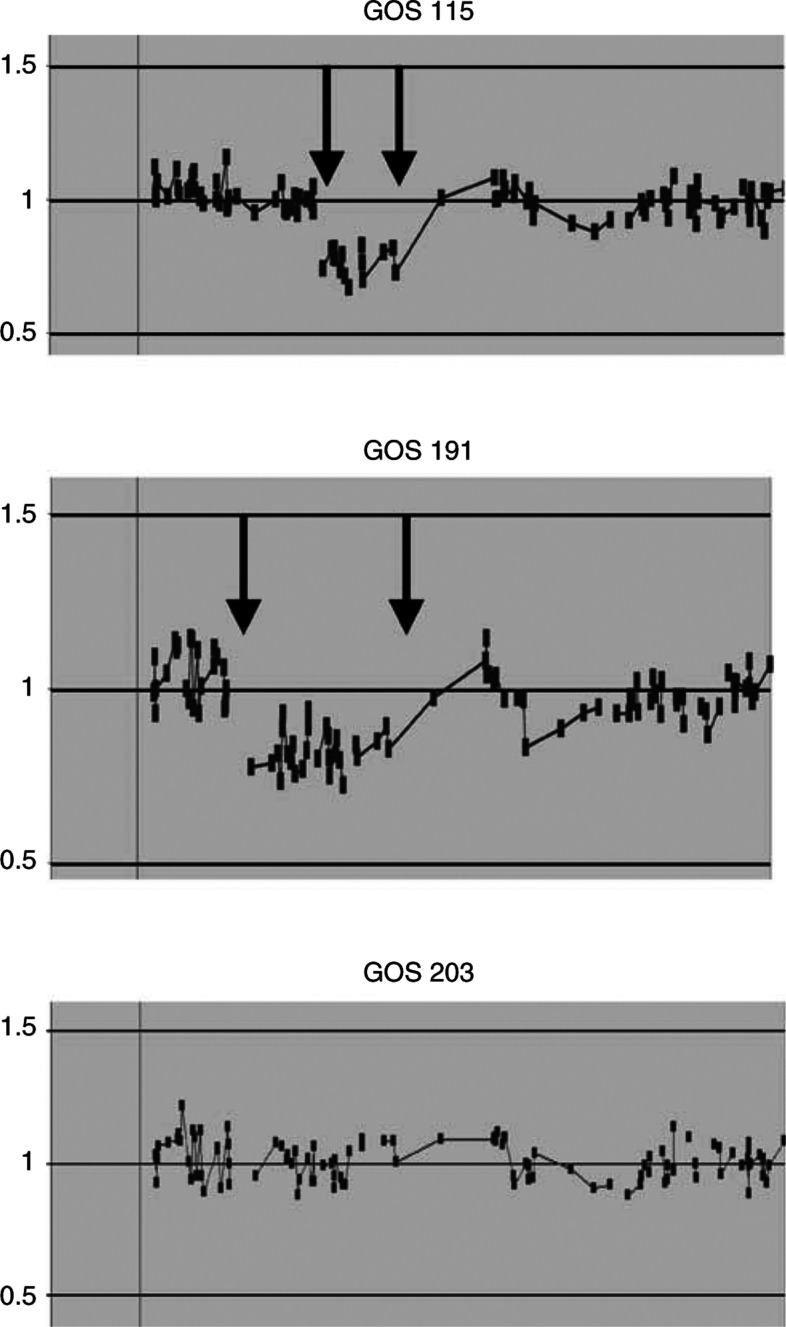
CGHa profile for patients with retinoblastoma. The deletions (arrows) in 13q14 for GOS 115 and 13q14–22 in GOS 191 can be clearly seen with a ratio of approximately –0.5. Patient GOS 203 shows a normal profile for chromosome 13 with all BACs, clustering around a mean of 1 (linear scale).
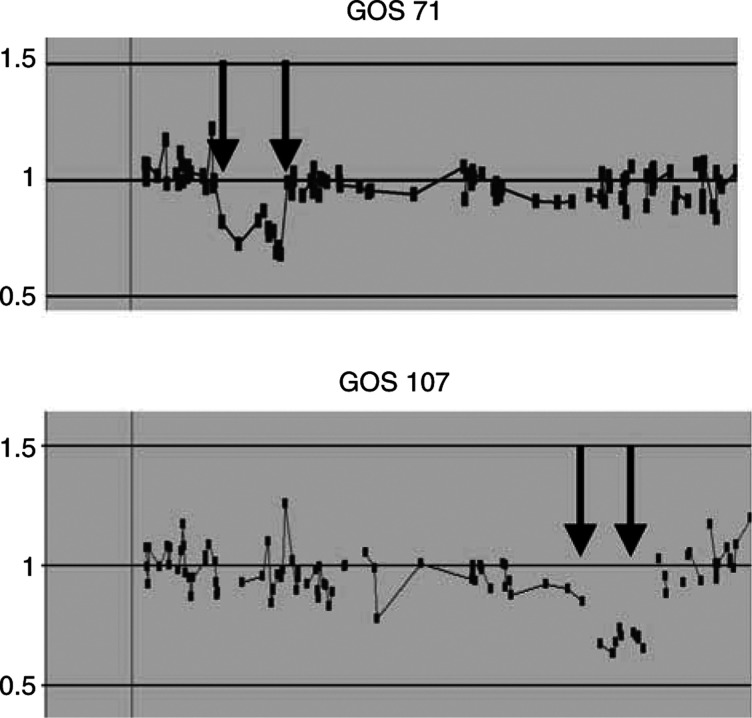
CGHa profiles for patients reportedly with 13q- syndrome. In GOS 71, the deletion (arrows) is seen in the 13q12–14 region, whereas, in patient GOS 107, the deletion (arrows) lies more distal in the 13q31–33 region.
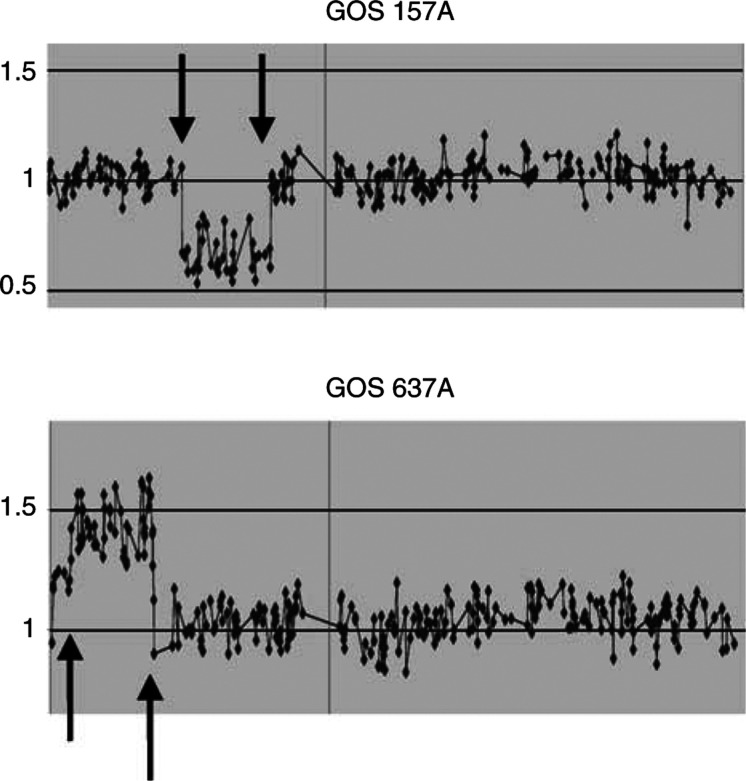
CGHa profiles for patients with constitutional chromosome abnormalities involving chromosome 11. Patient GOS 157 carries a deletion (arrows) in the 11p13 region and patient GOS 637 shows a triplication (arrows) in the 11p15 region.
References
-
- Baldini A (2002) DiGeorge syndrome: the use of model organisms to dissect complex genetics. Hum Mol Genet 11: 2363–2369 - PubMed
-
- Bruder CEG, Hirvela C, Tapia-Paez I, Fransson I, Segraves R, Hamilton G, Zhang XX, Evans DG, Wallace AJ, Baser ME, Zucman-Rossi J, Hergersberg M, Boltshauser E, Papi L, Rouleau GA, Poptodorov G, Jordanova A, Rask-Andersen H, Kluwe L, Mautner V, Sainio M, Hung G, Mathiesen T, Moller C, Pulst SM, Harder H, Heiberg A, Honda M, Niimura M, Sahlen S, Blennow E, Albertson DG, Pinkel D, Dumanski JP (2001) High resolution deletion analysis of constitutional DNA from neurofibromatosis type 2 (NF2) patients using microarray-CGH. Hum Mol Genet 10: 272–282 - PubMed
-
- Cheung VG, Nowak N, Jang W, Kirsch IR, Zhao S, Chen XN, Furey TS, Kim UJ, Kuo WL, Olivier M, Conroy J, Kasprzyk A, Massa H, Yonescu R, Sait S, Thoreen C, Snijders A, Lemyre E, Bailey JA, Bruzel A, Burrill WD, Clegg SM, Collins S, Dhami P, Friedman C, Han CS, Herrick S, Lee J, Ligon AH, Lowry S, Morley M, Narasimhan S, Osoegawa K, Peng Z, Plajzer-Frick I, Quade BJ, Scott D, Sirotkin K, Thorpe AA, Gray JW, Hudson J, Pinkel D, Ried T, Rowen L, Shen-Ong GL, Strausberg SL, Birney E, Callen DF, Cheng JF, Cox DR, Doggett NA, Carter NP, Eichler EE, Haussler D, Korenberg JR, Morton CC, Albertson D, Schuler G, de Jong PJ, Trask BJ (2001) Integration of cytogenetic landmarks into the draft sequence of the human genome. Nature 409: 953–958 - PMC - PubMed
-
- Cowell JK, Barnett GH, Nowak NJ (2004b) Characterization of the 1p/19q chromosomal loss in oligodendrogliomas using CGHa. J Neuropath Exp Neurol, in press - PubMed
-
- Cowell JK, Hungerford J, Rutland P, Jay M (1987) A chromosomal breakpoint which separates the esterase-D and retinoblastoma predisposition loci in a patient with del(13) (q14-q31). Cancer Genet Cytogenet 27: 27–31 - PubMed
Publication types
MeSH terms
Grants and funding
LinkOut - more resources
Full Text Sources
