


Global analysis of nutrient control of gene expression in Saccharomyces cerevisiae during growth and starvation
- PMID: 14973188
- PMCID: PMC365758
- DOI: 10.1073/pnas.0308321100
Global analysis of nutrient control of gene expression in Saccharomyces cerevisiae during growth and starvation
Abstract
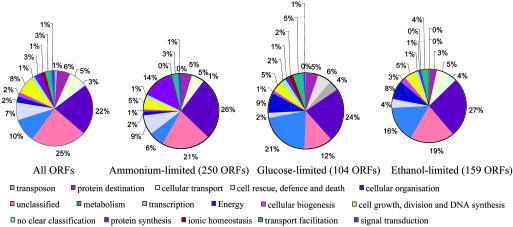
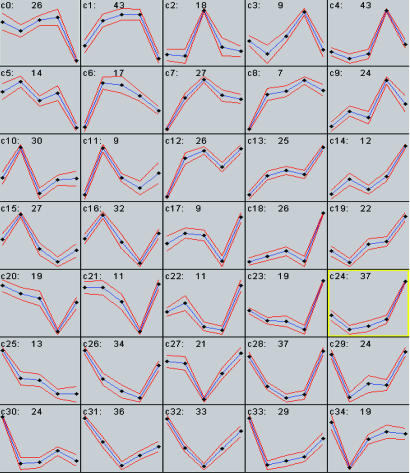
Global gene expression in yeast was examined in five different nutrient-limited steady states and in their corresponding starvation-induced stationary phases. The use of chemostats, with their ability to generate defined and reproducible physiological conditions, permitted the exclusion of the confounding variables that frequently complicate transcriptome analyses. This approach allowed us to dissect out effects on gene expression that are specific to particular physiological states. Thus, we discovered that a large number of ORFs involved in protein synthesis were activated under ammonium limitation, whereas the expression of ORFs concerned with energy and metabolism was enhanced by carbon limitation. Elevated transcription of genes in high-affinity glucose uptake, the trichloroacetic acid cycle, and oxidative phosphorylation were observed in glucose-limiting, but not glucose-abundant, conditions. In contrast, genes involved in gluconeogenesis and, interestingly, genes subject to nitrogen catabolite repression increased their transcription when ethanol was the carbon source, even though ammonium was in excess. This result suggests that up-regulation of genes sensitive to nitrogen catabolite repression may contribute anapleurotic intermediates in ethanol-grown cells. The different starvation conditions produced two general types of transcription profiles, with carbon-starved cells transcribing far fewer genes than cells starved for any of the other macronutrients. Nonetheless, each starvation condition induced its own peculiar set of genes, and only 17 genes were induced >5-fold by all five starvations. In all cases, analysis of the upstream sequences of clusters of coregulated genes identified motifs that may be recognized by transcription factors specific for controlling gene expression in each of the physiological conditions examined.
Figures

References
-
- Oliver, S. (2000) Nature 403, 601-603. - PubMed
-
- Hughes, T. R., Marton, M. J., Jones, A. R., Roberts, C. J., Stoughton, R., Armour, C. D., Bennett, H. A., Coffey, E., Dai, H., He, Y. D., et al. (2000) Cell 102, 109-126. - PubMed
-
- Hayes, A., Zhang, N., Wu, J., Butler, P. R., Hauser, N. C., Hoheisel, J. D., Lim, F. L., Sharrocks, A. D. & Oliver, S. G. (2002) Methods 26, 281-290. - PubMed
-
- Pirt, S. J. (1975) Principles of Microbe and Cell Cultivation (Blackwell Scientific, Oxford, U.K.).
Publication types
MeSH terms
Substances
LinkOut - more resources
Full Text Sources
Other Literature Sources
Molecular Biology Databases
