. 2004 Mar 2;101(9):2788-93.
doi: 10.1073/pnas.0305859101. Epub 2004 Feb 18.

Portability and fidelity of RNA-repair systems

Affiliations

Portability and fidelity of RNA-repair systems

Beate Schwer et al. Proc Natl Acad Sci U S A. .

Abstract

Yeast tRNA ligase (Trl1) is an essential enzyme that converts cleaved tRNA half-molecules into spliced tRNAs containing a 2'-PO(4), 3'-5' phosphodiester at the splice junction. Trl1 also catalyzes splicing of HAC1 mRNA during the unfolded protein response. Trl1 performs three reactions: the 2',3'-cyclic phosphate of the proximal RNA fragment is hydrolyzed to a 3'-OH, 2'-PO(4) by a cyclic phosphodiesterase; the 5'-OH of the distal RNA fragment is phosphorylated by a GTP-dependent polynucleotide kinase; and the 3'-OH, 2'-PO(4), and 5'-PO(4) ends are then sealed by an ATP-dependent RNA ligase. The removal of the 2'-PO(4) at the splice junction is catalyzed by the essential enzyme Tpt1, which transfers the RNA 2'-PO(4) to NAD(+) to form ADP-ribose 1"-2"-cyclic phosphate. Here, we show that the bacteriophage T4 enzymes RNA ligase 1 and polynucleotide kinase/phosphatase can fulfill the tRNA and HAC1 mRNA splicing functions of yeast Trl1 in vivo and bypass the requirement for Tpt1. These results attest to the portability of RNA-repair systems, notwithstanding the significant differences in the specificities, mechanisms, and reaction intermediates of the individual yeast and T4 enzymes responsible for the RNA healing and sealing steps. We surmise that Tpt1 and its unique metabolite ADP-ribose 1"-2"-cyclic phosphate do not play essential roles in yeast independent of the tRNA-splicing reaction. Our finding that one-sixth of spliced HAC1 mRNAs in yeast cells containing the T4 RNA-repair system suffered deletion of a single nucleotide at the 3' end of the splice-donor site suggests a model whereby the yeast RNA-repair system evolved a requirement for the 2'-PO(4) for RNA ligation to suppress inappropriate RNA recombination.


Figures
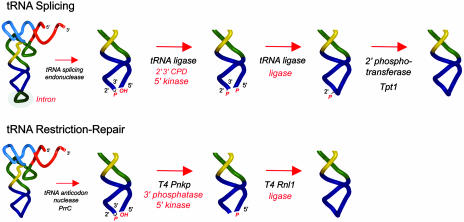
Fig. 1.
Fig. 1.
Yeast tRNA-splicing and phage tRNA-restriction-repair pathways. In tRNA splicing, the pre-tRNA is cleaved at the exon–intron junctions in the anticodon loop by a tRNA-splicing endonuclease, which leaves a 2′,3′-cyclic phosphate end on the proximal half-molecule and a 5′-OH on the distal half-molecule. The ends are then remodeled and sealed by tRNA ligase (Trl1), a multifunctional protein with 2′,3′-CPD, 5′ kinase, and ligase activities. The residual 2′-PO4 at the splice junction is then removed by the NAD+-dependent 2′ phosphotransferase Tpt1. In tRNA-restriction repair, the mature tRNALys is cleaved in the anticodon loop by PrrC, which leaves 2′,3′-cyclic phosphate and 5′-OH ends. The ends are then healed by T4 Pnkp, which removes the phosphate at the 3′ end and phosphorylates the 5′ terminus. T4 Rnl1 then seals the 3′-OH and 5′-PO4 termini to form a standard 3′-5′ phosphodiester linkage and thus restore tRNALys function in protein synthesis.
Fig. 2.
Fig. 2.
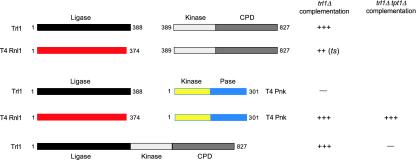
The T4 RNA-repair system can replace yeast tRNA ligase in vivo and bypass the requirement for Tpt1. The N-terminal adenylyltransferase/ligase domain is black and the C-terminal kinase-CPD domains of Trl1 are white/gray. T4 Rnl1 is red. T4 Pnkp is yellow (N-terminal kinase) and blue (C-terminal phosphatase). CEN plasmids expressing the indicated components were tested by plasmid shuffle for complementation of the yeast trl1Δ strain and, where indicated, the trl1Δ tpt1Δ strain. Complementation was scored as described in Materials and Methods.
Fig. 3.
Fig. 3.
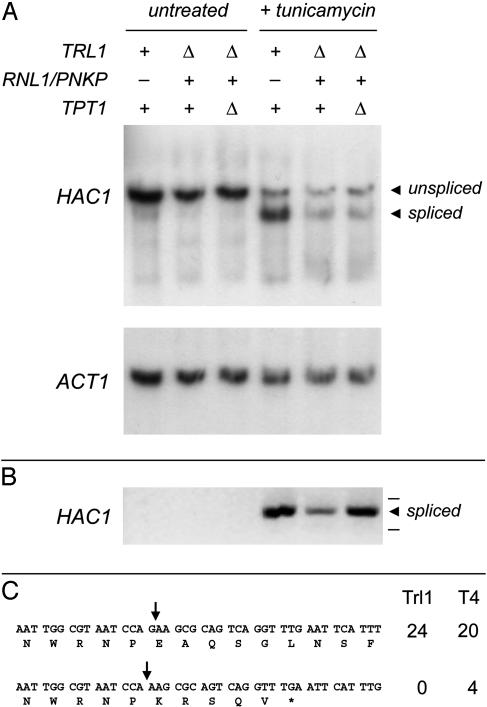
Splicing of HAC1 mRNA in the unfolded protein response. (A) The genotypes of the yeast strains with respect to the tRNA-splicing enzymes are indicated above the lanes. Total RNA isolated from uninduced and tunicamycin-induced yeast cultures was resolved by agarose gel electrophoresis, transferred to a membrane, and probed for HAC1 and ACT1 mRNAs, as indicated. The hybridized 32P-labeled probes were detected by autoradiography. The spliced and unspliced HAC1 mRNAs are indicated by the arrowheads at right. (B) Spliced HAC1 mRNA was amplified by RT-PCR. The DNA products were analyzed by agarose gel electrophoresis, stained with ethidium bromide, and visualized by short-wave UV transillumination. An inverse image of the stained gel is shown. The amplified spliced HAC1 cDNA (indicated by the arrowhead at right) migrated between the 600- and 400-bp linear duplex DNA markers (-, above and below the arrowhead). (C) Individual cDNA clones of spliced HAC1 mRNAs derived from tunicamycin-treated cell containing either yeast tRNA ligase (Trl1; n = 24) or T4 Rnl1 and Pnkp (T4; n = 24) were sequenced. The coding strand sequence flanking the correctly spliced junction of Ire1-incised HAC1 mRNA is shown above the sequence of the minority population (4 of 24) of incorrectly spliced HAC1 mRNAs detected in RNL1 PNKP cells.

References

    1. Silber, R., Malathi, V. G. & Hurwitz, J. (1972) Proc. Natl. Acad. Sci. USA 69, 3009-3013. - PMC - PubMed
    1. Abelson, J., Trotta, C. R. & Li, H. (1998) J. Biol. Chem. 273, 12685-12688. - PubMed
    1. Simpson, L., Sbicego, S. & Aphasizhev, R. (2003) RNA 9, 265-276. - PMC - PubMed
    1. Amitsur, M., Levitz, R. & Kaufman, G. (1987) EMBO J. 6, 2499-2503. - PMC - PubMed
    1. Kaufmann, G. (2000) Trends Biochem. Sci. 25, 70-74. - PubMed

LinkOut - more resources