


A Framework for Decision-Making for Mass Distribution of Mectizan(R) in Areas Endemic for Loa loa
- PMID: 14975066
- PMCID: PMC2147661
- DOI: 10.1186/1475-2883-2-S1-S9
A Framework for Decision-Making for Mass Distribution of Mectizan(R) in Areas Endemic for Loa loa
Abstract
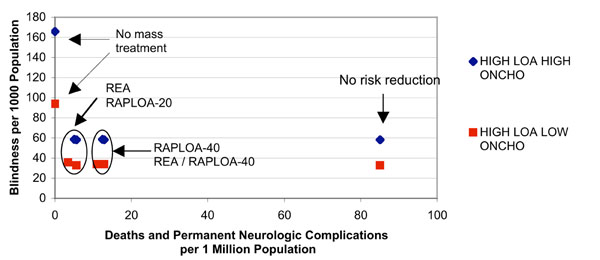
BACKGROUND: The occurrence of Loa loa encephalopathy following mass treatment of onchocerciasis with Mectizan(R) has adversely affected onchocerciasis control efforts in central Africa. Persons with very high densities of L. loa microfilaremia are at increased risk of encephalopathy, but little is known about the geographic distribution of these persons within central Africa. RAPLOA, a new technique that correlates the proportion of community members reporting a history of eyeworm with the prevalence of high-intensity L. loa microfilaremia in that community, may be useful for rapid assessment of areas at potential risk of treatment-related L. loa encephalopathy. Validation of RAPLOA is ongoing. The operational and risk-reduction advantages of RAPLOA over the current technique of village-by-village rapid epidemiologic assessment for onchocerciasis (REA) are unknown. METHODS: We developed a decision model to compare four strategies for minimizing sequelae of L. loa encephalopathy following mass treatment with Mectizan(R) in areas co-endemic for onchocerciasis and loiasis: REA; RAPLOA with threshold eyeworm prevalences of 40% and 20% (RAPLOA-40 and RAPLOA-20, respectively); and combined REA/RAPLOA-40. RESULTS: In the model, all four strategies significantly reduced risk of death and neurologic complications from L. loa encephalopathy, but RAPLOA-20 and REA resulted in half as many such cases as did RAPLOA-40 or combined REA/RAPLOA-40. CONCLUSION: RAPLOA is likely to be useful programmatically in reducing risk of L. loa encephalopathy following mass treatment with Mectizan(R). It also may be cost-saving. Before full-scale implementation, additional data are needed on geographic clustering of high-density L. loa microfilaremia and on RAPLOA's reliability and cost.
Figures
References
-
- Ducorps M, Gardon-Wendel N, Ranque S, Ndong W, Boussinesq M, Gardon J, Schneider D, Chippeaux J-P. Effets secondaires du traitement de la loase hypermicrofilarémique par l'ivermectine. Bulletin de la Societe de Pathologie Exotique et de ses Filiales. 1995;88:105–112. - PubMed
-
- Noma M, Nwoke BEB, Nutall I, Tambala PA, Enyong P, Namsenmo A, Remme J, Amazigo UV, Kale OO, Sékétéli A. Rapid epidemiological mapping of onchocerciasis (REMO): its application by the African Programme for Onchocerciasis Control (APOC) Ann Trop Med Parasitol. 2002;96:29–40. doi: 10.1179/000349802125000637. - DOI - PubMed
-
- TDR (UNDP/World Bank/WHO Special Programme for Research and Training in Tropical Diseases) Guidelines for analysis of REMO data using GIS TDR/TDF/COMDT/98.3. Geneva World Health Organization. 1998.
-
- Anonymous Central Nervous System Complications of Loiasis and Adverse CNS Events following Treatment: Report of an Invited Consultation, 2–3 October 1995. Atlanta Mectizan Donation Program. 1996.
LinkOut - more resources
Full Text Sources
