. 2004 Mar 2;101(9):2993-8.
doi: 10.1073/pnas.0400050101. Epub 2004 Feb 19.

Mice deficient for soluble adenylyl cyclase are infertile because of a severe sperm-motility defect

Affiliations

Mice deficient for soluble adenylyl cyclase are infertile because of a severe sperm-motility defect

Gloria Esposito et al. Proc Natl Acad Sci U S A. .

Erratum in

  • Proc Natl Acad Sci U S A. 2004 Apr 6;101(14):5180. Jaiswal Byjay S [corrected to Jaiswal Bijay S]

Abstract

To acquire the ability to fertilize, spermatozoa undergo complex, but at present poorly understood, activation processes. The intracellular rise of cAMP produced by the bicarbonate-dependent soluble adenylyl cyclase (sAC) has been suggested to play a central role in initiating the cascade of the events that culminates in spermatozoa maturation. Here, we show that targeted disruption of the sAC gene does not affect spermatogenesis but dramatically impairs sperm motility, leading to male sterility. sAC mutant spermatozoa are characterized by a total loss of forward motility and are unable to fertilize oocytes in vitro. Interestingly, motility in sAC mutant spermatozoa can be restored on cAMP loading, indicating that the motility defect observed is not caused by a structural defect. We, therefore, conclude that sAC plays an essential and nonredundant role in the activation of the signaling cascade controlling motility and, therefore, in fertility. The crucial role of sAC in fertility and the absence of any other obvious pathological abnormalities in sAC-deficient mice may provide a rationale for developing inhibitors that can be applied as a human male contraceptive.


Figures

Fig. 1.
Fig. 1.
Generation of sAC-deficient mice. (A) Schematic representation of the gene targeting in the sAC locus by homologous recombination. Only exons 1-5 of the wild-type locus are shown. Rectangles represent coding DNA. Only the relevant EcoRI sites are shown. E, exon; RI, EcoRI site; P, 5′ external probe. (B) Targeted ES cells. A Southern blot of EcoRI-digested DNA from targeted ES and wild-type cells, respectively, is shown. A 5′ external probe was used. The wild-type fragment migrates at 16 kb, and the fragment from the targeted locus migrates at 8 kb. (C) PCR genotyping-confirmed gene disruption in mice. Tail genomic DNA was used to amplify the sAC targeted allele and the sAC wild-type allele. (D) In situ hybridization of testis from wild-type (msAC+/+) and sAC-/- (msAC-/-) mice, respectively.
Fig. 2.
Fig. 2.
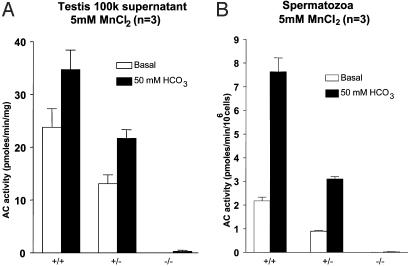
AC activity in testes (A) and spermatozoa (B) from the sAC-/-, matched sAC+/-, and wild-type littermates, respectively. Testes and spermatozoa extracts were prepared as described in Methods. Aliquots of the extracts were used to measure AC activity in the presence of 5 mM MnCl2 without or with 50 mM HCO3-.
Fig. 3.
Fig. 3.
Characteristics of mutant testes. (A) β-Galactosidase activity in the testis from a 9-week-old male sAC-/- mouse. Strong positive staining (arrows) in the late stages of spermatogenesis, near the spermatids. (B) Bouin-fixed and PAS-stained section from the testis of a 10-week-old male sAC-/- mouse. Normal histological appearance of the testis with seminiferous tubules in all stages of spermatogenesis including stage 12 (*) with normal meiotic cells. (B Inset) Detailed view showing the acrosome staining in the elongated spermatids.
Fig. 4.
Fig. 4.
sAC-/- male mice are infertile. (A) Shown is the percentage of litter production from sAC+/+ (n = 10) and sAC-/- females (n = 8) after a breeding period of 1 week. sAC-/- male mice (n = 20) were caged with three C57BL/6 females each for periods of 2 weeks to 2 months. (B) Sperm and elongated spermatid count. Only one epididymis per mouse was used for sperm isolation, and only one testis per mouse was used. The graphs represent data from 12 wild-type and 12 sAC-/- animals. (C) Linear motility measurement. A-C represent means ± SEM.
Fig. 5.
Fig. 5.
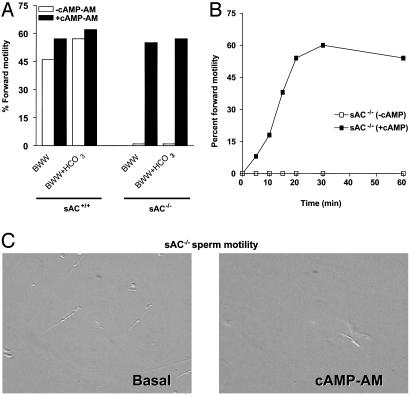
Forward motility is restored in the sAC-/- spermatozoa by cAMP loading. (A) Total number of sperm (immotile and forward-moving) was scored by two individuals independently. Motility is expressed as percentage of sperm moving forward. (B) Motility was monitored at various times after exposure to cAMP-AM. (C) Frame of sAC-/- control spermatozoa or spermatozoa exposed to cAMP-AM. For the complete movie, see Movies 1 and 2, which are published as supporting information on the PNAS web site.

References

    1. Breihbart, H. (2002) Mol. Cell. Endocrinol. 187, 139-144. - PubMed
    1. Visconti, P. E., Moore, G. D., Bailey, J. L., Leclerc, P., Connors, S. A., Pan, D., Olds-Clarke, P. & Kopf, G. S. (1995) Development (Cambridge, U.K.) 121, 1139-1150. - PubMed
    1. Zippin, J. H., Levin, L. R. & Buck, J. (2001) Trends Endocrinol. Metab. 12, 366-370. - PubMed
    1. Lee, M. A. & Storey, B. T. (1986) Biol. Reprod. 34, 349-356. - PubMed
    1. Chen, Y., Cann, M. J., Litvin, T. N., Iourgenko, V., Sinclair, M. L., Levin, L. R. & Buck, J. (2000) Science 289, 625-628. - PubMed

Publication types