. 2004 Mar;72(3):1374-82.
doi: 10.1128/IAI.72.3.1374-1382.2004.

Humoral responses to Porphyromonas gingivalis gingipain adhesin domains in subjects with chronic periodontitis

Affiliations

Humoral responses to Porphyromonas gingivalis gingipain adhesin domains in subjects with chronic periodontitis

Ky-Anh Nguyen et al. Infect Immun. 2004 Mar.

Abstract

The gingipains have been implicated in the pathogenicity of Porphyromonas gingivalis, a major etiologic agent of chronic periodontitis. Mature gingipains often present as a membrane-bound glycosylated proteinase-adhesin complex comprising multiple adhesin domains (HA1 to -4) and a catalytic domain. Using recombinant adhesin domains, we were able to show that patients with chronic periodontitis produce significantly more immunoglobulin G reactive with gingipain domains than a corresponding group with healthy periodontium. Titers were predominantly directed toward the carbohydrate epitopes shared between the gingipains and the lipopolysaccharide of P. gingivalis with little recognition of the peptide backbone of the catalytic domains. Distribution of titers to peptide epitopes of the adhesin domains was as follows: HA4 approximately HA1 > HA3 >> HA2. No correlation was observed between markers of disease severity and titers to individual adhesins within the disease group. Posttreatment titers showed no change or a decrease in titers for the majority of patients except for titers to the HA2 domain which showed marked increases in a few responding patients. Since the HA2 domain is important in hemoglobin binding and acquisition of essential porphyrin, boosting titers of antibodies to this domain may have the potential to control the growth of this organism.


Figures
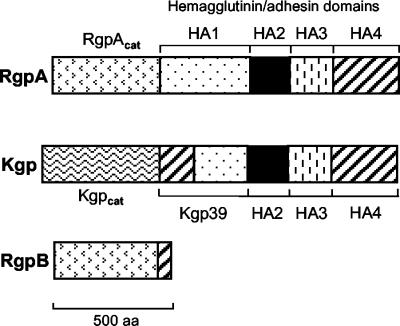
FIG. 1.
FIG. 1.
Domains of the gingipain complex. Highly homologous regions (similarly hatched regions) occur between the mature proteins of RgpA, RgpB, and Kgp in P. gingivalis strain HG66 (31, 34). Rgpcat and Kgpcat denote the catalytic domains of the arginine-specific and lysine-specific gingipains, respectively. The hemagglutinin/adhesin domains are denoted as HA1 to HA4. Kgp39 is a fusion protein between the N-terminal region of HA4 and the C-terminal region of HA1.
FIG. 2.
FIG. 2.
Diagram of the regions of the cloned protein with respect to the rgpA gene. Small arrows denote the position of primers for the particular cloned domain.
FIG. 3.
FIG. 3.
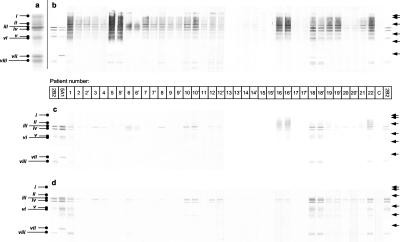
SDS-PAGE of the gingipain complex and the corresponding patient sera reactivity in Western blots. (a) N-terminal sequencing by automated Edman degradation identified the composition of the bands in the denaturing (boiled and reduced) SDS-PAGE preparation of gingipain as RgpA (i), Kgpcat (ii), RgpAcat plus HA1 (iii), Kgp39 (iv), truncated HA1 + HA4 (v), and truncated RgpAcat (vi), HA2 (vii), and HA3 (viii). (b to d) Western blots of whole sera from disease patients against the gingipain complex (b), sera predepleted of anti-P. gingivalis LPS antibodies (c), and sera against the deglycosylated gingipain complex (d). 2B2 and 5A1 denote MAbs recognizing HA1, HA3, and Kgp39 and HA1, HA2, and Kgp39, respectively. Disease patients are numbered in the bar below panel b; number-prime values denote posttreatment serum from the same numbered patient. The “C” denotes serum from one representative control subject. Right arrows represent molecular weight markers: 118, 82, 50.4, 33.4, 26.7, and 19.6 kDa, respectively.
FIG. 4.
FIG. 4.
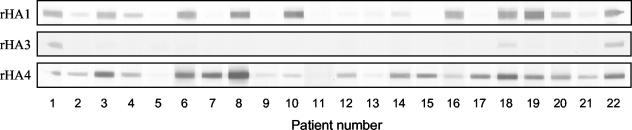
Patient antibodies against recombinant adhesin products as shown by Western blotting. Purified recombinant proteins were separated by denaturing SDS-PAGE and transferred onto nitrocellulose membranes. Membranes were probed with 1:40 dilutions of individual patients (numbered below the blots) sera as described in Materials and Methods. There was no recognition of rHA2.
FIG. 5.
FIG. 5.
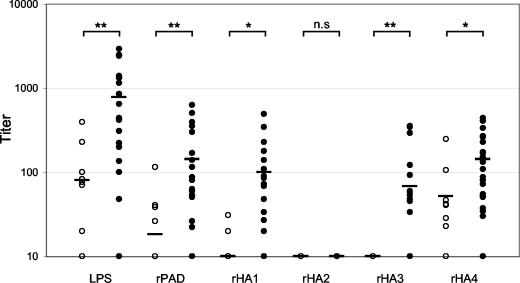
IgG titers to domains of RgpA. Open symbols denote the periodontally healthy subjects, and solid symbols denote the disease patients. Bar in each column represents the mean group titer to each domain. The unpaired, nonparametric Mann-Whitney test was used to analyze differences in mean titer between healthy and disease groups for each domain (n.s, not significant; ✽, P < 0.05; ✽✽, P < 0.01).
FIG. 6.
FIG. 6.
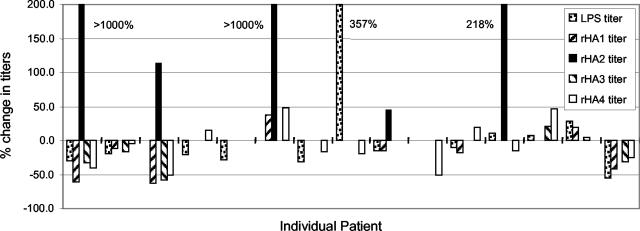
Percent change in pre- and posttreatment antibody titers to each gingipain component in individual patients. Patients with undetectable pretreatment titers to rHA2 were assigned a titer of 1 to enable the calculation of percentage increase posttreatment.

References

    1. Aukhil, I., D. E. Lopatin, S. A. Syed, E. C. Morrison, and C. J. Kowalski. 1988. The effects of periodontal therapy on serum antibody (IgG) levels to plaque microorganisms. J. Clin. Periodontol. 15:544-550. - PubMed
    1. Bradshaw, D. J., and P. D. Marsh. 1999. Use of continuous flow techniques in modeling dental plaque biofilms. Methods Enzymol. 310:279-296. - PubMed
    1. Chen, H. A., B. D. Johnson, T. J. Sims, R. P. Darveau, B. J. Moncla, C. W. Whitney, D. Engel, and R. C. Page. 1991. Humoral immune responses to Porphyromonas gingivalis before and following therapy in rapidly progressive periodontitis patients. J. Periodontol. 62:781-791. - PubMed
    1. Chen, T., K. Nakayama, L. Belliveau, and M. J. Duncan. 2001. Porphyromonas gingivalis gingipains and adhesion to epithelial cells. Infect. Immun. 69:3048-3056. - PMC - PubMed
    1. Ciborowski, P., M. Nishikata, R. D. Allen, and M. S. Lantz. 1994. Purification and characterization of two forms of a high-molecular-weight cysteine proteinase (porphypain) from Porphyromonas gingivalis. J. Bacteriol. 176:4549-4557. - PMC - PubMed

Publication types

MeSH terms