


Antibodies that inhibit binding of Plasmodium falciparum-infected erythrocytes to chondroitin sulfate A and to the C terminus of merozoite surface protein 1 correlate with reduced placental malaria in Cameroonian women
- PMID: 14977967
- PMCID: PMC356046
- DOI: 10.1128/IAI.72.3.1603-1607.2004
Antibodies that inhibit binding of Plasmodium falciparum-infected erythrocytes to chondroitin sulfate A and to the C terminus of merozoite surface protein 1 correlate with reduced placental malaria in Cameroonian women
Abstract
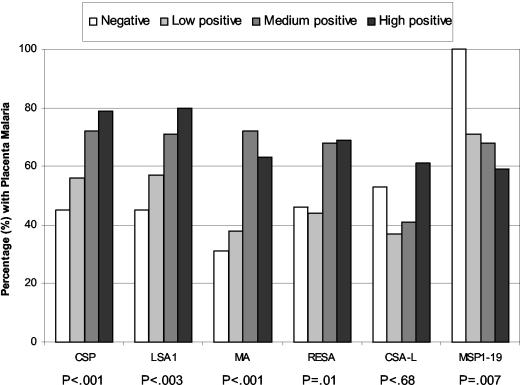
Plasmodium falciparum-infected erythrocytes often sequester in the placenta of pregnant women, producing placental malaria, a condition that can compromise the health of the developing fetus. Scientists are hopeful that a vaccine can be developed to prevent this condition. Immunological mechanisms responsible for eliminating parasites from the placenta remain unclear, but antibodies to the carboxyl-terminal 19-kDa segment of the merozoite surface protein 1 (MSP1-19), the ring-infected erythrocyte surface antigen (RESA), and an erythrocyte-surface ligand that binds chondroitin sulfate A (CSA-L) have been implicated. In addition, antibodies to sporozoite and liver-stage antigens could reduce initial parasite burdens. This study sought to determine if antibodies to the circumsporozoite protein (CSP), liver-stage antigen 1 (LSA1), RESA, MSP1-19, or CSA-L correlated with either the absence of placental parasites or low placental parasitemias. Using a frequency-matched case-control study design, we compared antibody levels in women (gravidity 1 to 11) with and without placental malaria. Results showed that women who were antibody negative for MSP1-19 were at a higher risk of having placental malaria than women with antibodies (P < 0.007). Furthermore, an association between high levels of antibodies that blocked the binding of infected erythrocytes to CSA and low placental parasitemias was observed (P = 0.02). On the other hand, women with high antibody levels at term to CSP, LSA1, and RESA were more likely to have placental malaria than antibody-negative women. Since antibodies to MSP1-19 and CSA-L were associated with reduced placental malaria, both antigens show promise for inclusion in a vaccine for women of child-bearing age.
Figures
References
-
- Achur, R. N., M. Valiyaveettil, A. Alkhalil, C. F. Ockenhouse, and D. C. Gowda. 2000. Characterization of proteoglycans of human placenta and identification of unique chondroitin sulfate proteoglycans of the intervillous spaces that mediate the adherence of Plasmodium falciparum-infected erythrocytes to the placenta. J. Biol. Chem. 275:40344-40356. - PubMed
-
- Alkhalil, A., R. N. Achur, M. Valiyaveettil, C. F. Ockenhouse, and D. C. Gowda. 2000. Structural requirements for the adherence of Plasmodium falciparum-infected erythrocytes to chondroitin sulfate proteoglycans of human placenta. J. Biol. Chem. 275:40357-40364. - PubMed
-
- Astagneau, P., R. W. Steketee, J. J. Wirima, C. O. Khoromana, and P. Millet. 1994. Antibodies to ring-infected erythrocyte surface antigen (Pf155/RESA) protect against P. falciparum parasitemia in highly exposed multigravidas women in Malawi. Acta Trop. 57:317-325. - PubMed
-
- Beck, S., F. P. Mockenhaupt, U. Bienzle, T. A. Eggelte, W. N. Thompson, and S. K. 2001. Multiplicity of Plasmodium falciparum infection in pregnancy. Am. J. Trop. Med. Hyg. 65:631-636. - PubMed
Publication types
MeSH terms
Substances
Grants and funding
LinkOut - more resources
Full Text Sources
Research Materials
