Comparative Study
. 2004 Mar;72(3):1666-76.
doi: 10.1128/IAI.72.3.1666-1676.2004.

Glycolytic and gluconeogenic growth of Escherichia coli O157:H7 (EDL933) and E. coli K-12 (MG1655) in the mouse intestine

Affiliations
Comparative Study

Glycolytic and gluconeogenic growth of Escherichia coli O157:H7 (EDL933) and E. coli K-12 (MG1655) in the mouse intestine

Regina L Miranda et al. Infect Immun. 2004 Mar.

Abstract

Escherichia coli EDL933, an O157:H7 strain, is known to colonize the streptomycin-treated CD-1 mouse intestine by growing in intestinal mucus (E. A. Wadolkowski, J. A. Burris, and A. D. O'Brien, Infect. Immun. 58:2438-2445, 1990), but what nutrients and metabolic pathways are employed during colonization has not been determined. In this study, when the wild-type EDL933 strain was fed to mice along with an EDL933 DeltappsA DeltapckA mutant, which is unable to utilize tricarboxylic acid cycle intermediates and gluconeogenic substrates for growth, both strains colonized the mouse intestine equally well. Therefore, EDL933 utilizes a glycolytic substrate(s) for both initial growth and maintenance when it is the only E. coli strain fed to the mice. However, in the presence of large numbers of MG1655, a K-12 strain, it is shown that EDL933 utilizes a glycolytic substrate(s) for initial growth in the mouse intestine but appears to utilize both glycolytic and gluconeogenic substrates in an attempt to maintain colonization. It is further shown that MG1655 predominantly utilizes glycolytic substrates for growth in the mouse intestine whether growing in the presence or absence of large numbers of EDL933. Data are presented showing that although small numbers of EDL933 grow to large numbers in the intestine in the presence of large numbers of MG1655 when both strains are fed to mice simultaneously, precolonization with MG1655 affords protection against subsequent colonization by EDL933. Moreover, in mice that are precolonized with EDL933, small numbers of MG1655 are able to grow rapidly in the intestine and EDL933 is eliminated. In situ hybridization experiments using E. coli-specific rRNA probes showed that while MG1655 is found only in mucus, EDL933 is found both in mucus and closely associated with intestinal epithelial cells. The data are discussed with respect to competition for nutrients and to the protection that some intestinal commensal E. coli strains might afford against infection by O157:H7 strains.


Figures
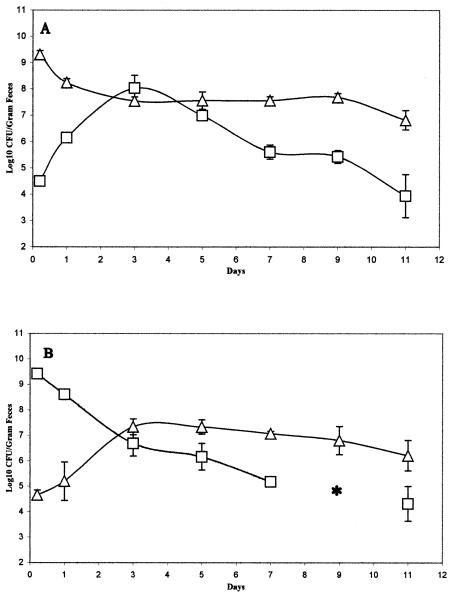
FIG. 1.
FIG. 1.
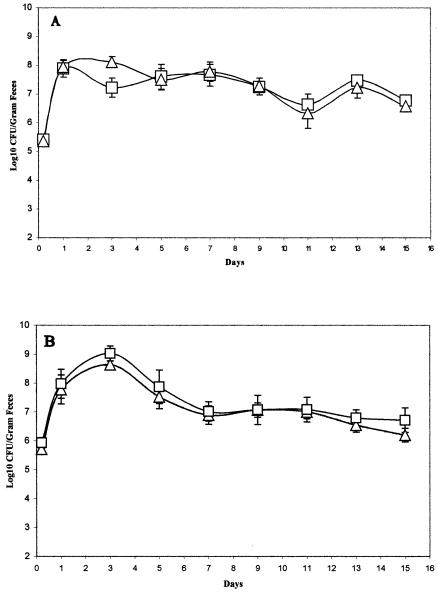
Colonization of the intestine by MG1655 and EDL933 fed simultaneously to mice. Sets of three mice were fed either 1010 CFU of MG1655 Strr (▵) and 105 CFU of EDL933 Strr Nalr (□) (A) or 1010 CFU of EDL933 Strr (□) and 105 CFU of MG1655 Strr Nalr (▵) (B). At the indicated times, fecal samples were homogenized, diluted, and plated as described in Materials and Methods. When necessary, 100 colonies from MacConkey agar plates containing streptomycin were applied with toothpicks to MacConkey agar plates containing both streptomycin and nalidixic acid. The asterisk in place of the day 9 data point represents <1 colony in 100 toothpicked colonies from each mouse that were EDL933 Strr. Bars representing standard errors of the log10 means of CFU per gram of feces for each set of three mice are presented for each time point.
FIG. 2.
FIG. 2.
Colonization of the mouse intestine by E. coli strain MG1655 and its ppsA pckA deletion mutant and EDL933 and its ppsA pckA deletion mutant. Sets of three mice were fed either 105 CFU of MG1655 Strr Nalr (□) and 105 CFU of MG1655 Strr ΔppsA ΔpckA::Cm (▵) (A) or 105 CFU of EDL933 Strr Nalr (□) and 105 CFU of EDL933 Strr ΔppsA ΔpckA::Cm (▵) (B). At the indicated times, fecal samples were homogenized, diluted, and plated as described in Materials and Methods. Bars representing standard errors of the log10 means of CFU per gram of feces for each set of three mice are presented for each time point.
FIG. 3.
FIG. 3.
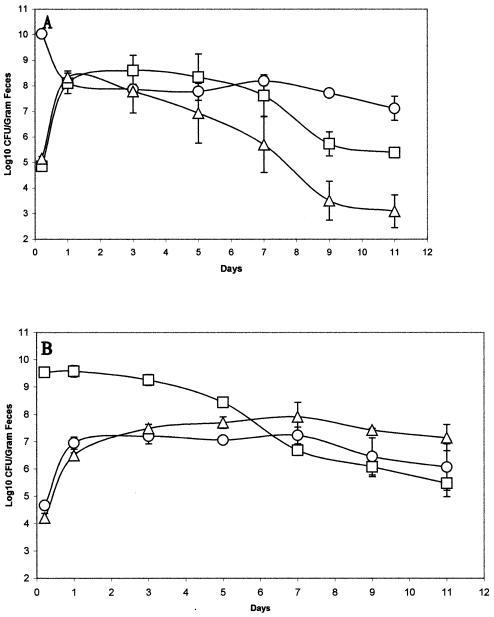
Colonization of the mouse intestine by E. coli strains MG1655 and EDL933 and their ΔppsA ΔpckA::Cm mutants. Sets of three mice were fed 1010 CFU of MG1655 Strr (○) and 105 CFU each of EDL933 Strr Nalr (□) and EDL933 Strr ΔppsA ΔpckA::Cm (▵) (A) or 1010 CFU of EDL933 Strr (□) and 105 CFU each of MG1655 Strr Nalr (○) and MG1655 Strr ΔppsA ΔpckA::Cm (▵) (B). At the indicated times, fecal samples were homogenized, diluted, and plated as described in Materials and Methods. When necessary, 100 colonies from MacConkey agar plates containing streptomycin were applied with toothpicks to MacConkey agar plates containing both streptomycin and nalidixic acid and plates containing both streptomycin and chloramphenicol to determine numbers of either EDL933 Strr or MG1655 Strr cells. Bars representing standard errors of the log10 means of CFU per gram of feces for each set of three mice are presented for each time point.
FIG. 4.
FIG. 4.
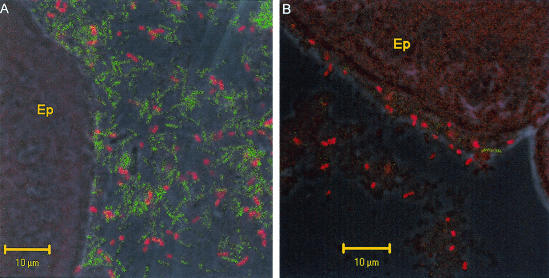
In situ hybridization with fluorescence-labeled oligonucleotide probes. At 24 and 48 h postfeeding, cecal mucosal sections of mice fed EDL933 Strr were hybridized with an E. coli-specific oligonucleotide probe (red) and a eubacteria-specific oligonucleotide probe (green). Cecal sections from 48 h are shown. EP, epithelial cell. E. coli cells appear red, while all other bacteria appear green. Bar, 10 μm. (A) The mucus layer is intact. (B) The mucus layer was separated from the epithelial cell during preparation.
FIG. 5.
FIG. 5.
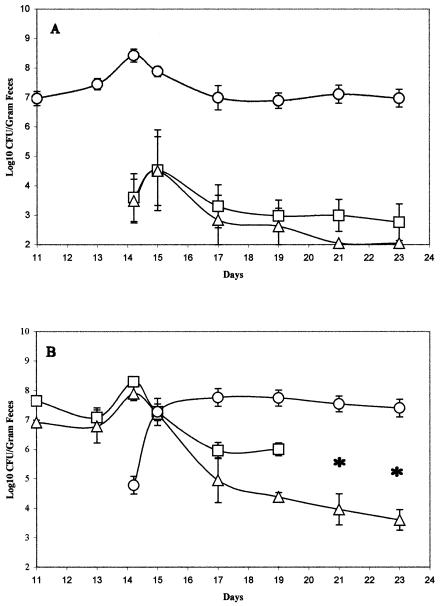
Colonization of the intestine by strains MG1655 and EDL933 when precolonized with either MG1655 or EDL933. Sets of three mice were fed either 105 CFU of MG1655 Strr on day 0 (○) and 105 CFU each of EDL933 Strr Nalr (□) and EDL933 Strr ΔppsA ΔpckA::Cm (▵) on day 14 postfeeding (A) or 105 CFU each of EDL933 Strr (□) and EDL933 Strr ΔppsA ΔpckA::Cm (▵) on day 0 and 105 CFU of MG1655 Strr Nalr (○) on day 14 postfeeding (B). At the indicated times, fecal samples were homogenized, diluted, and plated as described in Materials and Methods. When necessary, 100 colonies from MacConkey agar plates containing streptomycin were applied with toothpicks to MacConkey agar plates containing both streptomycin and nalidixic acid and plates containing both streptomycin and chloramphenicol to determine numbers of EDL933 Strr cells. Asterisks in place of data points represent days when <1 colony in 100 toothpicked colonies from each mouse were EDL933 Strr. Bars representing standard errors of the log10 means of CFU per gram of feces for each set of three mice are presented for each time point.

References

    1. Allan, A. 1981. Structure and function of gastrointestinal mucus, p. 637-639. In L. R. Johnson (ed.), Physiology of the gastrointestinal tract. Raven Press, New York, N.Y.
    1. Brunder, W., H. Schmidt, and H. Karch. 1997. EspP, a novel extracellular serine protease of enterohaemorrhagic Escherichia coli O157:H7 cleaves human coagulation factor V. Mol. Microbiol. 24:767-778. - PubMed
    1. Cohen, P. S., and D. C. Laux. 1995. Bacterial adhesion to and penetration of intestinal mucus in vitro. Methods Enzymol. 253:309-314. - PubMed
    1. Datsenko, K. A., and B. L. Wanner. 2000. One-step inactivation of chromosomal genes in Escherichia coli K-12 using PCR products. Proc. Natl. Acad. Sci. USA 97:6640-6645. - PMC - PubMed
    1. Dean-Nystrom, E. A., B. T. Bosworth, W. C. Cray, Jr., and H. W. Moon. 1997. Pathogenicity of Escherichia coli O157:H7 in the intestines of neonatal calves. Infect. Immun. 65:1842-1848. - PMC - PubMed

Publication types

MeSH terms

LinkOut - more resources