. 2004 Mar 2;101(9):3258-63.
doi: 10.1073/pnas.0308744101. Epub 2004 Feb 20.

Serum leptin level is a regulator of bone mass

Affiliations

Serum leptin level is a regulator of bone mass

F Elefteriou et al. Proc Natl Acad Sci U S A. .

Abstract

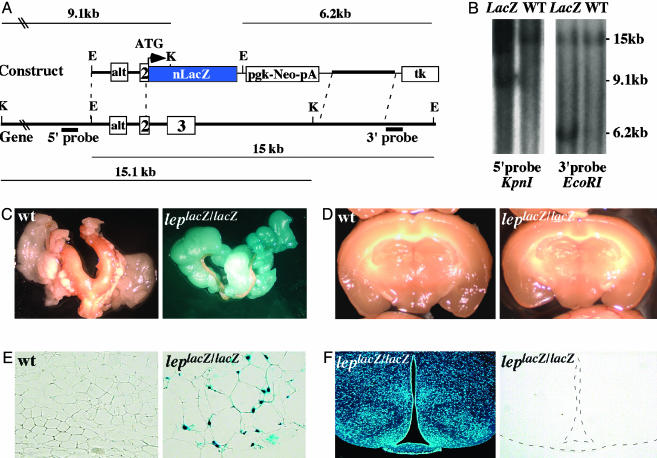
Leptin is a powerful inhibitor of bone formation in vivo. This antiosteogenic function involves leptin binding to its receptors on ventromedial hypothalamic neurons, the autonomous nervous system and beta-adrenergic receptors on osteoblasts. However, the mechanisms whereby leptin controls the function of ventromedial hypothalamic antiosteogenic neurons remain unclear. In this study, we compared the ability of leptin to regulate body weight and bone mass and show that leptin antiosteogenic and anorexigenic functions are affected by similar amounts of leptin. Using a knock-in of LacZ in the leptin locus, we failed to detect any leptin synthesis in the central nervous system. However, increasing serum leptin level, even dramatically, reduced bone mass. Conversely, reducing serum-free leptin level by overexpressing a soluble receptor for leptin increased bone mass. Congruent with these results, the high bone mass of lipodystrophic mice could be corrected by restoring serum leptin level, suggesting that leptin is an adipocyte product both necessary and sufficient to control bone mass. Consistent with the high bone mass phenotype of lipodystrophic mice, we observed an advanced bone age, an indirect reflection of premature bone formation, in lipodystrophic patients. Taken together, these results indicate that adipocyte-derived circulating leptin is a determinant of bone formation and suggests that leptin antiosteogenic function is conserved in vertebrates.


Figures
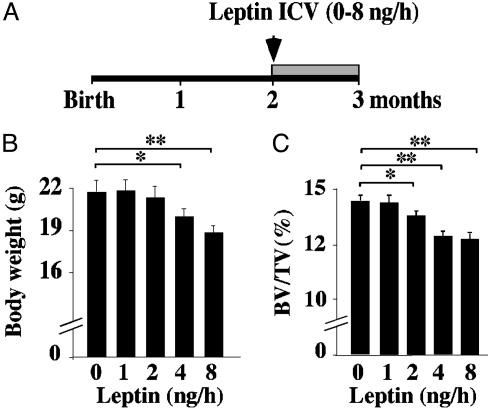
Fig. 1.
Fig. 1.
Comparison of leptin antiosteogenic and anorexigenic functions. (A) Two-month-old C57BL6J females were infused ICV for 28 days with the indicated amount of leptin. (B) The lowest leptin amount that significantly decreased body weight was 4 ng/h. (C) The lowest leptin amount that significantly decreased bone volume over tissue volume (BV/TV, %) was 2 ng/h (n = 8; *, P < 0.05; **, P < 0.005).
Fig. 2.
Fig. 2.
Adipose tissue as the only detectable source of leptin. (A) Genomic organization of the Leptin locus and structure of the targeting vector. Probes used for Southern blots and restriction fragments are indicated. (B) Southern blots. The WT and lacZ knock-in loci gave, respectively, 15.0- and 6.2-kb bands with the 3′ probe, and 15.1- and 9.1 kb bands with the 5′ probe. E, EcoRI; K, KpnI. (C and D) X-Gal-stained gonadal adipose tissue and brain. Staining was detected exclusively in adipose tissue in LepLacZ/LacZ mice. No staining was detected in brain. (E and F) Histological examination of adipose and brain tissues after X-Gal staining. Nuclear staining was readily detectable in adipocyte nuclei, but no staining was observed in any brain section. A representative brain section containing arcuate and ventromedial hypothalamus neurons counterstained with Hoescht (Left) and stained with X-Gal (Right) are shown.
Fig. 3.
Fig. 3.
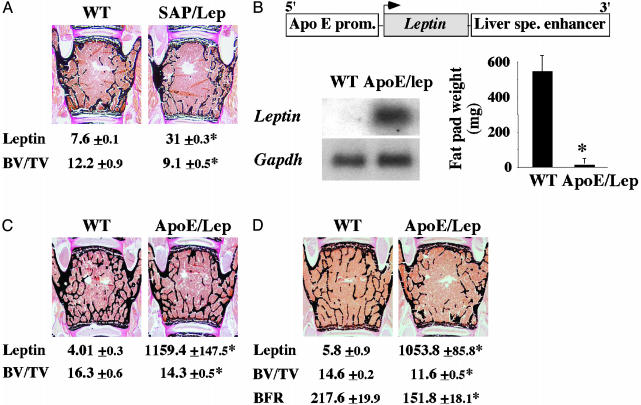
Increasing serum leptin reduces bone mass. (A) Six-month-old SAP-Leptin mice are mildly hyperleptinemic (leptin, ng/ml) and display a low bone volume over tissue volume (BV/TV, %) compared to controls (n = 4; *, P < 0.05). (B) Schematic representation of the ApoE/Lep transgene. Northern blot analysis confirmed the expression of the transgene in liver. ApoE/Lep mice have no fat pads (n = 8; *, P < 0.01). (C and D) Compared to controls, ApoE/lep mice at 3 (C) and 6 (D) months of age displayed a reduced bone volume and a decreased BFR/BS (μm3/μm2 per yr) despite a 200- to 300-fold increase in serum leptin level (ng/ml) (n = 8; *, P < 0.05).
Fig. 4.
Fig. 4.
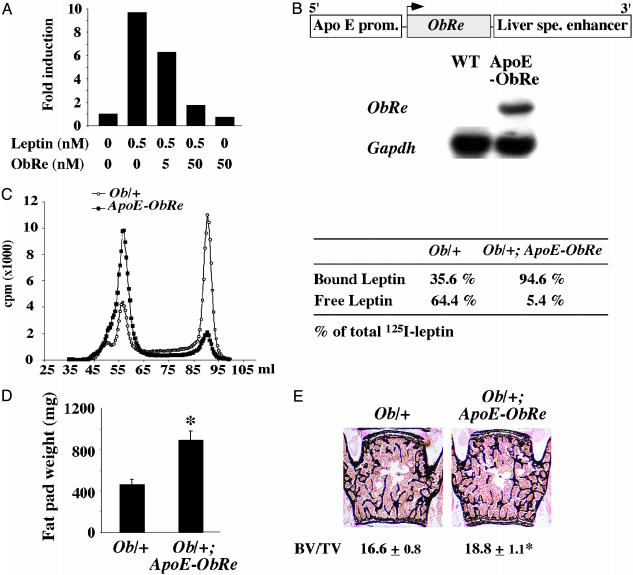
Decreasing serum free leptin level increases bone mass. (A) Leptin-induced STAT3 reporter activity is decreased by ObRe treatment. (B) Schematic representation of the ApoE-ObRe transgene. Northern blot analysis confirmed the expression of the transgene in liver. (C) Size fractionation chromatogram. Marked reduction in serum free leptin level in Ob/+; ApoE-ObRe mice compared to Ob/+ mice (a representative chromatogram is shown, n = 4). (D and E) Three-month-old Ob/+; ApoE-ObRe mice had a significant increase in gonadal fat pad weight (D) and in bone volume over tissue volume (BV/TV, %) (E) compared to controls (n = 8; *, P < 0.05).
Fig. 5.
Fig. 5.
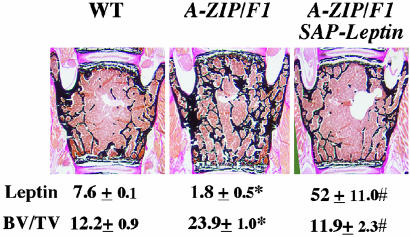
Leptin and bone mass in lipodystrophic mice. Expression of the SAP-leptin transgene in the A-ZIP/F1 genetic background increased serum leptin levels (ng/ml) and corrected the high bone mass of A-ZIP/F1 mice (n = 4; *, controls versus A-ZIP/F1, P < 0.05; #, A-ZIP/F1 versus A-ZIP/F1;SAP-leptin, P < 0.05).

References

    1. Ducy, P., Amling, M., Takeda, S., Priemel, M., Schilling, A. F., Beil, T., Shen, J., Vinson, C., Rueger, J. M. & Karsenty, G. (2000) Cell 100, 197-207. - PubMed
    1. Takeda, S., Elefteriou, F., Levasseur, R., Liu, X., Zhao, L., Parker, K. L., Armstrong, D., Ducy, P. & Karsenty, G. (2002) Cell 111, 305-317. - PubMed
    1. Baldock, P. A., Sainsbury, A., Couzens, M., Enriquez, R. F., Thomas, G. P., Gardiner, E. M. & Herzog, H. (2002) J. Clin. Invest. 109, 915-921. - PMC - PubMed
    1. Sainsbury, A., Baldock, P. A., Schwarzer, C., Ueno, N., Enriquez, R. F., Couzens, M., Inui, A., Herzog, H. & Gardiner, E. M. (2003) Mol. Cell. Biol. 23, 5225-5233. - PMC - PubMed
    1. Moitra, J., Mason, M. M., Olive, M., Krylov, D., Gavrilova, O., Marcus-Samuels, B., Feigenbaum, L., Lee, E., Aoyama, T., Eckhaus, M., et al.(1998) Genes Dev. 12, 3168-3181. - PMC - PubMed

Publication types