. 2004 Mar;13(3):567-74.
doi: 10.1110/ps.03422604.

Nucleotide-induced switch in oligomerization of the AAA+ ATPase ClpB

Affiliations

Nucleotide-induced switch in oligomerization of the AAA+ ATPase ClpB

Vladimir Akoev et al. Protein Sci. 2004 Mar.

Abstract

ClpB is a member of the bacterial protein-disaggregating chaperone machinery and belongs to the AAA(+) superfamily of ATPases associated with various cellular activities. The mechanism of ClpB-assisted reactivation of strongly aggregated proteins is unknown and the oligomeric state of ClpB has been under discussion. Sedimentation equilibrium and sedimentation velocity show that, under physiological ionic strength in the absence of nucleotides, ClpB from Escherichia coli undergoes reversible self-association that involves protein concentration-dependent populations of monomers, heptamers, and intermediate-size oligomers. Under low ionic strength conditions, a heptamer becomes the predominant form of ClpB. In contrast, ATP gamma S, a nonhydrolyzable ATP analog, as well as ADP stabilize hexameric ClpB. Consistently, electron microscopy reveals that ring-type oligomers of ClpB in the absence of nucleotides are larger than those in the presence of ATP gamma S. Thus, the binding of nucleotides without hydrolysis of ATP produces a significant change in the self-association equilibria of ClpB: from reactions supporting formation of a heptamer to those supporting a hexamer. Our results show how ClpB and possibly other related AAA(+) proteins can translate nucleotide binding into a major structural transformation and help explain why previously published electron micrographs of some AAA(+) ATPases detected both six- and sevenfold particle symmetry.


Figures
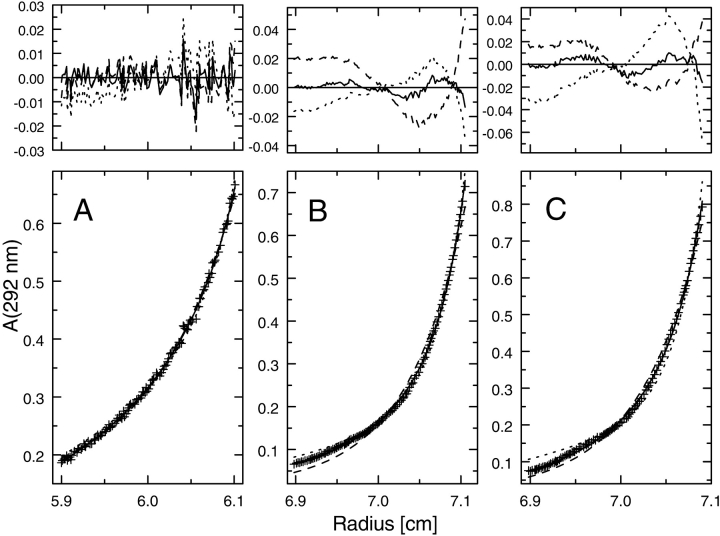
Figure 1.
Figure 1.
Sedimentation equilibrium of ClpB at physiological ionic strength. ClpB was dialyzed against 50 mM Hepes/KOH at pH 7.5, 0.2 M KCl, 20 mM MgCl2, 1 mM β-mercaptoethanol, and 1 mM EDTA and loaded into a centrifuge cell at 0.96 mg/mL (A), 2.0 mg/mL (B), and 4.0 mg/mL (C). Protein concentration gradients (crosses, lower panels) measured at equilibrium at 8000 rpm (4°C) are shown along with fits corresponding to a single-species model (broken line), monomer-heptamer association (dotted line), and monomer-dimer-heptamer association (solid line). The upper panels show residuals (Aexp-Amodel) for the single-species fit (broken line), monomer-heptamer (dotted line), and monomer-dimer-heptamer (solid line). Three data sets shown in panels A, B, and C were simultaneously included in the fitting of each model. The single-species fit gave an apparent molecular weight of 257,100. In the self-association fits, the monomer molecular weight of ClpB (95,543) has been selected as a known constant and the association equilibrium constants were used as adjustable parameters. The monomer-dimer-heptamer fit gave the following values of the equilibrium constants: monomer-dimer, K12 = 5 × 10⁶ M−1; monomer-heptamer, K17 = 2 × 1037 M−6.
Figure 2.
Figure 2.
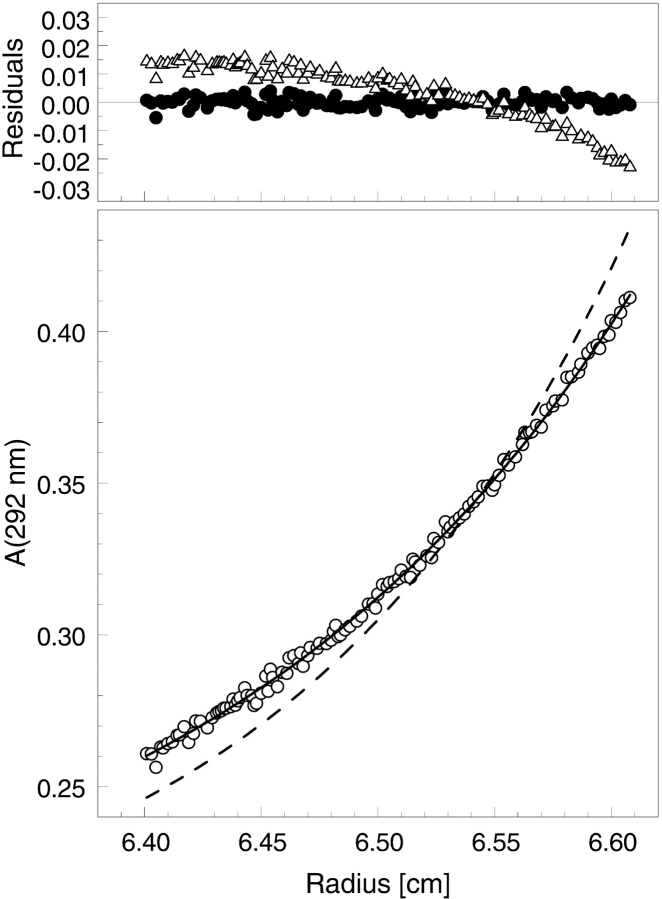
Sedimentation equilibrium of ClpB in the presence of an ATP analog. A ClpB sample was collected from a gel filtration column (Superose 6 PC 3.2/30, Amersham Pharmacia Biotech); equilibrated with 50 mM Hepes at pH 7.5, 0.2 M KCl, 20 mM MgCl2, 1 mM β-mercaptoethanol, 1 mM EDTA, and 2 mM ATPγS; and loaded into a centrifuge cell at 3.0 mg/mL. The protein concentration gradient (circles, lower panel) measured at equilibrium at 3500 rpm (4°C) is shown along with a model fit (solid line) assuming a single component of 531,000 molecular weight. The upper panel shows residuals (Aexp-Amodel) for the single-species fit (solid circles). The simulated concentration gradient for a heptameric ClpB (Mr 668,800) is also shown (broken line, lower panel), along with the corresponding residuals (triangles, upper panel).
Figure 3.
Figure 3.
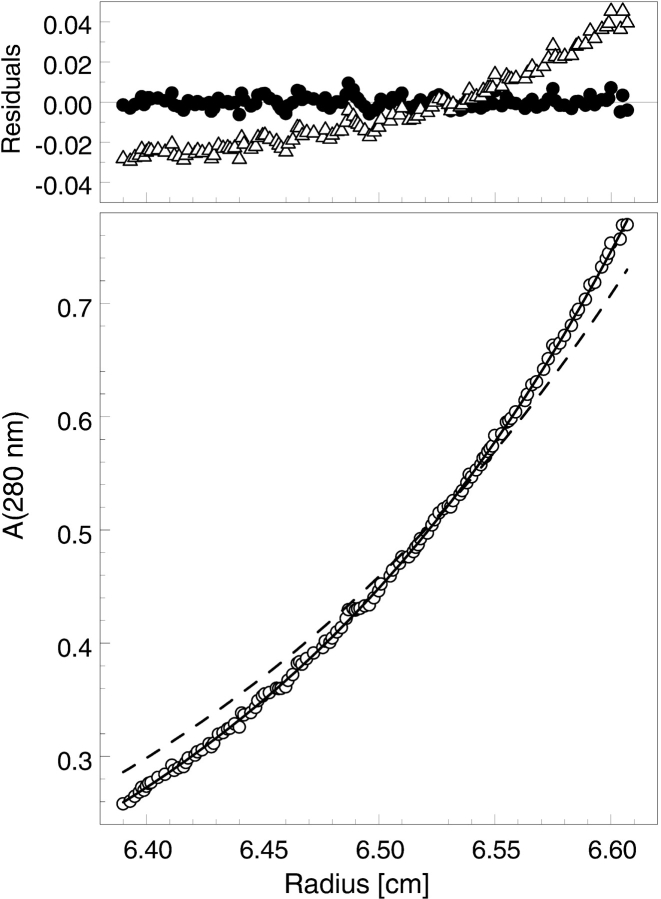
Sedimentation equilibrium of ClpB at low ionic strength. A ClpB sample was dialyzed against 50 mM Hepes at pH 7.5, 20 mM MgCl2, 1 mM β-mercaptoethanol, and 1 mM EDTA and loaded into a centrifuge cell at 2.8 mg/mL. The protein concentration gradient (circles, lower panel) measured at equilibrium at 3000 rpm (4°C) is shown along with a model fit (solid line), assuming a single component of 685,000 molecular weight. The upper panel shows residuals (Aexp-Amodel) for the single-species fit (circles). The simulated concentration gradient for a hexameric ClpB (Mr 573,260) is also shown (broken line, lower panel), along with the corresponding residuals (triangles, upper panel).
Figure 4.
Figure 4.
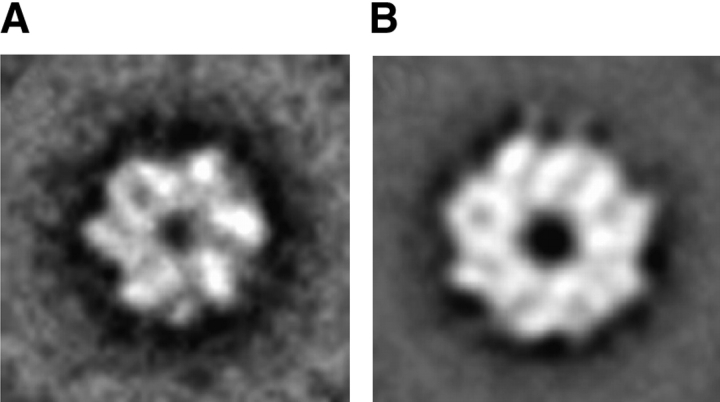
Electron microscopy images of ClpB. (A) Averaged electron micrographs of ClpB in the presence of ATPγS. The ClpB sample prepared as in Figure 2 ▶ was diluted to ~0.1 mg/mL and stained with uranyl acetate. Eighty-one end views of ClpB oligomers were aligned and averaged. (B) Averaged electron micrographs of ClpB at low ionic strength. The ClpB sample prepared as in Figure 3 ▶ was diluted to ~0.1 mg/mL and stained with uranyl acetate. The average includes 298 end views of ClpB oligomers. The size of the image frame in panels A and B is 25 nm.
Figure 5.
Figure 5.
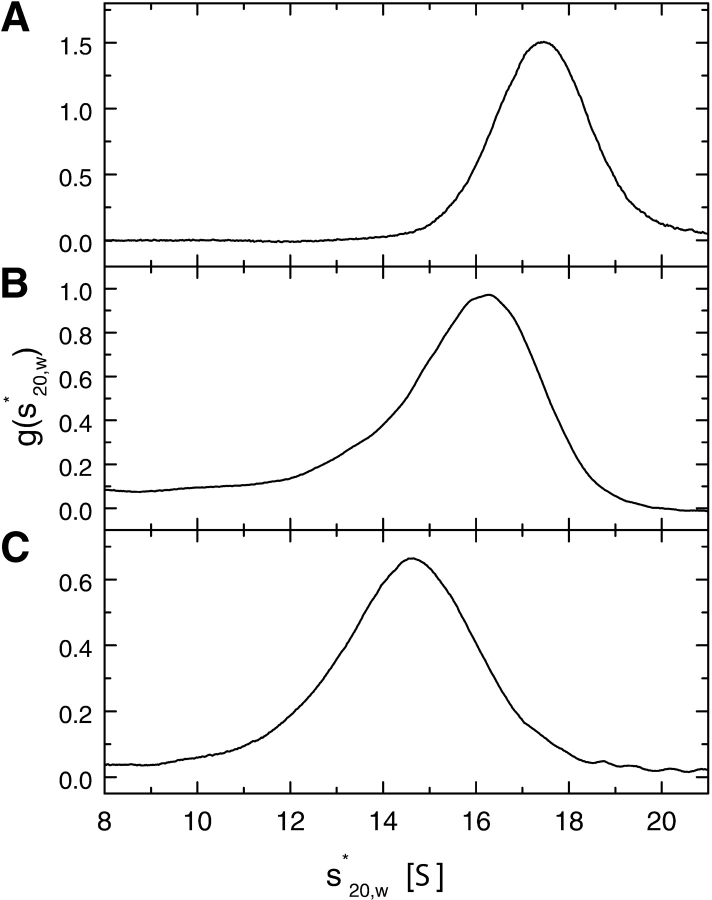
Sedimentation velocity of ClpB at 20°C and 40,000 rpm. Representative results of the time-derivative analysis (Stafford III 1992) are shown for 2 mg/mL ClpB in the low-salt buffer (A), the buffer containing 0.2 M KCl (B), and with 0.2 M KCl and 2 mM ATPγS (C). Solid lines show apparent distribution functions g(s*20,w) vs. the sedimentation coefficient s*20,w in Svedberg units (S).
Figure 6.
Figure 6.
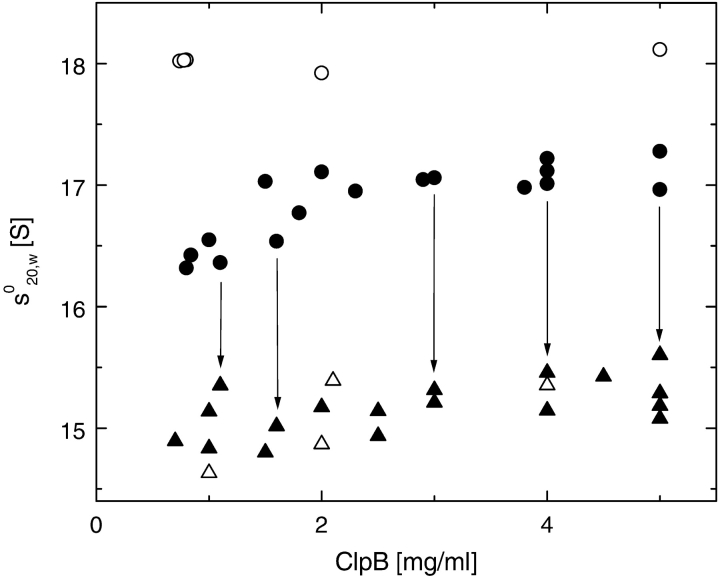
Apparent sedimentation coefficients of ClpB. Sedimentation velocity experiments were performed at 20°C and 40,000 rpm for ClpB samples prepared in the low-salt buffer (open circles), the buffer containing 0.2 M KCl (filled circles), with 0.2 M KCl and 2 mM ATPγS (filled triangles), or 2 mM ADP (open triangles) at a given protein concentration. In each experiment, the value of s°20,w was obtained from the maximum of the g(s*20,w) distribution (see Fig. 5 ▶). In several experiments, s°20,w was determined first in the absence of nucleotides and then again after restoring uniform protein concentration in the centrifuge cell and adding ATPγS (arrows).
Figure 7.
Figure 7.
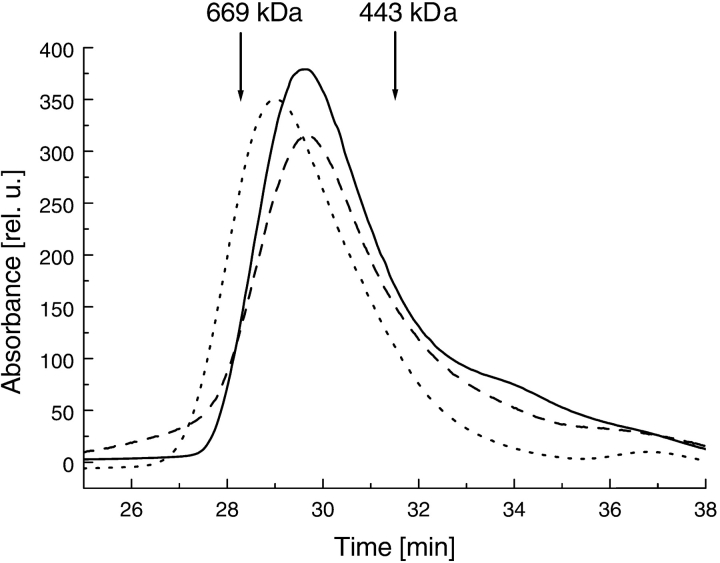
Gel filtration chromatography of ClpB. ClpB samples were injected onto a Superose 6 column equilibrated with the low-salt buffer (dotted line), with 0.2 M KCl (solid line), or with 0.2 M KCl and 2 mM ATPγS (broken line). The ClpB concentration on the column was ~2 mg/mL. The elution times of thyroglobulin (669 kD) and ferritin (443 kD) are indicated.

References

    1. Barnett, M.E. and Zolkiewski, M. 2002. Site-directed mutagenesis of conserved charged amino acid residues in ClpB from Escherichia coli. Biochemistry 41 11277–11283. - PMC - PubMed
    1. Barnett, M.E., Zolkiewska, A., and Zolkiewski, M. 2000. Structure and activity of ClpB from Escherichia coli. Role of the amino- and -carboxyl-terminal domains. J. Biol. Chem. 275 37565–37571. - PMC - PubMed
    1. Bochtler, M., Hartmann, C., Song, H.K., Bourenkov, G.P., Bartunik, H.D., and Huber, R. 2000. The structures of HsIU and the ATP-dependent protease HsIU-HsIV. Nature 403 800–805. - PubMed
    1. Glover, J.R. and Lindquist, S. 1998. Hsp104, Hsp70, and Hsp40: A novel chaperone system that rescues previously aggregated proteins. Cell 94 73–82. - PubMed
    1. Goloubinoff, P., Mogk, A., Zvi, A.P., Tomoyasu, T., and Bukau, B. 1999. Sequential mechanism of solubilization and refolding of stable protein aggregates by a bichaperone network. Proc. Natl. Acad. Sci. 96 13732–13737. - PMC - PubMed

Publication types

MeSH terms

LinkOut - more resources