


Computer-based analysis of Haemophilus parasuis protein fingerprints
- PMID: 14979439
- PMCID: PMC1142133
Computer-based analysis of Haemophilus parasuis protein fingerprints
Abstract
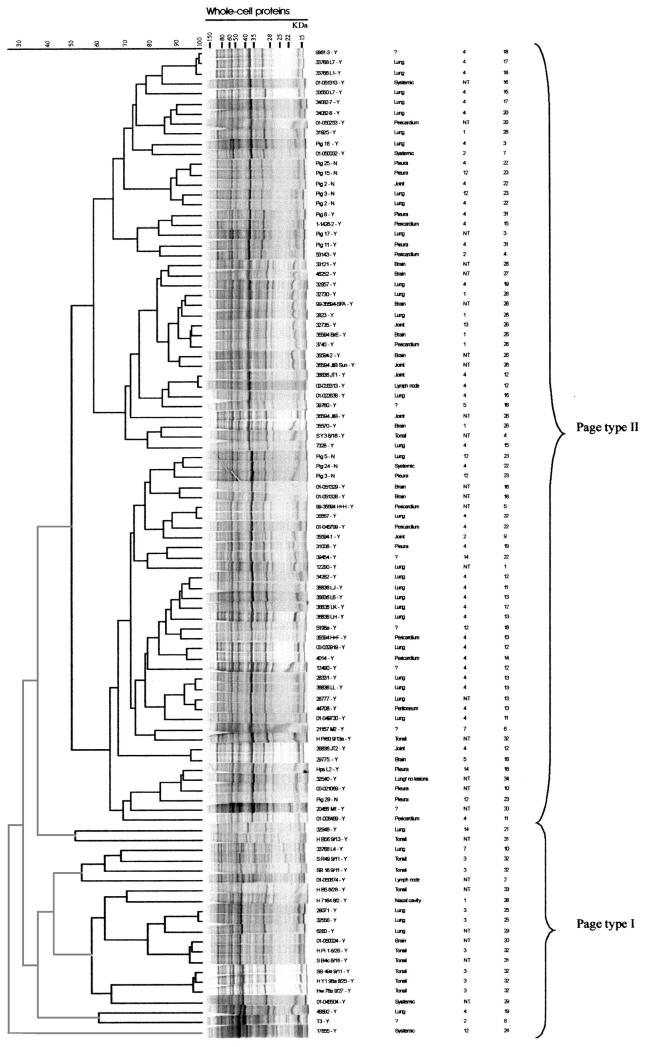
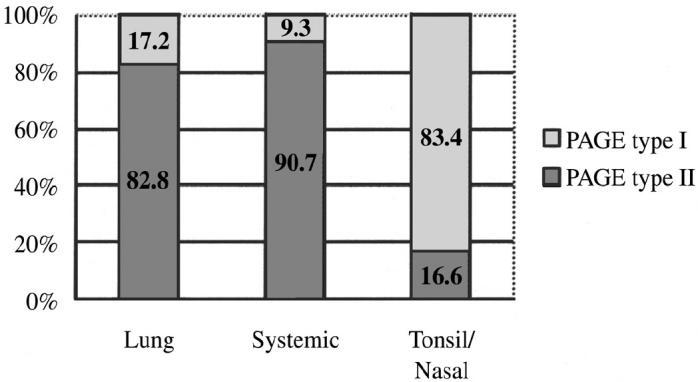
The present study aimed to compare the whole-cell protein profiles of Haemophilus parasuis field isolates by using a computer-based analysis, and evaluate the relationship between polyacrylamide gel electrophoresis (PAGE) type and virulence potential based on isolation site. A dendrogram clustering isolates with similar protein profiles was generated. Haemophilus parasuis isolates were grouped into 2 major PAGE type groups. The PAGE type II isolates were characterized by the presence of major proteins with molecular weights varying from between 36 and 38 kDa and included 90.7% of the isolates recovered from systemic sites, such as pleura, pericardium, peritoneum, lymph nodes, joints, and brain. Isolates classified as PAGE type I were characterized by the absence of this group of proteins and included 83.4% of the isolates recovered from the upper respiratory tract of healthy animals. The present study further corroborates the existence of a unique group of major proteins in potentially virulent H. parasuis isolates.
Dans cette étude, une comparaison a été effectuée entre les profils de protéines des cellules entières d’isolats cliniques de Haemophilus parasuis par analyse informatique, ainsi que d’évaluer la relation entre les patrons électrophorétiques obtenus sur gel de polyacrylamide (PAGE) et le potentiel de virulence basé sur le site d’isolement. Un dendrogramme regroupant les isolats ayant des profils de protéines similaires a été produit. Les isolats d’H. parasuis ont été regroupés en 2 groupes majeurs basés sur leur profil PAGE. Les isolats appartenant au profil de type II étaient caractérisés par la présence de protéines majeures avec des poids moléculaires variant entre 36 et 38 kDa et comptait 90,7 % des isolats retrouvés des sites d’infection systémique tels que la plèvre, le péricarde, le péritoine, les nœuds lymphatiques, les articulations et le cerveau. Les isolats classées comme appartenant au profil de type I étaient caractérisés par l’absence de ce groupe de protéines et comprenait 83,5 % des isolats provenant du tractus respiratoire supérieur d’animaux en santé. Cette étude corrobore l’existence d’un groupe unique de protéines majeures parmi les isolats potentiellement virulents de H. parasuis.
(Traduit par Docteur Serge Messier)
Figures
References
-
- Biberstein EL, Gunnarsson A, Hurvell B. Cultural and biochemical criteria for the identification of Haemophilus spp from swine. Am J Vet Res. 1977;38:7–11. - PubMed
-
- Nicolet J, Paroz PH, Krawinkler M. Polyacrylamide gel electrophoresis of whole-cell proteins of porcine strains of Haemophilus. Int J Syst Bacteriol. 1980;30:69–76.
-
- Morikoshi T, Kobayashi K, Kamino T, et al. Characterization of Haemophilus parasuis in Japan. Jpn J Vet Sci. 1990;52:667–669. - PubMed
Publication types
MeSH terms
LinkOut - more resources
Full Text Sources
Other Literature Sources
Medical