. 2004 Mar 2;101(9):2758-63.
doi: 10.1073/pnas.0308747101. Epub 2004 Feb 23.

Global analysis of Escherichia coli RNA degradosome function using DNA microarrays

Affiliations

Global analysis of Escherichia coli RNA degradosome function using DNA microarrays

Jonathan A Bernstein et al. Proc Natl Acad Sci U S A. .

Abstract

RNase E, an essential endoribonuclease of Escherichia coli, interacts through its C-terminal region with multiple other proteins to form a complex termed the RNA degradosome. To investigate the degradosome's proposed role as an RNA decay machine, we used DNA microarrays to globally assess alterations in the steady-state abundance and decay of 4,289 E. coli mRNAs at single-gene resolution in bacteria carrying mutations in the degradosome constituents RNase E, polynucleotide phosphorylase, RhlB helicase, and enolase. Our results show that the functions of all four of these proteins are necessary for normal mRNA turnover. We identified specific transcripts and functionally distinguishable transcript classes whose half-life and abundance were affected congruently by multiple degradosome proteins, affected differentially by mutations in degradosome constituents, or not detectably altered by degradosome mutations. Our results, which argue that decay of some E. coli mRNAs in vivo depends on the action of assembled degradosomes, whereas others are acted on by degradosome proteins functioning independently of the complex, imply the existence of structural features or biochemical factors that target specific classes of mRNAs for decay by degradosomes.


Figures
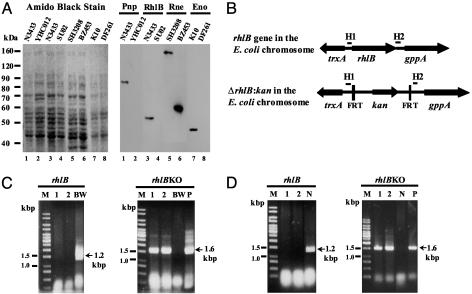
Fig. 1.
Fig. 1.
rhlB gene disruption and verification of degradosome component protein depletion in mutant strains. (A) Western blot-based verification of degradosome mutant protein expression. Shown are the amido-black-stained poly(vinylidene difluoride) (PVDF) membrane (Left) and corresponding Western blots (Right) conducted to verify mutant protein expression. PAGE and Western blotting were carried out as described in Materials and Methods. The target of antibodies used to probe each lane is indicated above the lanes corresponding to each parental/mutant strain pair. Deletion mutants YHC012 and SU02 failed to express PNPase and RhlB helicase (lanes 2 and 4, respectively). Strain DF261 contains a nonsense point mutation in the eno gene that also resulted in the absence of detectable protein expression (lane 6). Strain BZ453, carrying a chromosomal deletion of the C terminus of RNase E expressed an appropriately truncated RNase E protein (1–602 aa; lane 8). (B) A schematic diagram of the rhlB locus and flanking ORFs before and after deletion by homologous recombination. H1 and H2 indicate sequences complementary to the RhlBKO 5′ and 3′ primers. FRT is the Flp recombination target site. Arrowheads indicate the direction of ORFs. (C and D) PCR verification of rhlB disruption in strains SU01 and SU02. Agarose gels (2%) assessing PCR products are shown. Primer pairs rhlB and rhlBKO are as described in Materials and Methods; they amplify the rhlB locus, 1.2 kbp, and the formula image cassette, 1.6 kbp, respectively. M indicates lanes containing a 1-kbp DNA ladder. In lanes marked BW, N, and P, template DNA for PCR was from strains BW25113, N3433, and plasmid pKD4, respectively. In lanes marked 1 and 2, template DNA for PCR was from candidate recombinant colonies; in C these are derivatives of BW25113 after introduction of the rhlBKO PCR construct, and in D these are derivatives of N3433 after P1 transduction. For each candidate kanamycin-resistant colony, in contrast to the parental strains BW25113 and N3433, the rhlB gene-specific primer pair failed to produce a PCR product, whereas the rhlBKO primers resulted in a DNA fragment with an expected DNA size of a PCR fragment containing the kanamycin gene encoded in the plasmid pKD4.
Fig. 2.
Fig. 2.
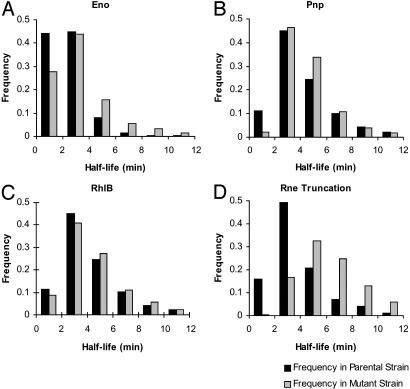
Histograms of mRNA half-life frequencies in mutant and parental strains. Each histogram shows the distribution of measured half-lives for Eno (A), Pnp (B), RhlB (C), and N-terminal Rne (D) mutants and their respective parental strains. Half-life ranges are indicated on the x axis in each histogram, and the fraction of transcripts in each range is indicated on the y axis. y axis values are expressed as a fraction of the total number of transcripts for which half-lives were determined. Source half-life data are shown in Table 3, which is published as supporting information on the PNAS web site.
Fig. 3.
Fig. 3.
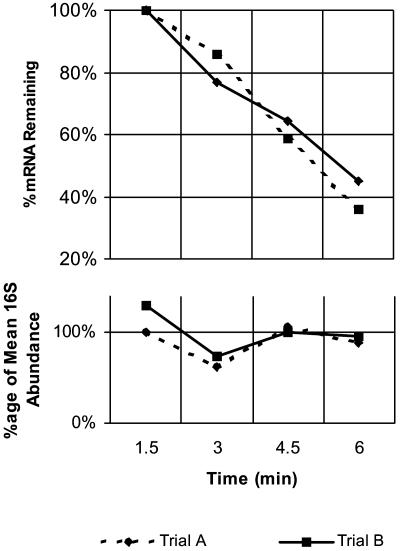
Quantitative RT-PCR determination of mRNA half-lives. The decay of the accC transcript in strain SU02 (rhlB-) was followed by using quantitative RT-PCR. (Lower) Raw abundance data for the 16S rRNA internal control are shown. (Upper) Normalized abundance data for the decay of the transcript are shown. Half-life for the transcript was determined from the slope of the log-transformed abundance versus time data as described in Materials and Methods.
Fig. 4.
Fig. 4.
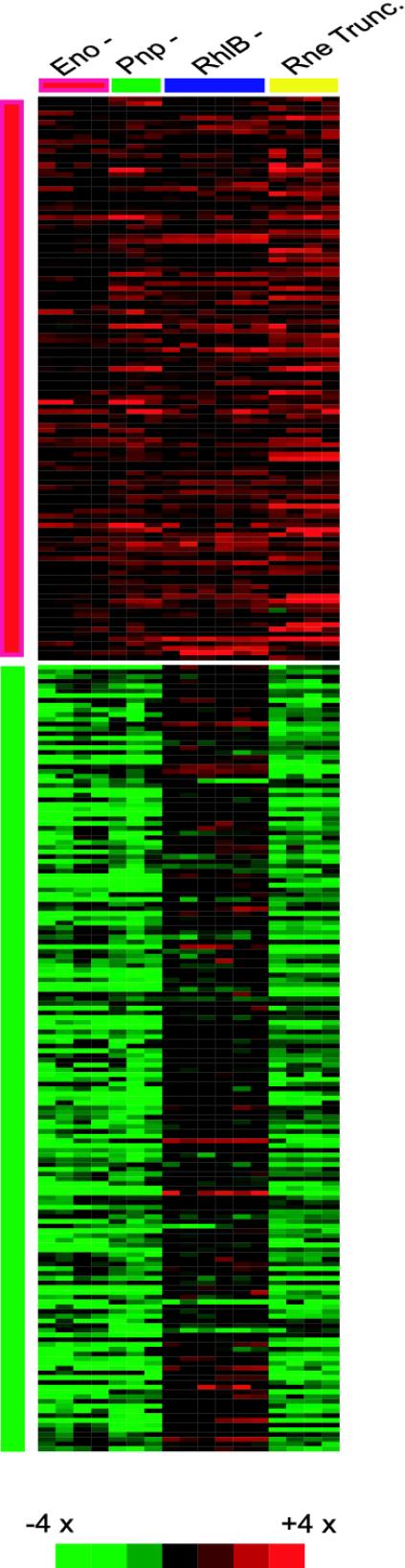
Comparative transcript abundances in degradosome mutants. The figure shows a false-color diagram of log-phase transcript abundance profiles in four degradosome mutants (scale as indicated). Genes included in the figure showed significant changes in abundance relative to parental strains in multiple degradosome mutants. (Upper) (red side bar) The diagram includes the 119 transcripts that demonstrated increased abundance in all four mutants studied: Eno, RhlB, Pnp, and Rne C-terminal deletion. (Lower) (green side bar) A display of the 166 transcripts that showed decreased abundance in strains carrying Eno, Pnp, and Rne C-terminal deletion mutations.

References

    1. Py, B., Higgins, C. F., Krisch, H. M. & Carpousis, A. J. (1996) Nature 381, 169-172. - PubMed
    1. Carpousis, A. J., Van Houwe, G., Ehretsmann, C. & Krisch, H. M. (1994) Cell 76, 889-900. - PubMed
    1. Kaberdin, V. R., Miczak, A., Jakobsen, J. S., Lin-Chao, S., McDowall, K. J. & von Gabain, A. (1998) Proc. Natl. Acad. Sci. USA 95, 11637-11642. - PMC - PubMed
    1. Miczak, A., Kaberdin, V. R., Wei, C. L. & Lin-Chao, S. (1996) Proc. Natl. Acad. Sci. USA 93, 3865-3869. - PMC - PubMed
    1. Coburn, G. A. & Mackie, G. A. (1999) Prog. Nucleic Acid Res. Mol. Biol. 62, 55-108. - PubMed

Publication types

MeSH terms