Clinical and economic consequences of a reimbursement restriction of nebulised respiratory therapy in adults: direct comparison of randomised and observational evaluations
- PMID: 14982865
- PMCID: PMC381049
- DOI: 10.1136/bmj.38020.698194.F6
Clinical and economic consequences of a reimbursement restriction of nebulised respiratory therapy in adults: direct comparison of randomised and observational evaluations
Abstract
Objective: To compare the results of a randomised and an observational evaluation of the same policy that restricted reimbursement for nebulised respiratory medications in adult patients in a community setting.
Designs: Cluster randomised controlled trial and observational time series with historical controls.
Setting: Pharmacare, the government funded drug benefits plan for elderly people and patients receiving social assistance in British Columbia, Canada.
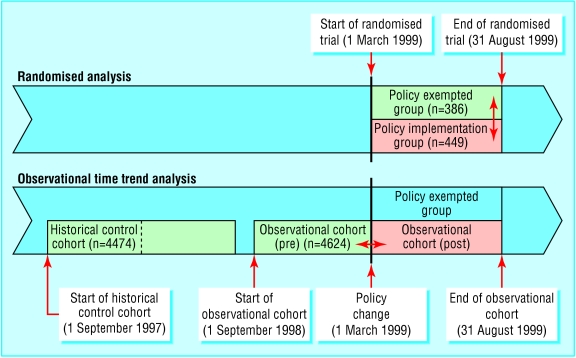
Participants: In the randomised controlled trial 104 clusters of medical practices, pair matched by geography and approximately by practice size, were randomised to the intervention group (449 patients affected by the policy on 1 March 1999), and the control group (offered a six month exemption, affecting 386 patients). The observational analysis included all Pharmacare beneficiaries (excluding the 386 exempt patients) who had used any nebulised drugs six months before the policy (4624 patients).
Intervention: Pharmacare restricted reimbursement for nebulised bronchodilators, steroids, and cromoglycate to patients whose doctors applied for an individual patient's exemption, giving an appropriate clinical reason.
Main outcome measures: Number of contacts with doctors and services, emergency admissions to hospital, and utilisation of and expenditure for respiratory drugs in databases of British Columbia's Ministry of Health.
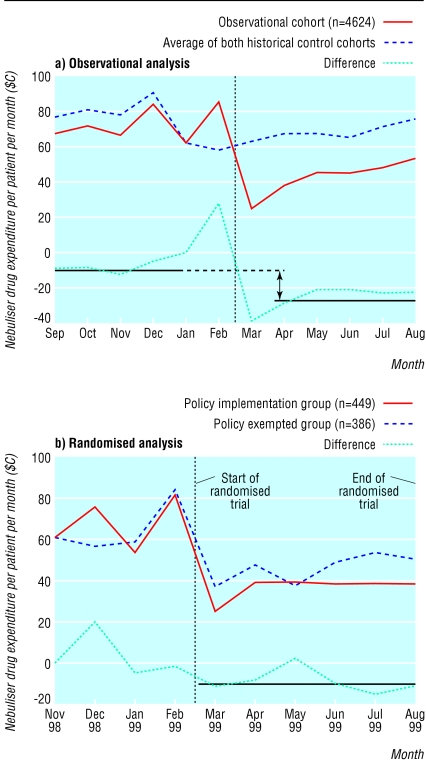
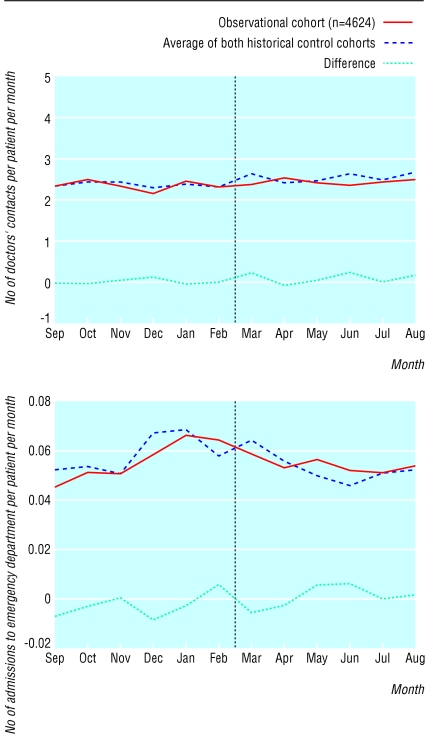
Results: Contacts with doctors or emergency admissions to hospital did not increase in association with the restriction, regardless of the analytical approach. In the observational analysis, we found a reduction of C24 dollars per patient month in all nebulised drug use (95% confidence interval 19 to 29) and an increase of C3 dollars per patient month in all expenditure for inhalers (1.4 to 4.5). The randomised evaluation found savings of C8 dollars per patient month for nebulisers (P = 0.24) and no increase in spending on inhalers (P = 0.79). Correcting for 60% non-compliance by exempt doctors in a sensitivity analysis yielded similar results as the observational evaluation.
Conclusions: Observational as well as randomised analyses found moderate net savings and no increase in unintended healthcare outcomes after restricting reimbursement for nebulised respiratory drugs. Randomised policy trials are feasible and, if carefully implemented, likely to be concordant with observational evaluations.
Figures
References
-
- Audit Commission. Primary care prescribing: a bulletin for primary care trusts. London: Audit Commission, 2003.
-
- Organisation for Economic Co-operation and Development. Health data 2001: a comparative analysis of 29 countries. Paris, OECD, 2001.
-
- Abel-Smith B, Mossialos E. Cost containment and health care reform. A study of the European Union. Health Policy 1994;28: 89-132. - PubMed
-
- Ess S, Schneeweiss S, Szucs T. European healthcare policies for controlling drug expenditure. PharmacoEconomics 2003;21: 89-103. - PubMed
-
- McFadden ER: Improper patient techniques with metered dose inhalers: clinical consequences and solutions to misuse. J Allergy Clin Immunol 1995;96: 278-83. - PubMed
Publication types
MeSH terms
Substances
Grants and funding
LinkOut - more resources
Full Text Sources
Medical
Miscellaneous