


The tumor suppressor LKB1 kinase directly activates AMP-activated kinase and regulates apoptosis in response to energy stress
- PMID: 14985505
- PMCID: PMC373461
- DOI: 10.1073/pnas.0308061100
The tumor suppressor LKB1 kinase directly activates AMP-activated kinase and regulates apoptosis in response to energy stress
Abstract
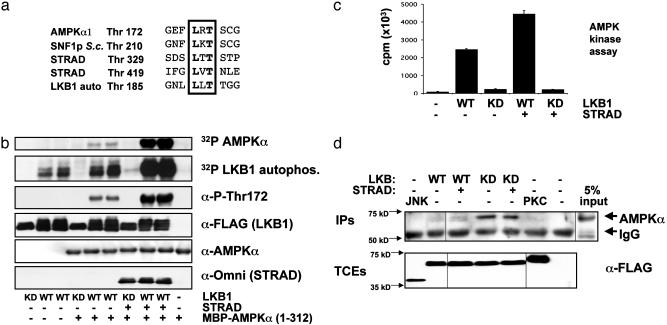
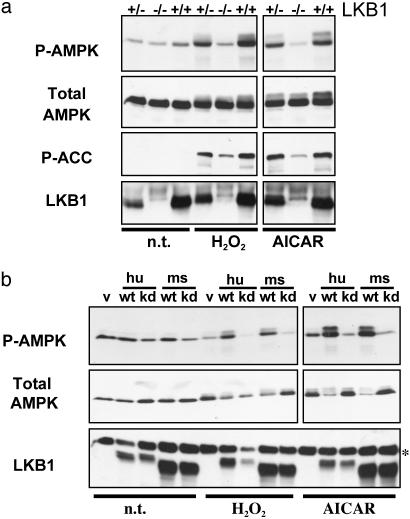
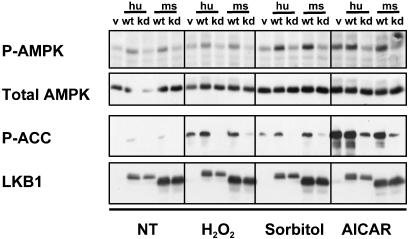
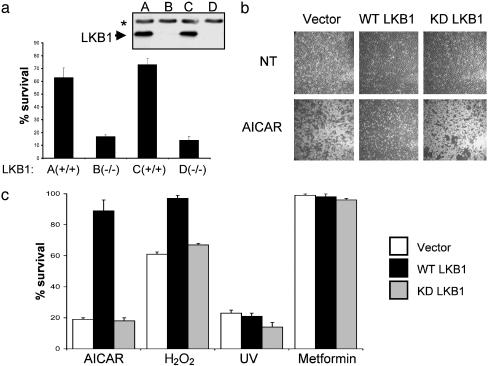
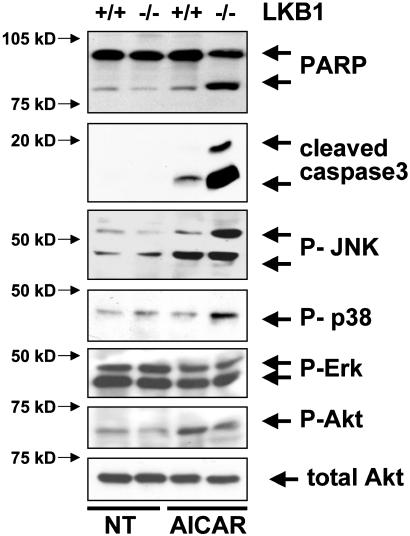
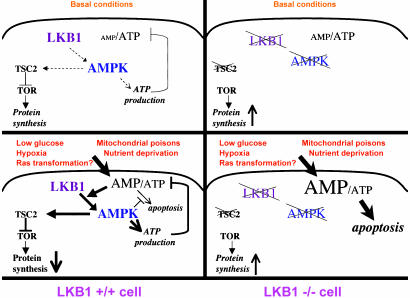
AMP-activated protein kinase (AMPK) is a highly conserved sensor of cellular energy status found in all eukaryotic cells. AMPK is activated by stimuli that increase the cellular AMP/ATP ratio. Essential to activation of AMPK is its phosphorylation at Thr-172 by an upstream kinase, AMPKK, whose identity in mammalian cells has remained elusive. Here we present biochemical and genetic evidence indicating that the LKB1 serine/threonine kinase, the gene inactivated in the Peutz-Jeghers familial cancer syndrome, is the dominant regulator of AMPK activation in several mammalian cell types. We show that LKB1 directly phosphorylates Thr-172 of AMPKalpha in vitro and activates its kinase activity. LKB1-deficient murine embryonic fibroblasts show nearly complete loss of Thr-172 phosphorylation and downstream AMPK signaling in response to a variety of stimuli that activate AMPK. Reintroduction of WT, but not kinase-dead, LKB1 into these cells restores AMPK activity. Furthermore, we show that LKB1 plays a biologically significant role in this pathway, because LKB1-deficient cells are hypersensitive to apoptosis induced by energy stress. On the basis of these results, we propose a model to explain the apparent paradox that LKB1 is a tumor suppressor, yet cells lacking LKB1 are resistant to cell transformation by conventional oncogenes and are sensitive to killing in response to agents that elevate AMP. The role of LKB1/AMPK in the survival of a subset of genetically defined tumor cells may provide opportunities for cancer therapeutics.
Figures
Comment in
-
A new protein kinase cascade.Nat Rev Mol Cell Biol. 2014 Apr;15(4):223. doi: 10.1038/nrm3771. Epub 2014 Mar 12. Nat Rev Mol Cell Biol. 2014. PMID: 24622616 No abstract available.
References
-
- Hardie, D. G., Scott, J. W., Pan, D. A. & Huson, E. R. (2003) FEBS Lett. 546, 1113-1120. - PubMed
-
- Kemp, B. E., Stapleton, D., Campbell, D. J., Chen, Z. P., Murthy, S., Walter, M., Gupta, A., Adams, J. J., Katsis, F., van Denderen, B., et al. (2003) Biochem. Soc. Trans. 31, 162-168. - PubMed
-
- Minokoshi, Y., Kim, Y. B., Peroni, O. D., Fryer, L. G., Muller, C., Carling, D. & Kahn, B. B. (2002) Nature 415, 339-343. - PubMed
-
- Mu, J., Brozinick, J. T., Jr., Valladares, O., Bucan, M. & Birnbaum, M. J. (2001) Mol. Cell 7, 1085-1094. - PubMed
Publication types
MeSH terms
Substances
Grants and funding
LinkOut - more resources
Full Text Sources
Other Literature Sources
Medical
Molecular Biology Databases
Research Materials
